# Kuroma — Full Content
> Kuroma is a GEO (Generative Engine Optimization) and AI SEO platform that tracks brand visibility across six AI search engines: ChatGPT, Perplexity, Gemini, Claude, Google AI Overviews, and Google AI Mode.
## About Kuroma
> Kuroma is an AI brand visibility and GEO (Generative Engine Optimization) platform that measures how AI answer engines (ChatGPT, Claude, Gemini, Perplexity, Google AI Overviews, and Google AI Mode) describe, rank, and recommend a brand.
- [Kuroma](https://kuroma.ai/): Home — track and improve your brand's visibility across AI answer engines (GEO / AI SEO).
- [AI Readiness](https://kuroma.ai/ai-readiness): Free tool to check how AI-ready your website is for answer engines.
- [Methodology](https://kuroma.ai/methodology): How the AI Readiness score is computed: the four categories and their weights, what is deliberately not scored, and the validation against observed AI answers.
- [Benchmarks](https://kuroma.ai/benchmarks): AI Readiness score distributions by industry, from the audited-site archive.
- Factor guides, one page per rubric factor (what the check reads on a page, its weight, and how to fix it): https://kuroma.ai/methodology/content-depth, https://kuroma.ai/methodology/question-coverage, https://kuroma.ai/methodology/structured-data, https://kuroma.ai/methodology/readability, https://kuroma.ai/methodology/heading-structure, https://kuroma.ai/methodology/media-accessibility, https://kuroma.ai/methodology/schema-markup, https://kuroma.ai/methodology/page-speed, https://kuroma.ai/methodology/mobile-optimization, https://kuroma.ai/methodology/crawlability, https://kuroma.ai/methodology/eeat, https://kuroma.ai/methodology/citations, https://kuroma.ai/methodology/trust-signals, https://kuroma.ai/methodology/answer-box-potential, https://kuroma.ai/methodology/citation-worthiness, https://kuroma.ai/methodology/content-freshness, https://kuroma.ai/methodology/unique-value, https://kuroma.ai/methodology/ai-discoverability, https://kuroma.ai/methodology/raw-html-availability
## Kuroma Blog
The Kuroma Blog covers SEO, GEO, and AI Search Optimization — helping marketers and brand managers understand and improve their visibility in AI-powered search engines.
## Blog Posts
### [What "Improve" Actually Means in GEO: A Practical Playbook](https://kuroma.ai/blog/what-improve-actually-means-in-geo-a-practical-playbook)
2026-09-24 | Tags: GEO, AI Search, content optimization, SEO, digital marketing
You've run the audit. You know your brand's AI visibility score. Now what?
As more brands begin measuring how they appear across AI search, this is becoming the next important question. Knowing whether your brand is mentioned, how often it appears, and where it shows up gives you a useful starting point. But measurement alone doesn’t tell you what to change.
We’re already seeing this gap in [Kuroma's](https://kuroma.ai/) early market feedback. Across evaluations and customer discussions with enterprise brands and agencies spanning financial services, real estate, FMCG, advertising, technology, and other sectors, 71% of accounts expressed a clear GEO or AI-search use case, question, or interest. Yet more than 50% raised some version of “We can see the data, now what?” and nearly 60% wanted stronger proof, methodology, or validation before acting on the results.
That’s where the challenge shifts from **GEO measurement to GEO execution.**
Knowing your score is the easy part. The harder questions are **what to change, where to start, and what to prioritize.**
A practical way to answer them is to look at three areas that can shape your AI visibility: **your website, your content, and the external sources surrounding your brand**. Once you start making improvements, competitor benchmarking can help put those changes into context and show whether you’re actually gaining ground.
## 1.Start with your website: can AI access and understand the right information?
Your website is the part of GEO you have the most direct control over, so it's a natural place to start. The first question is simple: can AI systems actually access the information you want them to find?
A page can look perfectly fine to a visitor while still making important information difficult for machines to access or understand. That makes basic technical foundations important: crawlability, clear page structure, internal linking, readable text, and consistent information across the site.
But accessibility is only half of the picture. A technically healthy website won't help much if it doesn't contain useful answers to the questions people are asking. This is why website readiness is better understood from two sides: technical readiness, or whether AI can access and interpret the page, and content readiness, or whether the page actually contains information worth using. (Source: [Google Search Central — guidance on AI features](https://developers.google.com/search/docs/appearance/ai-features))
[Kuroma's Website AI Readiness methodology ](https://kuroma.ai/methodology)takes this broader approach, evaluating areas such as on-page content, technical accessibility, how easily information can be used in an answer, and other signals supported by available research and platform guidance.
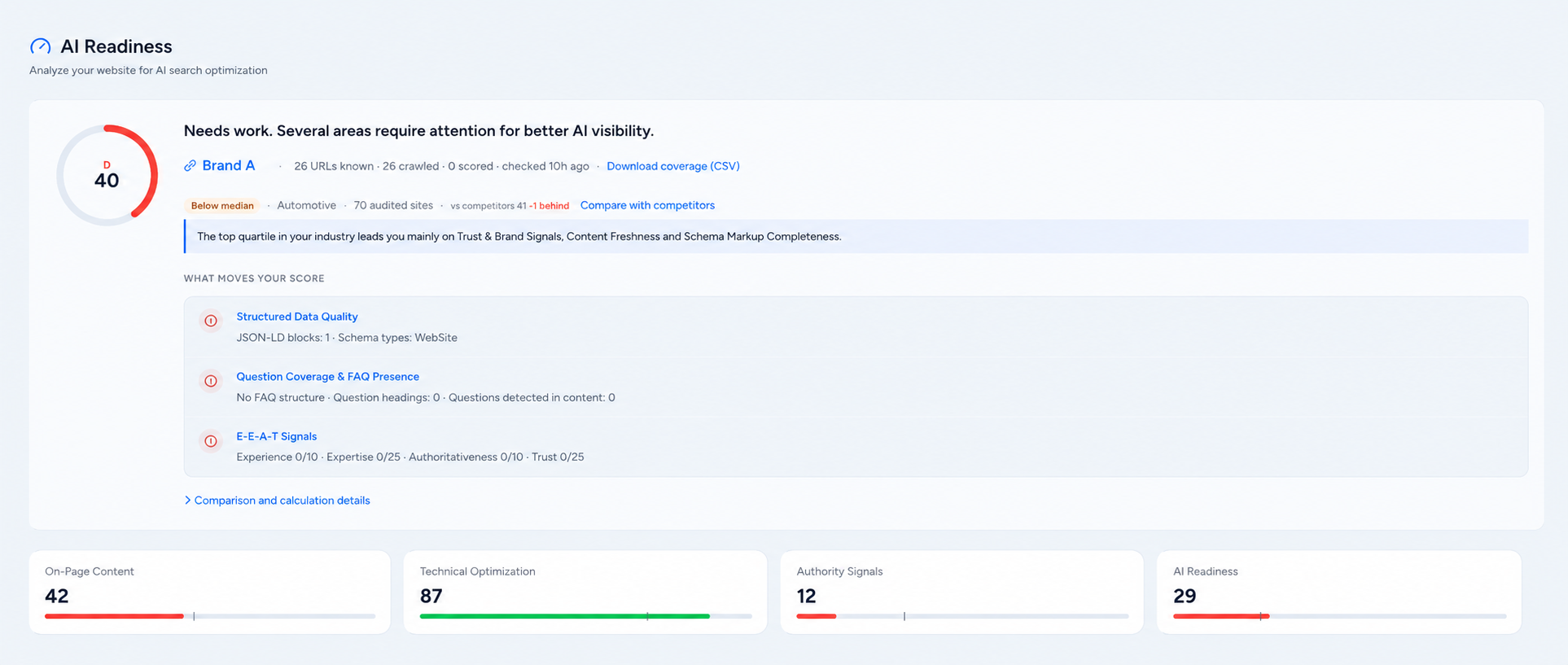
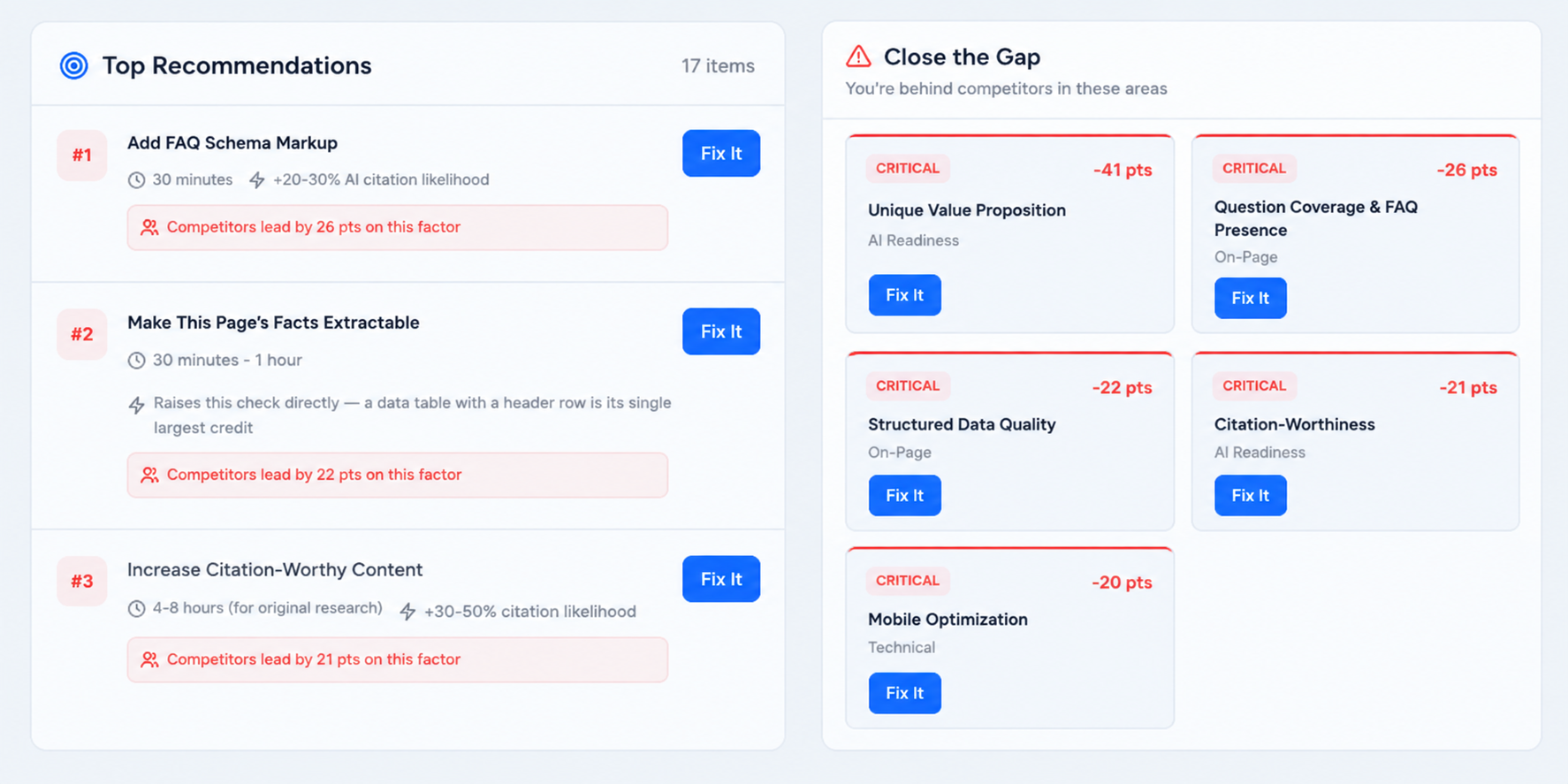
*(Kuroma Website AI Readiness, Source:[Kuroma](https://kuroma.ai/))*
The practical lesson is straightforward: get the fundamentals right before chasing new GEO tactics. Make sure important pages are accessible, information is clear and current, and the questions customers care about are actually answered on the site.
If those foundations are already strong but competitors continue to outperform you, the next place to investigate is the content itself.
## 2. Find the content gaps that matter
Publishing more content isn't automatically the answer. The better question is: what information are people looking for that you don't currently provide well?
Look at the prompts where competitors appear and your brand doesn't. What are those answers discussing? Maybe customers are looking for product comparisons, implementation guidance, pricing context, use cases, limitations, industry benchmarks, or answers to specific questions that your existing content barely covers.
This is where GEO starts to change the way teams think about content. Instead of focusing only on keywords or publishing volume, the goal becomes creating information that is genuinely useful when an AI system is constructing an answer.
The original GEO research presented at [ACM SIGKDD 2024](https://arxiv.org/abs/2311.09735) offers useful evidence here. Across 10,000 queries, the researchers tested nine approaches for improving visibility in generative-engine responses. Techniques such as adding relevant statistics, citations, and quotations improved visibility under the study's experimental conditions, while keyword stuffing performed poorly.
The takeaway isn't that every page needs more statistics or quotes. **It's that useful, well-supported information matters more than simply repeating the right keywords.**
That could mean answering a question directly, publishing a clear comparison, adding credible evidence to a claim, explaining a methodology, sharing expert insight, or producing original research that competitors cannot simply rewrite. Proprietary benchmarks, surveys, customer findings, and first-party data are especially valuable because they add something new to the information available in the market.
There is also evidence from retrieval research that context matters. Anthropic's Contextual Retrieval experiments found that adding relevant context to otherwise isolated content chunks reduced retrieval failures in its tested RAG systems, reinforcing the importance of making individual passages understandable in context. (Source: [Anthropic — Contextual retrieval (self-contained passages cut retrieval failures)](https://www.anthropic.com/news/contextual-retrieval))
This also changes the question content teams should ask. Instead of “How do we optimize this article for AI?”, start with **“What information can we provide that would make the answer better?”**
Once you've identified the questions and topics where your brand is underrepresented, the next step is to create content that addresses them clearly, accurately, and in a format AI systems can understand and use. This may involve updating existing pages, expanding thin sections, or developing new GEO-focused content based on the information your audience is actually seeking.
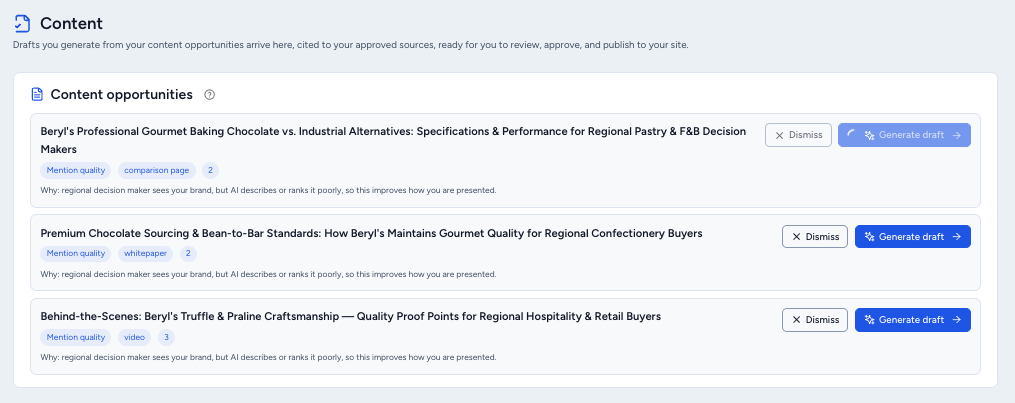
*(Kuroma Content Optimization, Source:[Kuroma](https://kuroma.ai/))*
## 3. Don't stop at your own domain
Your website is only one part of the information environment AI systems can use. Depending on the platform and query, AI-powered search and retrieval systems can surface information from multiple pages and sources rather than relying on a single website. Google, for example, says its AI features may use a “query fan-out” technique to issue multiple related searches across subtopics and data sources before constructing a response. (Source: [Google Search Central — guidance on AI features](https://developers.google.com/search/docs/appearance/ai-features))
That means improving GEO isn't only about publishing more on your own domain. You also need to understand which external sources are already shaping the conversation in your category.
Start with the sources appearing in the AI answers you're tracking. Which domains are cited repeatedly? Which publications appear when competitors are recommended? Which sources show up across broader industry questions, even when they aren't talking about your brand yet?
This makes third-party analysis much more actionable. Instead of simply deciding that you need “more PR” or “more backlinks,” you can start asking which publications, platforms, or communities already influence how AI talks about your market.
Kuroma refers to the most influential sources identified across industry-level citation patterns as **Kingmakers**. For PR, partnership, and earned-media teams, the value is straightforward: rather than guessing which external sources might matter, you can prioritize the ones that are already appearing in the AI conversations relevant to your category.
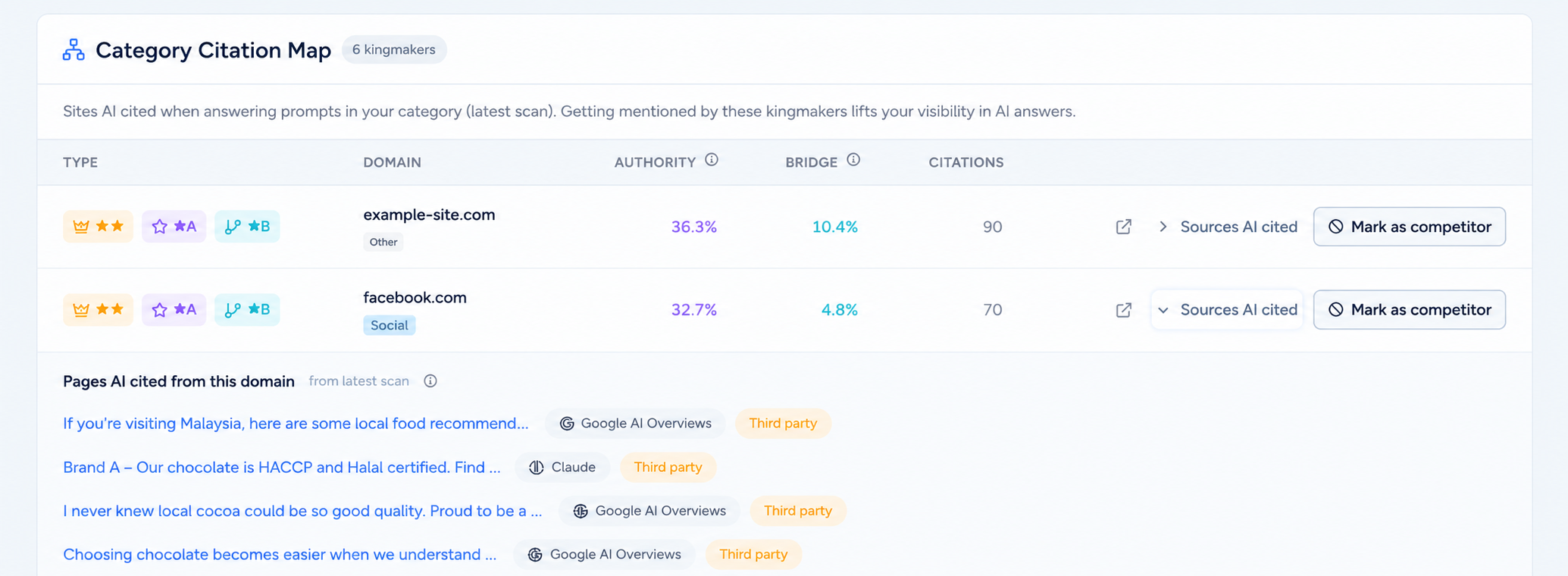
*(Kuroma Citations Analysis, Source:[Kuroma](https://kuroma.ai/))*
Third-party presence is also about accuracy, not just visibility. If AI repeatedly relies on an external source that contains outdated or incorrect information about your brand, publishing another article on your own website may not solve the problem. Sometimes the more useful action is to identify the source influencing the answer and correct the information there.
## Benchmark against competitors
Once you've identified a gap and made a change, the work isn't finished. Measure again. Did fixing an accessibility issue change how often your brand appears? Did new content help you surface a question you previously missed? Are different sources appearing in AI answers after your PR or content efforts?
But your own score only tells part of the story. **You also need to know whether you're gaining ground against competitors.**
Say your brand appears in 20% of the AI answers you're tracking. If your closest competitors appear in only 5–10%, you're already ahead. If the category leader appears in 60%, the same 20% tells a very different story. And if your visibility improves from 20% to 30% while a competitor moves from 40% to 60%, your own performance has improved, but the competitive gap has widened.
This is why competitor benchmarking should be part of the ongoing GEO cycle, rather than a one-time comparison. It gives your results context and can help surface where to investigate next.
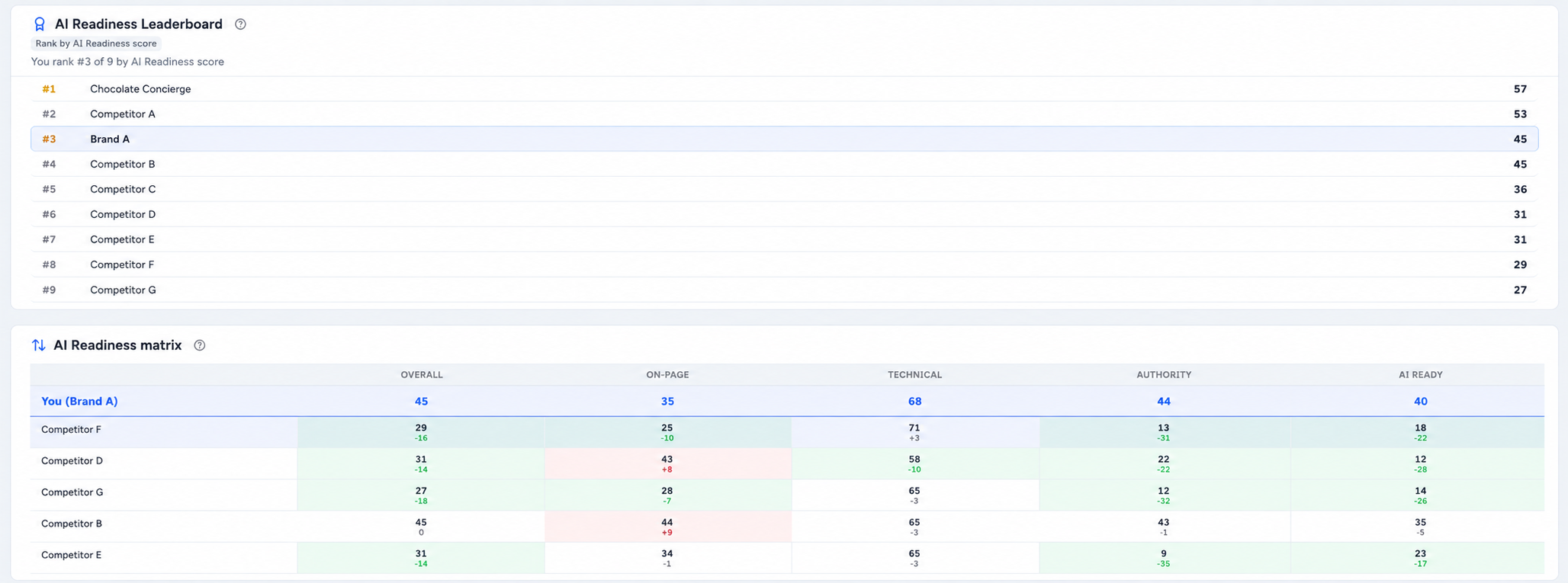
*(Kuroma Competitor Benchmarking, Source:[Kuroma](https://kuroma.ai/))*
GEO improvement therefore works better as a continuous learning process:
> Measure → Diagnose → Improve → Benchmark → Measure again.
Over time, you're not just tracking whether your visibility score went up. **You're building a clearer picture of where you stand, whether you're gaining ground, and what deserves attention next.**
## The takeaway
Improving GEO starts with identifying **what’s holding your visibility back**. The issue may be technical accessibility, missing or unclear content, or a lack of presence in the external sources AI relies on.
The key is to know **which problem to solve, where to act, and whether the change worked**. That’s what turns GEO monitoring into GEO optimization.
Kuroma helps teams move from insight to action by showing how AI sees your brand, where you stand against competitors, what’s limiting your visibility, and what to improve next.
[Check your AI visibility with Kuroma](https://kuroma.ai) →
[](https://kuroma.ai/)
Want to see how your brand performs in AI search? Explore [Kuroma](https://kuroma.ai/) for free
*▶ This article may not be reproduced, republished, publicly broadcast, or distributed without permission. Copyright and portrait rights for all images and materials referenced in this article remain with their respective rights holders.*
---
## Frequently Asked Questions (FAQ)
### Is AI visibility the same as AI readiness?
No, and mixing them up is a common source of confusion. AI readiness measures whether your own website can be accessed and understood by AI systems, a technical and content score. AI visibility measures the outcome: how often you actually get mentioned across real AI answers. A site can be technically excellent and still lose on visibility if competitors have stronger third-party coverage, and vice versa. That's exactly why comparing the two side by side, not just improving one, is the useful diagnostic step.
### Do I need to fix my website before working on content or PR?
Not strictly, but sequencing helps. If your site has serious crawlability problems, pages blocked from AI bots, or content that only renders after JavaScript runs, no amount of great content or PR will get pulled in, because the engine can't reach it in the first place. Once basic access is solved, content and third-party work can run in parallel; they reinforce each other rather than needing to happen in a strict order.
### How often should I re-check my GEO improvements?
Treat it as an ongoing loop rather than a one-time project. AI platforms update frequently, and even a fix that worked can lose ground as competitors update their own content. A quarterly review of your highest-value pages is a reasonable baseline, tightened to monthly for anything time-sensitive like pricing or legal content.
---
### [GEO Is Here. Now What?](https://kuroma.ai/blog/geo-is-here-now-what)
2026-09-11 | Tags: generative engine optimization, AI Search, GEO, search engine optimization, digital marketing, AI visibility
AI search already feels like a major shift. For more than two decades, search marketing was built around a relatively stable idea: people search, results appear, and brands compete to be found. AI is starting to change that journey.
Consumers can ask ChatGPT to compare products, use Gemini to research a purchase, or get an AI-generated answer without working through a page of search results. And this behavior is already showing up in the data.[ Adobe found that 38% of U.S. consumers had used generative AI for online shopping](https://business.adobe.com/blog/generative-ai-powered-shopping-rises-with-traffic-to-retail-sites?utm_source=chatgpt.com), with product research and recommendations among the most common use cases. During the 2025 holiday season, traffic from generative AI tools to U.S. retail sites grew 693% year over year.For brands and agencies, the implication is hard to ignore: being discoverable increasingly means being visible not only in search results, but also in AI-generated answers.
With a shift this significant, it might seem like the industry should already know how to respond. But the reality is: **AI search is already here. The playbook for winning in it isn’t.**
GEO, AEO, LLMO, AI SEO, AIO, and AI Search Optimization are still used to describe overlapping practices. Measurement frameworks vary across platforms. Ownership can sit anywhere from SEO and content to PR and brand. And the industry is still learning which optimization practices consistently translate into greater AI visibility. That gap explains a lot about where Generative Engine Optimization (GEO) is today.
## How Mature Is GEO Today?
ChatGPT was released publicly in late 2022. [In November 2023, researchers introduced Generative Engine Optimization (GEO) ](https://arxiv.org/abs/2311.09735)as a formal framework for improving visibility within generative engine responses. In other words, businesses are trying to build strategies around a discipline that is only a few years old.
But GEO hasn't had the luxury of developing slowly. AI search is already changing how people discover and evaluate information, pushing brands to respond while the discipline itself is still taking shape. Interest and investment are growing, specialized tools and services are emerging, and more teams are beginning to experiment with AI visibility.
That's what makes the current stage of GEO interesting: adoption and category maturity are moving at different speeds.
As the market has developed, the questions businesses ask have evolved with it. Each reflects a different stage of maturity: first understanding the new visibility problem, then finding a way to measure it, and now figuring out how to turn that measurement into action.
You can see that progression in three questions:
> “What is GEO?” → “Do we show up?” → “What do we do about it?”
### First: “What is GEO?”
The earliest challenge was understanding what had changed. For years, search visibility revolved around a familiar question: Where do we rank?
AI search introduced a different kind of visibility. When someone asks ChatGPT to recommend a product or Gemini to compare several options, the AI can mention certain brands, recommend some over others, draw from different sources, or leave a brand out altogether. So brands had a new question to think about: Are we part of the answer? That was the first shift GEO had to make sense of.
### Then: “Do we show up?”
Once brands understood that AI-generated answers had become another place where discovery happens, understanding the concept wasn't enough. They wanted to know where they stood. Does ChatGPT mention us? How often? Which competitors appear instead? What does Gemini say about our brand? Which sources are being cited?
That demand led to a new layer of measurement. What started as manually testing prompts could now be tracked more systematically across AI engines, topics, competitors, mentions, and citations.
In our recent research across 240+ brands and more than 37,000 AI responses, we explored this measurement problem in more detail and identified six metrics that can help build a more complete picture of AI search performance.
>[Read: [AI Search Performance Metrics: What Actually Measures Success]
](https://kuroma.ai/blog/ai-search-performance-metrics)
With a clearer way to measure AI visibility, brands can move beyond simply asking **“Do we show up?” They can start asking a more useful set of questions: Where are we strong? Where are we falling behind? And what might be shaping that difference?**
### Now: “What do we do about it?”
Once AI visibility becomes measurable, a new problem appears: **knowing where you stand is not the same as knowing what to do next.**
A brand may know that it appears less often than competitors, that certain topics perform poorly, or that AI engines rely heavily on third-party sources when talking about its category. But those numbers don't explain the response on their own. Teams now have to interpret what is behind them.
Is the gap related to search discoverability? Is important information missing from the website? Are competitors better represented across authoritative third-party sources? Is there a content gap around the questions customers are actually asking? And once a possible cause is identified, another question follows: **who should act on it?**
The answer may involve SEO, content, PR, brand, or web teams, sometimes several at once. This is what makes GEO different from simply adding another performance metric to a dashboard. The data has to translate into decisions across functions.
This is also where measurement starts becoming more valuable. Consistent GEO data gives organizations a baseline from which they can build benchmarks, define KPIs, assign responsibilities, and eventually evaluate whether their actions are actually improving AI visibility.
So the question is no longer simply: “Are we visible?” It becomes: **“What is influencing our visibility, what can we change, who should act, and did it work?”**
That shift marks an important stage in GEO's development: **from making AI visibility observable to making it operational.**
---
## What Comes Next for GEO
Businesses aren't waiting for GEO to be fully figured out.
That creates an important tension for the category: Investment is growing before the operating model is fully established.
For GEO to mature, the market will need more than greater awareness or more experimentation. Organizations need the structure that allows an emerging practice to become something they can manage consistently. That means more consistent measurement. More useful benchmarks. Clearer KPIs. Better-defined responsibilities. Repeatable workflows. And, eventually, enough accumulated learning to understand which actions actually improve performance.
These pieces build on one another. Better measurement makes benchmarking possible. Benchmarks give teams a reference point for setting goals. Goals create clearer accountability. And clearer accountability makes it easier to build workflows around who needs to act, when, and why.
This is how GEO can move from experimentation toward broader adoption. And one of the major enablers of that transition will be tooling.
---
## The Role of Tools in GEO Adoption
The role of GEO tools can be easy to underestimate. At first glance, they solve a relatively simple problem: instead of manually asking ChatGPT a set of questions, a platform can monitor AI visibility more systematically. But the bigger contribution isn't simply automation. **It's consistency.**
A marketer can manually ask ChatGPT 20 questions and learn something useful. An agency can run a prompt test for a client and identify interesting gaps. But it's difficult to build a quarterly benchmark, assign a KPI, or evaluate progress from a collection of one-off checks.
For that, teams need to measure the same things consistently across relevant prompts, topics, competitors, AI engines, and time. That's where tools become important to GEO's development. By turning individual observations into consistent data, tools give organizations a baseline. And once a baseline exists, those numbers can start gaining business context.
The progression is straightforward:
> Data creates a baseline. A baseline makes comparison possible. Comparison helps establish benchmarks. Benchmarks can become KPIs. KPIs give teams something to own and improve.
And once teams have something measurable to work against, they can begin building workflows around it. This becomes especially important because GEO is cross-functional.
An SEO team may need to investigate discoverability or technical issues. Content teams may respond to information gaps. PR may need to understand which third-party sources are shaping AI answers. Brand teams may care about how consistently the company is represented. The actions are different, **but consistent GEO measurement gives those teams a shared view of the outcome they are trying to influence.**
That is why the role of tools goes beyond putting AI visibility on a dashboard. They can help create the measurement layer around which organizations begin establishing benchmarks, KPIs, ownership, actions, and feedback loops.
Over time, that can change how GEO is adopted. For agencies, GEO can become a more repeatable client service rather than a one-off analysis. For brands, AI visibility can become part of regular search, content, PR, and digital planning rather than an isolated experiment. And as more organizations measure and learn from GEO consistently, the market itself can begin developing clearer benchmarks and a better understanding of what effective GEO looks like.
No GEO platform can guarantee what ChatGPT, Gemini, or another AI engine will say. But tools don't need to control the answer to contribute to GEO adoption.
*Their role is to give organizations a consistent way to measure what is happening, decide where to act, and learn whether those actions made a difference.*
That is how an emerging practice starts becoming an operational capability. GEO began with a simple question: Are we showing up in AI answers? The next stage is much more practical: How do we improve, who needs to act, and how do we know if it's working?
The first stage of GEO was understanding the shift. The next was learning how to measure it. Now the challenge is turning those measurements into benchmarks, decisions, and repeatable workflows.
> AI search is already here. Now the industry is building the playbook for how to manage visibility within it.
---
[](https://kuroma.ai/)
Want to see how your brand performs in AI search? Explore [Kuroma](https://kuroma.ai/) for free
*▶ This article may not be reproduced, republished, publicly broadcast, or distributed without permission. Copyright and portrait rights for all images and materials referenced in this article remain with their respective rights holders.*
---
## Frequently Asked Questions (FAQ)
#### What is GEO?
Generative Engine Optimization (GEO) is the practice of improving how brands and content appear in AI-generated answers across platforms like ChatGPT, Gemini, and Perplexity.
#### How is GEO different from SEO?
SEO focuses on visibility in traditional search results, while GEO focuses on how brands are mentioned, cited, and represented in AI-generated answers.
#### How can brands measure GEO performance?
Brands can track metrics such as AI mentions, citations, share of voice, rankings, and competitor visibility across AI engines over time.
>[Read: [AI Search Performance Metrics: What Actually Measures Success]
](https://kuroma.ai/blog/ai-search-performance-metrics)
#### Who should own GEO?
GEO is often cross-functional. SEO, content, PR, brand, and web teams may all influence different parts of AI visibility.
#### Can GEO guarantee visibility in AI answers?
No. AI responses are dynamic, so GEO cannot guarantee mentions or recommendations. The goal is to consistently measure visibility, identify opportunities, and evaluate what improves performance.
---
### [AI Search Performance Metrics: What Actually Measures Success](https://kuroma.ai/blog/ai-search-performance-metrics)
2026-08-20 | Tags: GEO, AI Search, metrics, AISEO, AIO, AEO, SEO
Your Google Search Console shows impressions climbing and clicks flat. Your prospects ask ChatGPT for recommendations and never see a results page. Somewhere between those two facts, the AI search performance metrics question stops being academic: the measurement stack the industry built over twenty years no longer answers the only question it was built for. Are you winning?
We build Kuroma, an AI visibility platform. Our team has spent the past year measuring how AI engines talk about brands, and we have helped brands across seven markets act on what the measurements say. This page defines the metrics we believe actually measure success in AI search, what each one can and cannot tell you, and the baselines we have measured across hundreds of brands and hundreds of thousands of real AI answers. Where a number comes from our own data, we say so and date it. Where the answer is "nobody knows yet", we say that too.
## Why did rankings stop being the scoreboard?
The old contract was simple. Rank well, get clicks, count them. AI search breaks the contract twice over. First, the answer often ends the journey: the user asks, reads, and leaves without visiting anyone. Second, the connection between ranking and being used as a source is weakening fast. [Industry-scale crawls of Google AI Overviews](https://ahrefs.com/blog/ai-overview-citations-top-10/) found that the share of cited pages which also appear in the top organic results has been falling steeply over recent quarters. Ranking is becoming one input among many, not the scoreboard.
So what replaces it? Six metrics, in two families: metrics about being KNOWN, and metrics about being USED.
## The metrics at a glance (measured baselines, August 2026)
| Metric | What it measures | Our measured baseline |
|---|---|---|
| Mention rate | Share of relevant AI answers naming the brand | 14.4% average across 240+ brands on unbranded discovery questions |
| AI share of voice | Your share of all brand naming in category answers | Varies by category; measure per engine |
| Citation rate | Answers naming you that also cite your site | 37.2% (so 62.8% of mentions are ghost mentions) |
| Answer rate | Substantive answers vs deflections | Engines deflect under 2% of discovery questions |
| Criteria-first share | Substantive answers naming no product at all | 63 to 67% of answered discovery questions |
| Retrieval alignment | Semantic closeness of your content to engine queries | Strongest single predictor improvement we have measured |
Baselines come from our own measurement corpus: 240+ brands, over 37,000 real engine answers, repeated runs, seven engines, collected through August 2026. The full method, including every cohort and test size, is published on our [methodology page](https://kuroma.ai/methodology) so the numbers are independently checkable.
## What is mention rate in AI search?
Mention rate is the share of relevant AI answers that name your brand at all. Ask the engines a fixed set of questions your buyers actually ask, in your market and language, and count. It is the closest thing AI search has to unaided awareness, and it is the headline number for what we call generative engine optimization, whether you spell it GEO, AISEO, AIO, or AEO.
Two things separate a mention rate you can act on from one that flatters you. The question set must not name your brand, because an answer to "is Kuroma good?" that mentions Kuroma proves nothing. And it must be measured across repeated runs, because AI answers change from run to run far more than people expect. In our measurements, a single check is closer to a coin-flip sample than a reading. Treat any tool that shows you a mention rate from one run per prompt with suspicion, including ours if you configure it that way.
## What is AI share of voice?
Share of voice is mention rate made relative: of the brands named in answers to your category questions, what fraction of naming goes to you? It answers a different question than mention rate. A 20 percent mention rate means one thing in a category where AI names nobody, and something else entirely where every answer lists five competitors. Measured per engine, it also reveals where you are strong. The engines differ a great deal in what they cite and whom they name: [analysis of roughly 680 million AI answer citations](https://www.tryprofound.com/blog/ai-platform-citation-patterns) found Wikipedia alone accounting for 7.8% of ChatGPT's citations while other engines lean on entirely different source mixes, and our own seven-engine corpus shows the same divergence. A single blended number hides more than it shows, and the engine where you are weakest is usually the one your dashboard averages away.
## What is citation rate, and what is a ghost mention?
Being named is not being used. Citation rate measures whether the engine actually cites your site as a source when it talks about you. Our research measured this directly in August 2026: we analyzed 5,714 AI answers that named a tracked brand and checked them against the sources those same answers cited. We found the brand's own website cited in 37.2% of the answers that named it.
> Key finding: in 62.8% of AI answers that mention a brand, the brand's own website is not among the sources. The engine is speaking from memory, not from your site.
Read that the other way and you get the ghost mention rate, a pattern [independent research has documented at scale](https://www.seerinteractive.com/insights/llm-ghost-citations-why-your-content-is-working-and-your-brand-isnt): in roughly two out of three answers that mention a brand, the AI is speaking from what it already knows, not from the brand's site. The engine learned about you somewhere else, and your website was not part of the conversation.
This distinction turns out to be the most useful diagnostic in the whole stack, because the two numbers respond to different work. Our analysis found something sharper: a brand's footprint on the wider web predicts whether AI knows it, but predicts whether AI cites it slightly worse than chance. This is the most significant dissociation in our data. What predicts citation is retrievability: whether your content actually surfaces when the engine goes looking. Brands famous enough to be ghost-mentioned constantly can still be invisible as sources, and small brands with sharply aligned content can punch far above their footprint in citations. If you track one pair of numbers, track this pair.
## What is answer rate, and why does answer composition matter?
Before any mention can happen, the engine has to produce a substantive answer. We classify every monitored response as answered, deflected, or errored, and the composition is worth watching. In our recent monitoring data, engines rarely refuse outright, but our research found roughly two thirds of substantive answers to buyer-style discovery questions named no specific product at all: 63 to 67% of the 50,018 answered checks we classified in the first half of August 2026. The engines increasingly open with criteria, what to look for, how to compare, and only sometimes proceed to names. That is not a measurement failure. It is the market moving, and it means the page that teaches the criteria is competing for the same answer your product page used to own.
## Retrieval alignment: the leading indicator
Everything above is an outcome. The most promising leading indicator we have measured is retrieval alignment: how semantically close your site's content sits to the queries AI engines actually issue when they research your category. Engines do not search your buyer's question verbatim. They fan out into their own reformulations, and whether anything on your site matches those reformulations is measurable with embeddings. When we analyzed 6,950 brand-question pairs across 193 brands, adding this one feature produced the largest single improvement we have measured in models predicting which brands get named. It is early, and we published the numbers with their limitations, but the direction is consistent with everything else on this page: alignment with how engines retrieve beats decoration of what humans read.
## What does NOT measure success in AI search?
A few numbers circulate as AI search metrics that do not survive contact with data. Your organic ranking is a weakening proxy for citation, as above. AI crawler hits in your server logs [mostly measure training ingestion](https://blog.cloudflare.com/crawlers-click-ai-bots-training/), not answer inclusion; a bot reading your site is not a bot citing your site. And one-shot visibility checks are noise wearing a dashboard: independent studies of answer stability, and our own repeated sampling, both find that the sources cited for the same question overlap between runs far less than dashboards imply. Anything measured once is mostly measuring luck.
Content tricks deserve a mention here too. The academic field that named GEO, in the [original 2024 paper](https://arxiv.org/abs/2311.09735), reported large visibility gains from content transformations, but the recent replication work, led by the [C-SEO Bench study](https://arxiv.org/abs/2506.11097), tells a more sobering story: across engines and domains, most rewriting tricks moved nothing, and several made citation rank worse. What survived replication is substance, citing sources, quoting evidence, carrying real statistics. Which is convenient, because that is also just good writing.
## How do you measure AI search performance without fooling yourself?
Four rules our specialists learned the hard way, current as of August 15, 2026:
- **Freeze the question set** before you start measuring, and version every change.
- **Sample repeatedly**: report rates over runs, never single checks.
- **Split by engine**: ChatGPT, Gemini, Perplexity and Google AI Overviews behave like different countries, not different fonts.
- **Demand published validity**: a visibility score that never shows whether it predicts real citations is a mood, not a metric.
In longer form: Fix your question set before you start and freeze it, or you will measure your own prompt edits instead of the market. Sample repeatedly and report rates, never single runs. Split every metric by engine, because ChatGPT, Gemini, Perplexity and Google AI Overviews behave like different countries, not different fonts. And demand that any score you rely on publishes its predictive validity: if a vendor sells you an AI readiness number, ask them to show whether it actually predicts citations. We [publish ours](https://kuroma.ai/methodology), including the cohort where it did badly, because a number you only show when it flatters you is not evidence.
AI search is measurable. It is just not measurable with the instruments the last era left behind. Define the metrics, publish the baselines, and let the data argue.
## Frequently asked questions about AI search metrics
### What are the core AI search performance metrics?
Mention rate, AI share of voice, citation rate, ghost mention rate, answer rate, and retrieval alignment. The first two measure whether AI knows you; the next two measure whether AI uses you as a source.
### What is a good mention rate?
Our measured average is 14.4% across 240+ brands on unbranded discovery questions, but the benchmark that means anything is per category and per engine, against your competitors on the same frozen question set.
### Why does my brand get mentioned but not cited?
Because models often speak from what they already learned about you. We measured own-site citation in only 37.2% of answers naming a brand. Citation follows retrievability, not fame.
### Do SEO rankings still matter for AI search?
As one input, yes; as the scoreboard, no. The overlap between cited pages and top organic results has fallen sharply, and our own models found ranking features add far less than footprint and retrieval alignment.
---
### [iKala Kuroma onboards Gemini 3.6 Flash](https://kuroma.ai/blog/ikala-kuroma-onboards-gemini-3-6-flash-en)
2026-07-22 | Tags: AI visibility, Gemini 3.6 Flash, AI search monitoring, generative engine optimization, AEO, AIO, GEO, AISEO
On July 21, 2026, Google rolled out Gemini 3.6 Flash, its new workhorse model, to everyone in the Gemini app. Most people who use it will not notice anything. The app looks the same, the prompt box is where it always was, and answers still arrive in a second or two. What moved sits underneath: the model that writes those answers. When that model changes, your AI visibility can change with it, meaning whether Gemini names your brand at all, and where in the answer.
## The short version
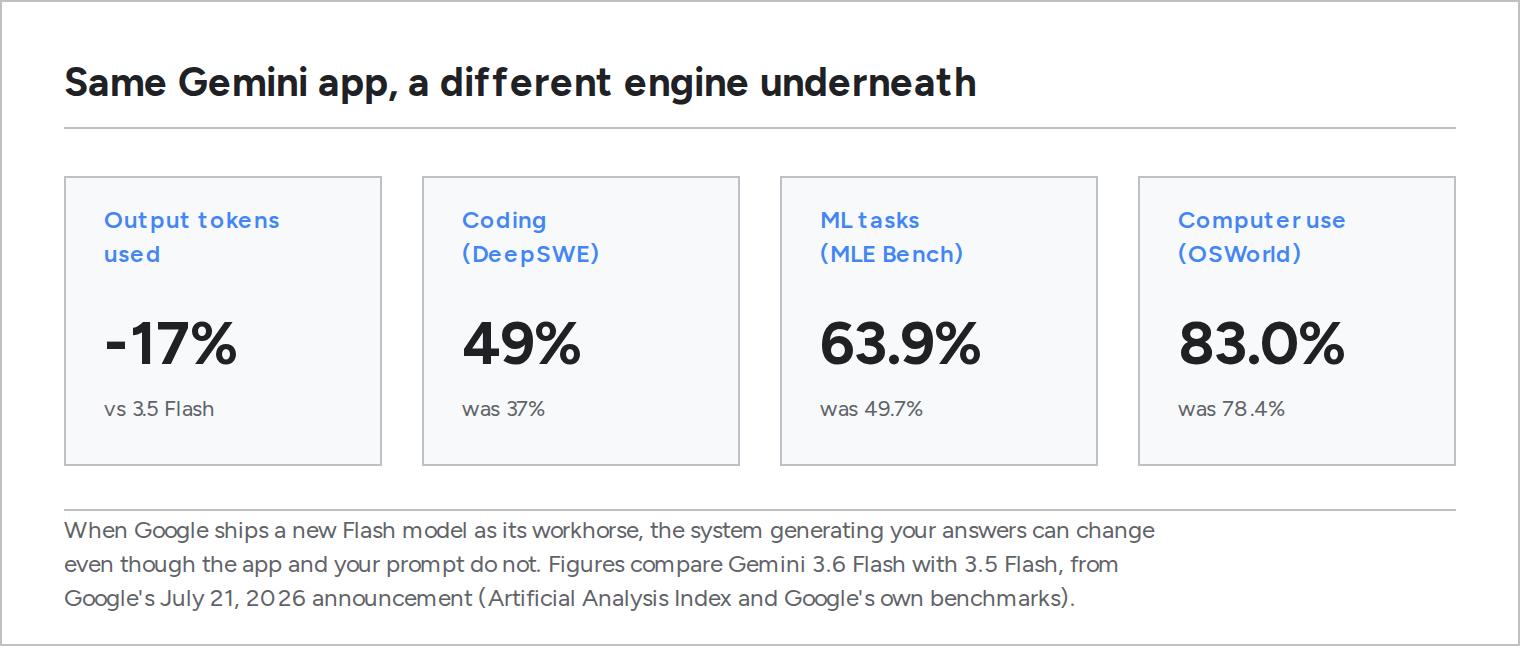
Google shipped [Gemini 3.6 Flash](https://blog.google/innovation-and-ai/models-and-research/gemini-models/gemini-3-6-flash-3-5-flash-lite-3-5-flash-cyber/) on July 21, 2026 as its new workhorse Flash model, rolling out to everyone in the Gemini app. According to Google, it uses about **17% fewer output tokens** than 3.5 Flash and scores higher on its coding, computer-use, and machine-learning benchmarks, at a lower price per token.
Flash is the model most people actually get, and Google keeps handing that default seat to the newest Flash version. A newer model writes different text, which can reorder or even drop the brands an answer names. In our own testing, we found that re-running the same prompts after a model swap regularly changes the wording of the answer, and sometimes who gets mentioned. So if your last visibility reading ran on 3.5 Flash, it is already describing a model your buyers have moved off. Kuroma now scans Gemini 3.6 Flash, and the only reliable way to know where you stand is to measure the model that is live right now.
## What did Google actually change on July 21?
Google released three models at once: Gemini 3.6 Flash, plus two smaller ones, 3.5 Flash-Lite and a security-tuned 3.5 Flash Cyber. The one that matters for most people is 3.6 Flash, which Google calls its ["workhorse model"](https://techcrunch.com/2026/07/21/google-releases-three-new-gemini-models-but-no-3-5-pro/).
> Google's framing: 3.6 Flash is the workhorse tier, cheaper to run than 3.5 Flash, and rolling out to everyone in the Gemini app.
According to Google, 3.6 Flash [uses about 17% fewer output tokens](https://blog.google/innovation-and-ai/models-and-research/gemini-models/gemini-3-6-flash-3-5-flash-lite-3-5-flash-cyber/) than 3.5 Flash on the Artificial Analysis Index, and up to 65% fewer on the DeepSWE coding benchmark. It is priced at $1.50 per million input tokens and $7.50 per million output tokens, which Google's [developer changelog](https://ai.google.dev/gemini-api/docs/changelog) describes as a lower price point than 3.5 Flash. According to the same announcement, the capability numbers moved significantly too:
| Measure | Gemini 3.5 Flash | Gemini 3.6 Flash |
|---|---|---|
| Output tokens used | baseline | about 17% fewer |
| Coding (DeepSWE) | 37% | 49% |
| Machine learning (MLE Bench) | 49.7% | 63.9% |
| Computer use (OSWorld-Verified) | 78.4% | 83.0% |
| Agentic value (GDPval-AA v2) | 1349 | 1421 |
3.6 Flash is rolling out for everyone in the Gemini app, for developers through the Gemini API, Google AI Studio, and Antigravity, and for enterprises in the Gemini Enterprise Agent Platform. Notably, Google has not shipped a 3.5 Pro to everyone yet; it says that is coming soon, and it has [started pre-training Gemini 4](https://www.androidauthority.com/google-launches-gemini-36-flash-3689795/). So this is not the last swap you will see this year.
Same Gemini app, a different engine underneath. Figures are Gemini 3.6 Flash versus 3.5 Flash, from Google's July 21, 2026 announcement.
## Why does a Flash model matter more than the flagship?
Most people never touch the flagship. They open the app, type a question, and take whatever the default gives them. That default is Flash, the fast and cheap tier Google tunes for everyday use. Pro models get the launch headlines, but Flash answers the bulk of real queries.
Google also keeps handing the default seat to the newest Flash. According to Google, when Gemini 3 Flash shipped it was ["now the default model in the Gemini app, replacing 2.5 Flash"](https://blog.google/products/gemini/gemini-3-flash/), and it rolled out as the default for AI Mode in Search too. When 3.5 Flash arrived, it became [the default for the Gemini app and AI Mode in Search globally](https://blog.google/innovation-and-ai/models-and-research/gemini-models/gemini-3-5/). Now 3.6 Flash is the one rolling out to everyone. Whether or not Google flips a switch labeled "default" for it this time, the model behind the answer most people get has moved again.
## Does a model swap really change which brands get named?
It can, and the mechanism is not mysterious. A new model is trained and tuned differently, and Google's own benchmarks show 3.6 Flash behaving noticeably differently from 3.5 Flash: 49% versus 37% on coding, 83.0% versus 78.4% on computer use, 63.9% versus 49.7% on machine-learning tasks. The same retraining that moves a benchmark score also moves the wording of an ordinary answer, including which sources it leans on, which products it lists first, and whether it names you at all.
That is the uncomfortable part of AI search. You are querying a system Google reserves the right to replace, and it just did. For example, a comparison answer that put you second last month can put you fourth this month for no reason you controlled, because the model underneath is new. We have watched exactly that happen in our own scans when a default model changes.
## How would you know if your AI visibility moved?
You would have to ask the model people are actually getting, and ask it more than once. A screenshot from June ran on an older Flash. An answer a colleague checked by hand yesterday might have run on 3.6 Flash, with nothing on screen telling them which model replied. There is no version stamp on an AI answer.
Measuring AI visibility properly means three things: pin down the engine you are testing, run the prompts your buyers really type, and repeat the runs, because a single answer is noisy and a single model is a moving target. This is the work behind GEO and AEO, sometimes called AISEO or AIO. Done once a year, it tells you almost nothing. Done on the model that is live right now, it tells you where you actually stand.
## What should you do the week a new default ships?
Our approach when a new default ships comes down to four steps:
1. Re-scan on the new model. A visibility reading taken on the model it replaced is already history.
2. Compare against your last baseline. Look for prompts where you fell out of the answer or slid down the list.
3. Trace the movement to sources. AI answers lean heavily on third-party pages, so if a page that used to get you cited stopped getting pulled, that is your first lead.
4. Fix where the mentions actually come from. A lot of GEO and AIO work lives on pages you do not own, not on your own site.
## How is Kuroma handling the Gemini 3.6 Flash swap?
Kuroma now scans Gemini 3.6 Flash. When Google promotes a new default-tier model, we move our scans onto it, so the visibility score you open reflects the model your buyers get today rather than the one it replaced. The bundled auto-refresh re-runs your prompts on the current model, and our analysis holds the new reading up against your last one so you can see exactly which answers changed and by how much.
That is the whole idea of treating AI search visibility as a live measurement rather than a one-off audit. Kuroma was among the first tools built for this, and it is one of the few that keeps re-measuring as the models change. The engine keeps shifting underneath you, so the number has to be taken again each time it does. A dashboard that quietly keeps reporting a 3.5 Flash reading after 3.6 Flash went live is not measuring your visibility. It is measuring a museum.
## Is this just going to keep happening?
Yes, and Google has more or less said so. It has not released 3.5 Pro to everyone yet and says that is coming soon, and it has already begun pre-training Gemini 4. The rhythm of the last year, from 2.5 Flash to 3 Flash to 3.5 Flash to 3.6 Flash, is now the normal pace.
Every one of those swaps is a chance for your AI visibility to move without anyone telling you. The brands that keep up are the ones checking continuously, on whatever model is answering today, and acting on the pages that feed those answers.
## Frequently asked questions
### What is Gemini 3.6 Flash?
According to Google, Gemini 3.6 Flash is its new workhorse Flash model, released on July 21, 2026 and rolling out to everyone in the Gemini app. It uses about 17% fewer output tokens than 3.5 Flash while scoring higher on coding, computer-use, and machine-learning benchmarks, at a lower price per token.
### Is Gemini 3.6 Flash the default model in the Gemini app?
Google announced that 3.6 Flash is rolling out for everyone in the Gemini app as its workhorse model, but its announcement did not use the word "default" for 3.6 Flash specifically. The previous two Flash generations did become the default: Gemini 3 Flash replaced 2.5 Flash as the app default, and Gemini 3.5 Flash became the default in the app and in AI Mode in Search globally.
### Does a new AI model change which brands get recommended?
It can. A new model is trained and tuned differently, which changes how it writes an answer, including which sources it pulls and which products it names first. According to Google's benchmarks, 3.6 Flash and 3.5 Flash score differently across coding, computer use, and machine-learning tasks, which is evidence the underlying behavior shifted, and answer wording shifts with it.
### Why measure AI visibility on the current model instead of once a year?
Because the model behind the answers keeps changing. A reading taken on 3.5 Flash may not describe what 3.6 Flash says today. GEO and AISEO work is only meaningful when it is measured on the engine users are actually getting, and repeated as that engine changes.
### Does Kuroma scan Gemini 3.6 Flash?
Yes. Kuroma now scans Gemini 3.6 Flash, so your AI visibility score reflects the model your buyers get today. When Google promotes a new default-tier model, Kuroma moves its scans onto it and lets you compare the new reading against your last baseline.
---
### [Why AI search engines cite some brands and ignore others: the RAG factor](https://kuroma.ai/blog/why-ai-cites-some-brands-rag-factor)
2026-07-19 | Tags: GEO, AI Search
Run the same product question through ChatGPT and Google AI Mode and you will often see two different brand lists, citing two different sets of pages. Marketers usually read that as noise. It isn't. The two answers were assembled by two different machines, and in many cases one of those machines never looked at the live web at all. Understanding that assembly line, retrieval-augmented generation, or RAG, is the difference between optimizing for AI search and optimizing at it.
**TL;DR:** AI engines build answers in two modes. In memory mode the model writes from its training data and retrieves nothing, so a brand it never absorbed cannot appear; roughly a third of ChatGPT prompts trigger a live search, and that share is falling. In retrieval mode each engine searches differently: Google AI Mode expands one prompt into about 9 sub-queries against Google's index, ChatGPT issues about 2 against a Bing-anchored stack, and Perplexity queries its own 200-billion-URL index. Citation is won or lost at retrieval time, engine by engine.
## What are the two modes behind every AI answer?
Every AI answer is produced one of two ways. Either the model writes from what it memorized during training (call it parametric or memory mode), or it runs a live search first, reads the retrieved pages, and writes from those (retrieval-augmented mode). Only the second mode can cite a source it fetched. The first mode can only repeat what the training corpus taught it.
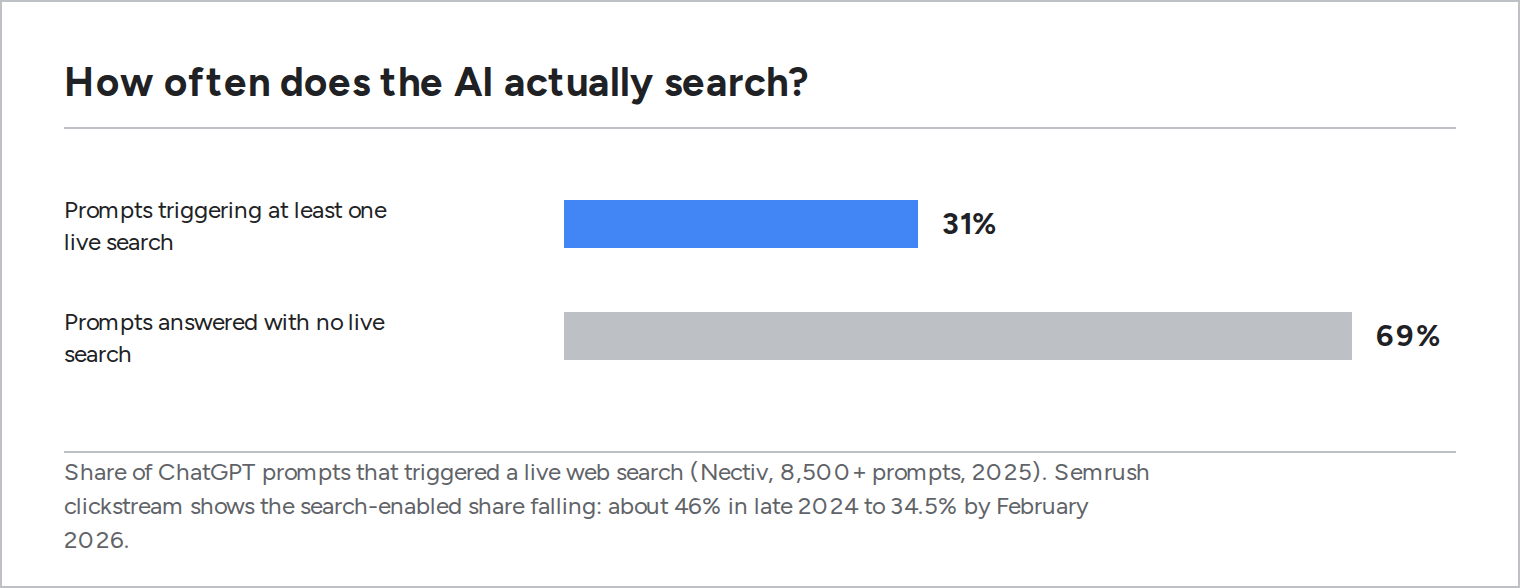
The split between the two is more lopsided than most GEO plans assume. When Nectiv ran 8,500+ prompts through ChatGPT, only [31% triggered at least one live web search](https://nectivdigital.com/blog/new-data-study-what-queries-is-chatgpt-using-behind-the-scenes). The trigger rate ranged from 18% for credit-card prompts to 59% for local ones. Semrush's US clickstream panel, a different methodology, puts the search-enabled share of ChatGPT queries at [34.5% as of February 2026, down from about 46% in late 2024](https://www.semrush.com/blog/chatgpt-search-insights/). Two studies, two methods, one direction: most ChatGPT answers involve no live retrieval, and the searching share is shrinking, not growing.
In Nectiv's 8,500+ prompt study, 31% of ChatGPT prompts triggered at least one live search. Semrush clickstream data shows the search-enabled share falling: about 46% in late 2024 to 34.5% by February 2026.
Nectiv did not analyze how the non-searching two-thirds were answered, but the mechanics leave one option: with no retrieval step, the answer contains only what the model already carries in its weights.
## Why do long-tail brands vanish in memory mode?
Here is the part that should bother you. When no search fires, the candidate pool for that answer was frozen the day the model finished training. A brand that appeared rarely in the training corpus is not competing and losing in those answers. It was never entered.
This is why two brands with comparable products and comparable websites get wildly different AI visibility. The heavily covered brand exists inside the model's memory and gets recommended even when nothing is retrieved. The lightly covered one gets a chance only when retrieval fires and its pages enter the candidate pool. No amount of on-site tuning changes what a frozen model already believes; that takes third-party coverage that survives into the next training run, which moves on a scale of quarters.
Whatever your team calls this discipline, GEO, AEO, AISEO, or AIO, the plan should say which mode it is optimizing. Most GEO plans are retrieval-side plans built on the assumption that the engine always searches. On ChatGPT, the assumption fails about two times in three.
## What happens when the engine does search?
When retrieval does fire, the answer passes through four stages, and a brand can drop out at each one:
1. **Retrieval**: the engine turns your prompt into one or more search queries and runs them against an index.
2. **Candidate pool**: the pages those queries return are fetched and read.
3. **Synthesis**: the model writes an answer from the passages it judged relevant.
4. **Citation**: a subset of the used sources gets linked in the visible answer.
The funnel is brutal. AirOps traced 15,000 ChatGPT prompts and watched them expand into [43,233 search queries, retrieving 548,534 pages, of which 85% were never cited](https://www.airops.com/report/influence-of-retrieval-fanout-and-google-serps-in-chatgpt). Being retrieved is necessary and nowhere near sufficient. We walked each stage in detail in [our five-stage RAG funnel piece](https://kuroma.ai/blog/how-rag-works-ai-search-citations-five-stage-pipeline); this article is about why the same funnel produces different winners on different engines.
## How differently do engines retrieve for the same question?
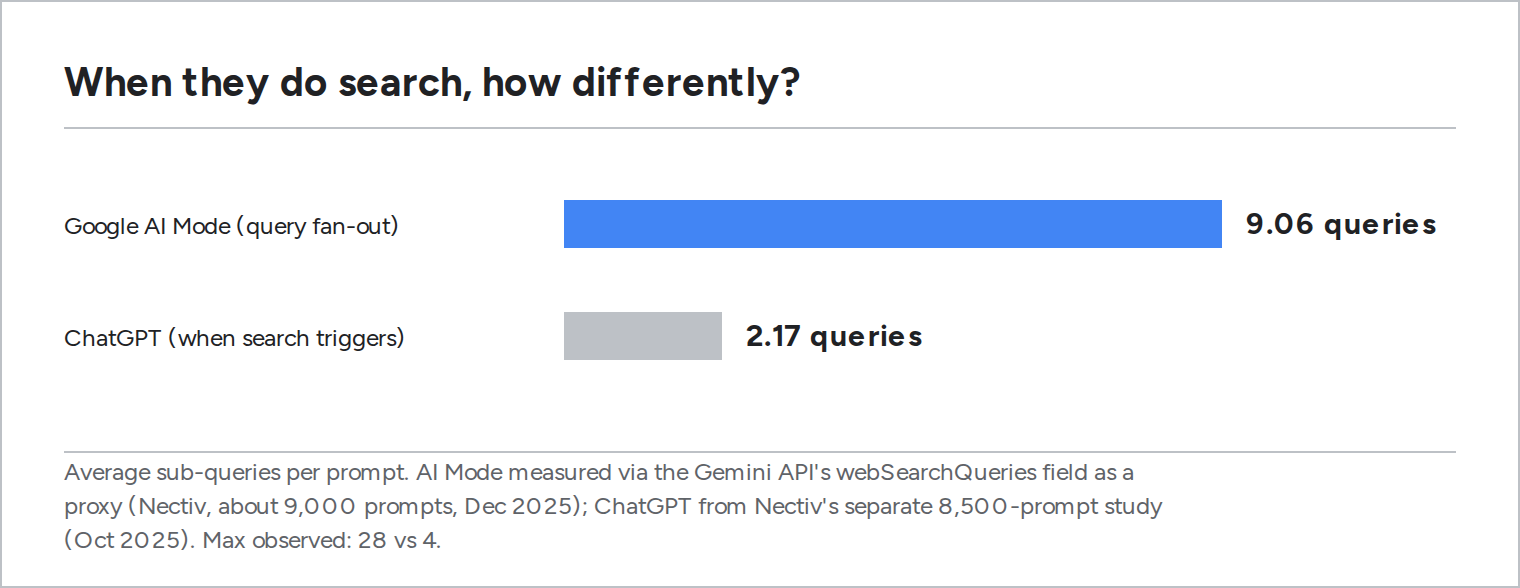
Google's official description of AI Mode is the "query fan-out technique": [breaking a question into subtopics and issuing multiple queries simultaneously](https://blog.google/products/search/google-search-ai-mode-update/). Google publishes no count. The best third-party measurement, by Nectiv through the Gemini API's webSearchQueries field as a proxy for AI Mode, found an average of [9.06 fan-out queries per prompt](https://nectivdigital.com/blog/new-research-we-analyzed-60k-google-fan-out-queries), with 59% of prompts producing between 5 and 11 and a maximum of 28.
ChatGPT, in Nectiv's separate study, averaged [2.17 searches per searching prompt](https://nectivdigital.com/blog/new-data-study-what-queries-is-chatgpt-using-behind-the-scenes), with a maximum of 4. Roughly a 4x gap. One engine casts a wide net of sub-queries; the other makes a couple of narrow probes. If your content answers the exact prompt but not its sub-questions, AI Mode may still find you through a fan-out query. ChatGPT probably won't.
Average sub-queries per prompt: AI Mode about 9, measured via the Gemini API as a proxy (Nectiv, ~9,000 prompts, Dec 2025), versus ChatGPT at 2.17 (Nectiv's separate 8,500-prompt study, Oct 2025).
## Which index does each engine search?
Fan-out counts are half the story. The other half is which index those queries hit: a brand invisible to the index cannot be retrieved, however good the content.
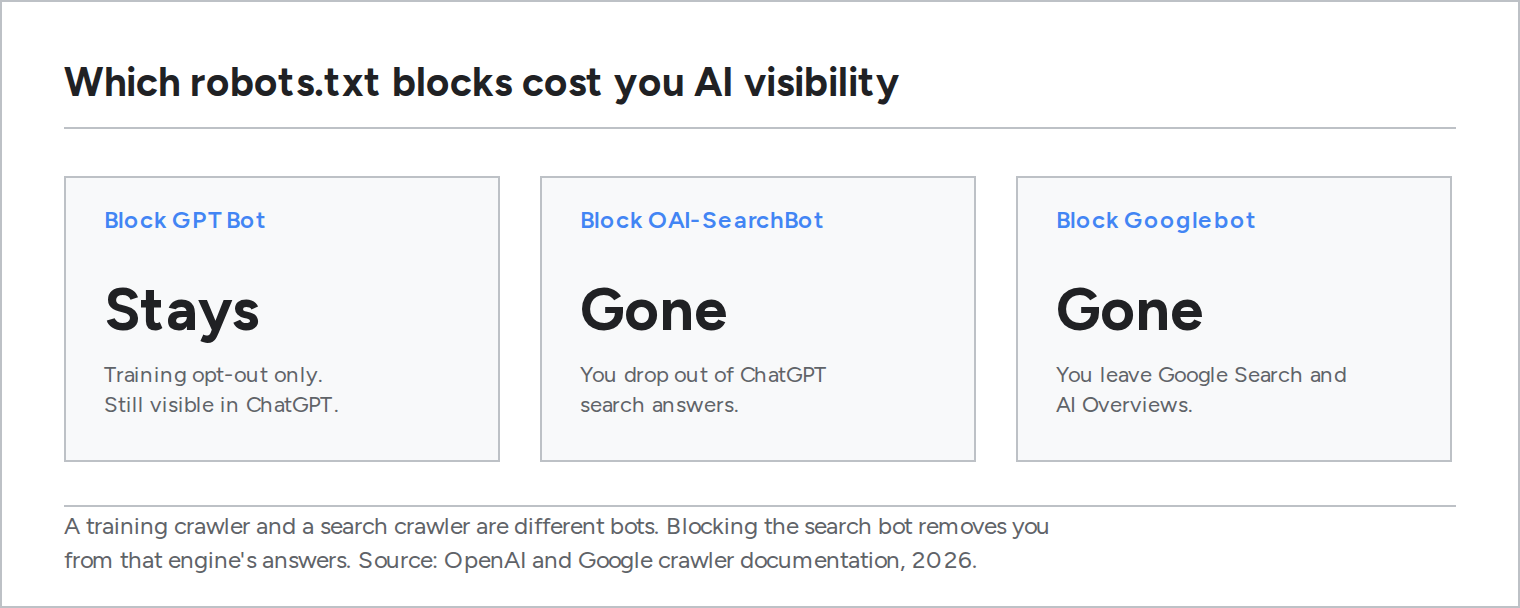
ChatGPT's search leg leans on Microsoft: Bing is the only web-search engine OpenAI names in [its own help documentation](https://help.openai.com/en/articles/10093903), and Seer Interactive found that [87%+ of SearchGPT citations matched Bing's top organic results versus a 56% match with Google](https://www.seerinteractive.com/insights/87-percent-of-searchgpt-citations-match-bings-top-results). OpenAI also runs its own crawler, OAI-SearchBot, and sites that block it are [excluded from ChatGPT's search results](https://developers.openai.com/api/docs/bots). Your Bing indexing, which almost nobody audits, quietly gates your ChatGPT visibility.
Perplexity went the other way and built its own index, which it says tracks [more than 200 billion unique URLs](https://research.perplexity.ai/articles/architecting-and-evaluating-an-ai-first-search-api). Its docs recommend [allowing PerplexityBot in robots.txt to ensure your site appears in its search results](https://docs.perplexity.ai/guides/bots). Google's AI Overviews sit on the opposite foundation again: a Gemini model customized for Search, paired with [the same crawl, index, and ranking systems as classic Google](https://blog.google/products/search/generative-ai-google-search-may-2024/). And the Gemini app is conditional by design: according to Google's API documentation, the model [decides per prompt whether a search would improve the answer](https://ai.google.dev/gemini-api/docs/google-search) and issues zero to many queries accordingly.
Each engine pairs its own index with its own trigger logic and fan-out depth, and the result is measurable: across identical prompts, the highest domain overlap between any two engines' citations was [25.19%, between Perplexity and ChatGPT](https://seranking.com/blog/chatgpt-vs-perplexity-vs-google-vs-bing-comparison-research/). Even Google's own two AI surfaces cite the same URL for the same query only [13.7% of the time, despite 86% semantic similarity in the answers](https://ahrefs.com/blog/ai-overviews-vs-ai-mode/). The words agree; the bibliographies barely intersect.
## Where do brands drop out of the RAG pipeline?
The whole mechanism, condensed into a drop-out map:
| Stage | What happens | Why brands drop out | What moves it |
|---|---|---|---|
| Mode decision | The engine decides whether to search at all; [31% of ChatGPT prompts trigger one](https://nectivdigital.com/blog/new-data-study-what-queries-is-chatgpt-using-behind-the-scenes) | No search means memory-only answers; thinly covered brands were never memorized | Prompt category (trigger rates run 18% to 59% by vertical); long-term earned coverage |
| Retrieval | Fan-out queries hit each engine's index ([9.06 vs 2.17 per prompt](https://nectivdigital.com/blog/new-research-we-analyzed-60k-google-fan-out-queries)) | Blocked crawlers or weak Bing indexing keep pages out of the pool | Allowing [OAI-SearchBot](https://developers.openai.com/api/docs/bots) and [PerplexityBot](https://docs.perplexity.ai/guides/bots); ranking for sub-queries, not just head terms |
| Candidate pool to synthesis | Retrieved pages compete; [85% are never cited](https://www.airops.com/report/influence-of-retrieval-fanout-and-google-serps-in-chatgpt) | Fetched but judged less relevant than rival passages | Rank still helps here: #1-ranked pages were cited at 3.5x the rate of pages beyond Google's top 20 |
| Citation | Each engine links its preferred source types | Your coverage lives on sources that engine discounts | Presence on that engine's kingmaker sources ([Wikipedia, Reddit, forums differ per engine](https://www.tryprofound.com/blog/ai-platform-citation-patterns)) |
## Does ranking #1 on Google still get you cited?
Less and less, and it depends which engine you ask. In July 2025, Ahrefs measured that [76.1% of AI Overview citations came from Google's top-10 results](https://ahrefs.com/blog/search-rankings-ai-citations/). Its latest follow-up study found [roughly 38%](https://ahrefs.com/blog/ai-overview-citations-top-10/) as of March 2026, with the rest split between positions 11-100 and beyond 100. Ahrefs attributes the shift to Gemini 3-driven query fan-out, while noting its citation parsing also improved between the two waves, so the drop is directional rather than precise. The chatbots were never rank-loyal to begin with: across 15,000 long-tail prompts, only about [12% of URLs cited by ChatGPT, Gemini, and Copilot ranked in Google's top 10](https://ahrefs.com/blog/ai-search-overlap/) for the original prompt, with Perplexity the most Google-aligned at 28.6%. AI Mode matched Google's own organic top 10 at just [14% at the URL level](https://seranking.com/blog/ai-mode-research/).
Before you archive your SEO program, look inside [the AirOps funnel](https://www.airops.com/report/influence-of-retrieval-fanout-and-google-serps-in-chatgpt) again. Among cited pages that ranked in any top-20 Google SERP, about a third got there only through a fan-out query, never the user's original prompt, and #1-ranked pages were cited at 3.5x the rate of pages outside the top 20. Ranking still buys entry to candidate pools. What changed is which queries you need to rank for: the machine-generated sub-questions, not just the keyword your dashboard tracks.
## Which sources does each engine prefer to cite?
Once pages survive retrieval and synthesis, each engine plays favorites at the citation stage. According to Muck Rack's most recent analysis (May 2026, 25M+ links), [ChatGPT cites sources in 96% of responses, Gemini in 82%, Claude in 55%](https://muckrack.com/blog/what-is-ai-reading-may-2026), and each has a different single most-cited domain: Wikipedia for ChatGPT, Reddit for Gemini, PubMed Central for Claude. Within each platform's ten most-cited sources, Profound's 680M-citation dataset shows [Wikipedia alone is 47.9% of ChatGPT's top-10 share, while Reddit is 46.7% of Perplexity's](https://www.tryprofound.com/blog/ai-platform-citation-patterns). Wix's AI Search Lab adds that [17.35% of Perplexity's citations come from discussions and forums](https://www.wix.com/studio/ai-search-lab/research/content-types-most-cited-by-llms), more than double the cross-engine average.
Even the citation counts are mode-dependent, which loops back to the two-mode thesis: with search mode explicitly on, SE Ranking measured [ChatGPT at 10.42 links per response, AI Overviews at 9.26, and Perplexity at 5.01](https://seranking.com/blog/chatgpt-vs-perplexity-vs-google-vs-bing-comparison-research/), while default-mode ChatGPT averaged [2.62 citations when it alone decided whether to cite](https://www.xfunnel.ai/blog/what-sources-do-ai-search-engines-choose).
Almost none of these preferred sources are your website. That is the "where" of this story, covered in [the mention economy](https://kuroma.ai/blog/ai-search-mention-economy): visibility is decided on third-party pages. This article is the "why": those pages are what retrieval fetches and citation rewards. Muck Rack puts earned, non-paid third-party media at [84% of all AI citations](https://muckrack.com/blog/what-is-ai-reading-may-2026).
## What moves retrieval, and what doesn't?
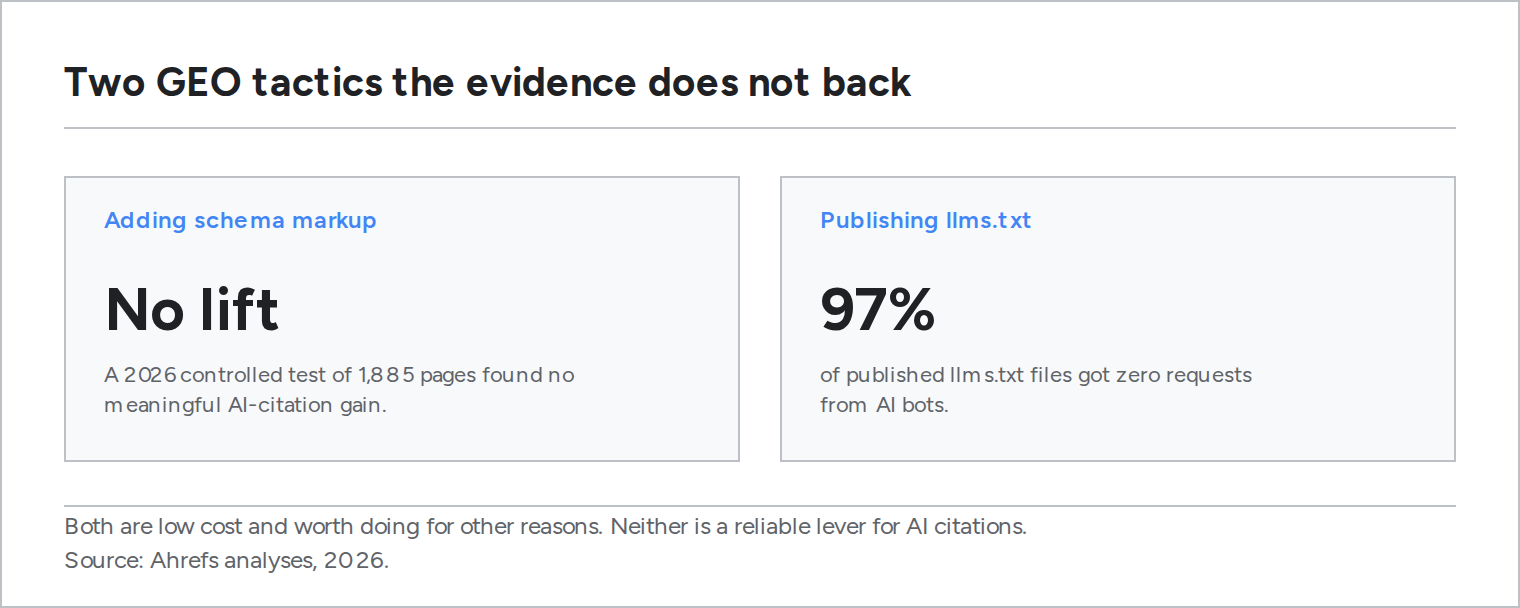
Start with the popular tactic that doesn't. Ahrefs' matched-control study found the opposite of the checklist promise: across 1,885 pages that added JSON-LD schema versus 4,000 controls, [AI Overview citations declined 4.6%, the only statistically significant movement, while AI Mode and ChatGPT changes were indistinguishable from zero](https://ahrefs.com/blog/schema-ai-citations/). A live-fetch experiment by searchVIU, reported in the same study, found none of five AI systems read JSON-LD at retrieval time; they extract visible HTML. Schema may still matter at index time, but it is not the citation lever the checklists promise.
What correlates instead, per Ahrefs' 75,000-brand study: [YouTube brand mentions at roughly 0.737 Spearman across ChatGPT, AI Mode, and AI Overviews, and branded web mentions at 0.66-0.71](https://ahrefs.com/blog/ai-brand-visibility-correlations/), versus Domain Rating at 0.27-0.33 and site page count at a near-null 0.194. Correlation is not causation, and the sample skews to established brands, but the ordering is consistent: being talked about beats publishing more.
Finally, hold every number in this piece loosely, because these studies update fast and the pipeline itself is probabilistic. SE Ranking reran 10,000 AI Mode keywords three times on the same day and got [9.2% average URL overlap](https://seranking.com/blog/ai-mode-research/); a fifth of keywords shared zero URLs across runs. Ahrefs notes [45% of AI Overview citations change between regenerations](https://ahrefs.com/blog/ai-overviews-vs-ai-mode/) of the same query. One-shot checks tell you almost nothing; occurrence rates across repeated runs are the only honest metric.
So, Monday morning: take your five highest-intent prompts and run each one ten times on the two engines your buyers use. Log three things per run: did it search, was your brand named, what got cited. I did this manually for a month before we automated it in Kuroma, and the spreadsheet settled more strategy arguments than any tool demo. By Friday you will know which mode you are losing in, and that decides everything: memory-mode losses call for earned coverage and third-party mentions; retrieval-mode losses call for crawler access, Bing indexing, sub-query content, and presence on the engine's favorite source types.
## Frequently asked questions
### What is RAG in AI search?
Retrieval-augmented generation is the architecture where an AI engine runs live searches, reads the retrieved pages, and writes its answer from them, citing some as sources. It contrasts with parametric answers, which come purely from the model's training memory. Only retrieval-augmented answers can cite pages the model has never memorized.
### How often does ChatGPT actually search the web?
In Nectiv's 8,500+ prompt study, [31% of prompts triggered at least one search](https://nectivdigital.com/blog/new-data-study-what-queries-is-chatgpt-using-behind-the-scenes). Semrush's US clickstream data measures the search-enabled share at [34.5% as of February 2026, down from about 46% in late 2024](https://www.semrush.com/blog/chatgpt-search-insights/). The exact figure depends on methodology, but every measurement agrees: most prompts get no live retrieval.
### Can an AI engine cite my site if I block its crawlers?
Not on its search surface. OpenAI states that sites blocking [OAI-SearchBot](https://developers.openai.com/api/docs/bots) are excluded from ChatGPT search results, and Perplexity recommends allowing [PerplexityBot](https://docs.perplexity.ai/guides/bots) so your site appears in its results. Check your robots.txt and your CDN's bot rules before spending anything on content.
### Does schema markup improve AI citations?
According to Ahrefs' matched-control study of 1,885 pages, there was [no positive citation effect on any engine measured, and a small significant decline on AI Overviews](https://ahrefs.com/blog/schema-ai-citations/). Live-fetch tests show AI systems reading visible HTML, not structured data. Keep schema for classic search; do not budget it as a GEO lever.
### Why is my brand cited on one AI engine but not another?
Because each engine retrieves from a different index with different fan-out and different source preferences. The maximum citation-domain overlap measured between any two engines is [25.19%](https://seranking.com/blog/chatgpt-vs-perplexity-vs-google-vs-bing-comparison-research/), and even Google's AI Overviews and AI Mode agree on cited URLs only [13.7% of the time](https://ahrefs.com/blog/ai-overviews-vs-ai-mode/). Per-engine visibility requires per-engine measurement.
---
### [The mention economy: AI search visibility is decided on websites you don't own](https://kuroma.ai/blog/ai-search-mention-economy)
2026-07-17 | Tags: AI Search, GEO, AEO, earned media, brand mentions, AI Citations
**TL;DR:** When ChatGPT, Google AI Mode, or Perplexity assemble a shortlist of recommended brands, they sample third-party pages: listicles, review sites, editorial coverage, YouTube, Reddit. Brand-owned domains barely register at the top of the citation stack. Your AI search visibility is decided mostly on websites you don't own, and the budget should follow that fact: earned media and third-party presence do the heavy lifting, while beloved on-site rituals like llms.txt and schema markup measure out near zero.
Most marketing teams treat AI visibility as a website project. The instinct makes sense: your site is the property you control, so that's where the optimization tickets land. Add schema. Publish llms.txt. Lengthen the pillar page. The problem is that the citation data, across every study that has measured it, says the shortlist is assembled somewhere else.
This discipline has collected too many names: GEO, AEO, AIO, AISEO. Pick whichever your team uses. Under all of them sits the same uncomfortable finding, and it changes how the money should be spent.
## Where do AI answers actually get their recommendations?
When [Cloro logged which domains ChatGPT cited](https://cloro.dev/blog/ai-shopping-chatgpt-recommends/) while recommending consumer electronics, the top of the stack was YouTube at 19%, Reddit at 19%, and the reviewer RTINGS at 16%, with Google properties at 12% and editorial reviewers like PCMag and Tom's Guide at 6 to 9% each. The study's own phrasing: "brand-owned domains are conspicuously absent from the top of this list." That was shopping intent, US English, one vendor's dataset, so don't carve the percentages into stone. The shape is the finding. The pages that decide the shortlist belong to other people.
The pattern holds beyond shopping. Across 250,000 citations from ChatGPT, Perplexity, and Gemini, [xfunnel found earned media](https://www.xfunnel.ai/blog/what-sources-do-ai-search-engines-choose) (third-party editorial, review, and affiliate content) was the most frequent citation type on every engine, and 31.5% of citations came from domains with authority scores of 80 to 100. Aggregate link analyses push further: [Muck Rack's 25-million-link dataset](https://machinerelations.ai/research/earned-vs-owned-ai-citation-rates-2026) puts third-party sources around 82 to 89% of citations with owned domains near 13.7%, while Meltwater's per-engine cut lands lower, at 40 to 51% earned. These are all vendor studies with competing definitions of "earned," so hold the exact percentages loosely. What matters is that no published dataset flips the ordering.
## Why doesn't your own website decide your AI visibility?
Two peer-reviewed results explain the mechanics. [Kandpal et al. (ICML 2023)](https://arxiv.org/abs/2211.08411) showed that language models fail on long-tail facts unless those facts appear repeatedly in training data; models "must be scaled by many orders of magnitude" to recall poorly supported facts, and retrieval augmentation is what closes the gap. [Mallen et al. (ACL 2023)](https://arxiv.org/abs/2212.10511) found that an entity's popularity strongly predicts whether a model knows anything about it at all.
For a brand, that leaves two doors into an AI answer. Either the model already knows you, which is a function of how often you appear in the text it trained on. Or the engine's retrieval step fetches pages that mention you, which is a function of how often you appear in the pages it trusts. Both doors open from the same side: the wider web corpus. Your own domain is one voice in that corpus, and as the citation stacks above show, it is not the voice the engines reach for first.
## What correlates with actually getting picked?
The largest correlational study available is [Ahrefs' analysis of 75,000 brands](https://ahrefs.com/blog/ai-overview-brand-correlation/): branded web mentions, linked or unlinked, correlated with AI Overview visibility at Spearman 0.664. Backlinks came in at 0.218. Ahrefs is explicit that this is correlation, not causation, and brand popularity confounds everything here. Even so, a three-times gap between mentions and backlinks is not subtle. SEO spent twenty years optimizing the link; AI visibility tracks the mention, with or without one.
In [Ahrefs' follow-up across ChatGPT, AI Mode, and AI Overviews](https://ahrefs.com/blog/ai-brand-visibility-correlations/), mentions on YouTube posted the highest correlation of any single factor, around 0.737. Part of that is Google surfacing its own property, but recall that ChatGPT cited YouTube more than any other domain in the shopping data too.
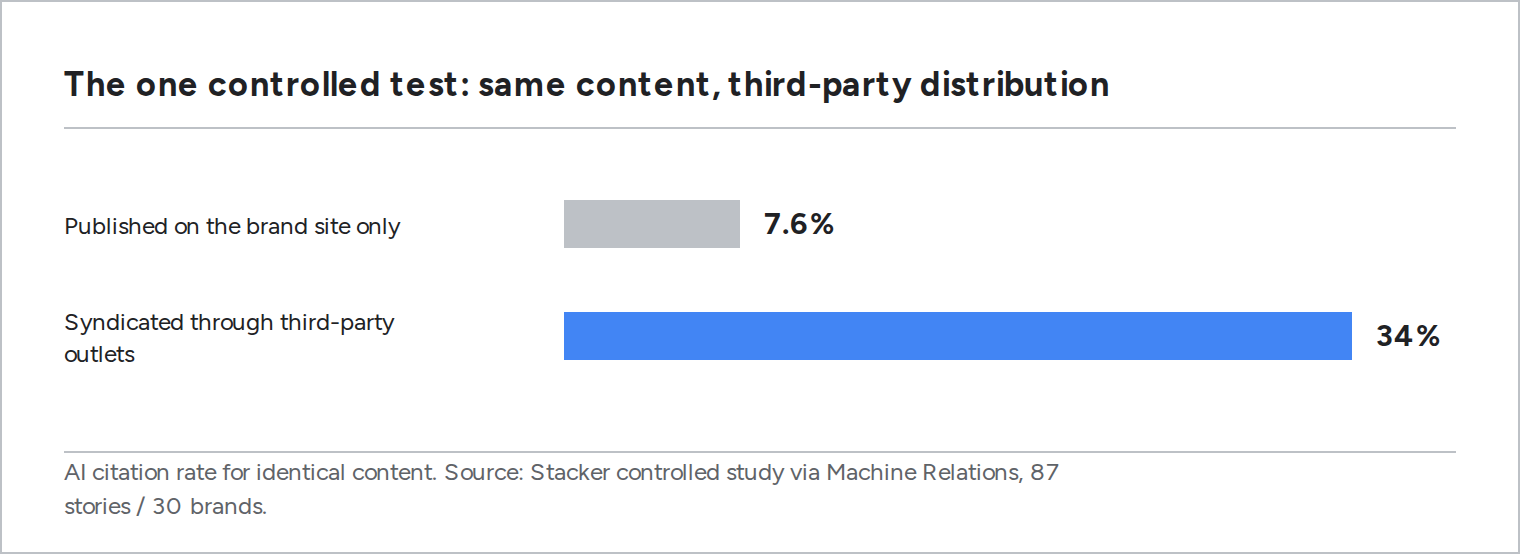
The closest thing to causal evidence comes from a [controlled syndication test by Stacker](https://machinerelations.ai/research/earned-vs-owned-ai-citation-rates-2026): identical content had a 7.6% AI citation rate when published on the brand's site alone, and 34% once syndicated through third-party news outlets. That is a lift of about 325%, and a broader follow-up run reported a lower median near 239%. The study was run by a syndication company, so the conflict of interest is right on the label, and 87 stories across 30 brands is small. It is also nearly the only controlled distribution experiment anyone in this industry has published.
The same content, roughly four and a half times the citation rate once it lived on other people's sites. Source: Stacker controlled study via Machine Relations.
## Do listicles and classic Google rank still matter?
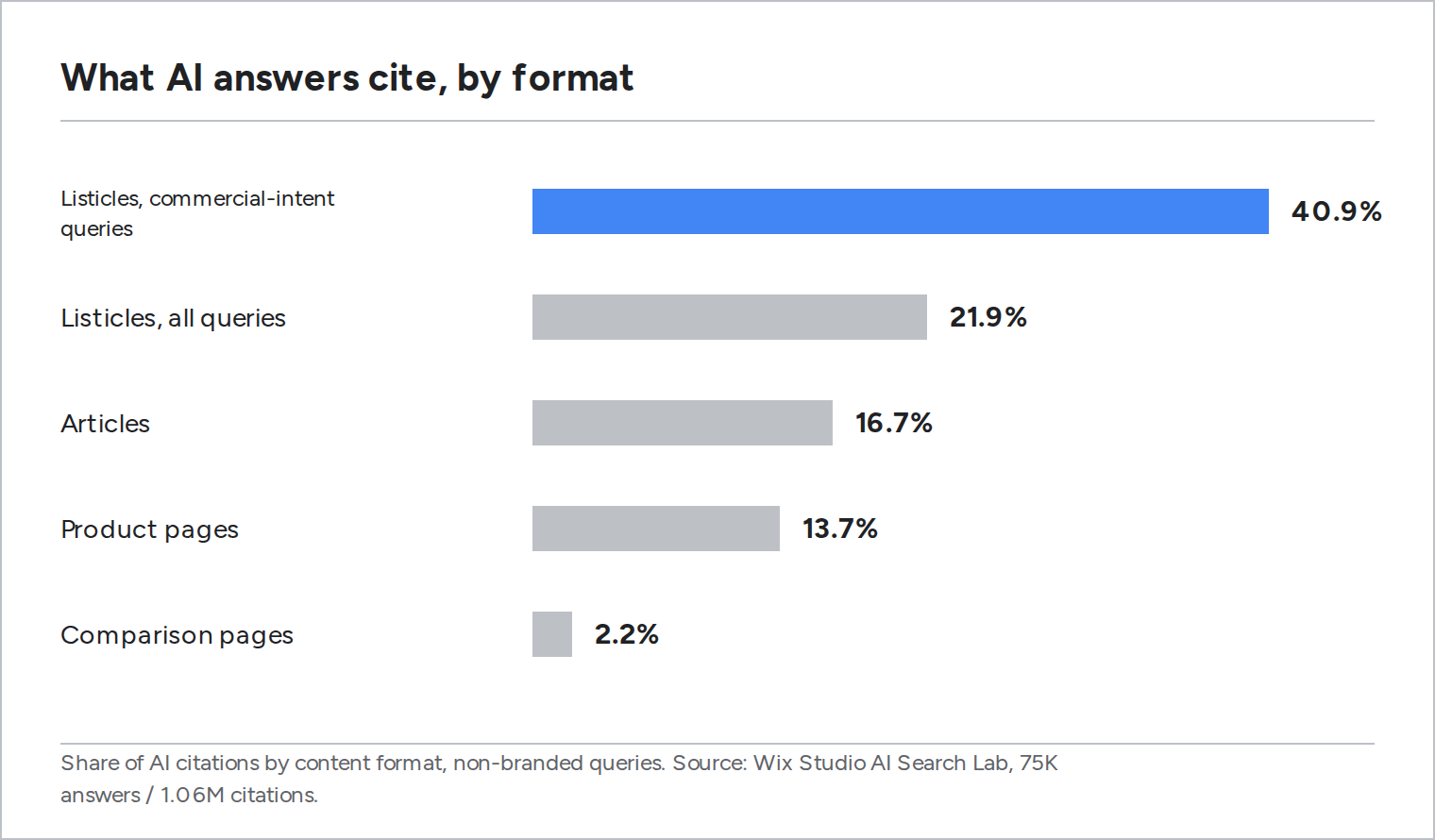
More than almost anything else. In [Wix Studio's analysis of 1.06 million citations](https://www.wix.com/studio/ai-search-lab/research/content-types-most-cited-by-llms) across 75,000 AI answers, listicles were the most cited format at 21.88%, ahead of articles at 16.68% and product pages at 13.66%. Comparison pages, the format brands love to build, took 2.2%. And on commercial-intent queries (by Wix's own intent classification), the listicle share jumps to 40.86%, nearly double any other format.
What AI answers cite, by format. Listicles dominate exactly where purchase decisions happen. Source: Wix Studio AI Search Lab, 75K answers and 1.06M citations.
If your category has "best X for Y" roundups, those pages are the ballot, and publishers write them, not you. Getting named in the lists that answer engines already cite is answer engine optimization (AEO) in the most literal sense.
Classic rank feeds the same machine. In [AirOps' study of 548,534 retrieved pages](https://www.airops.com/report/influence-of-retrieval-fanout-and-google-serps-in-chatgpt), pages ranking #1 in Google were cited by ChatGPT 43.2% of the time, about 3.5 times the rate of pages outside the top 20. For Google's AI Overviews, [Ahrefs measured 76% of citations coming from the organic top 10](https://ahrefs.com/blog/search-rankings-ai-citations/) in 2025, then revised that to roughly 38% in March 2026 on a larger dataset. The direction survives the revision: rank still feeds retrieval, though the coupling is loosening.
## Does schema markup or llms.txt help at all?
No, and for once the evidence is not ambiguous.
llms.txt first. [Otterly's 90-day crawler log study](https://otterly.ai/blog/the-llms-txt-experiment/) found about 0.1% of AI crawler requests touched the file. Google's Gary Illyes confirmed Google does not support it and has no plans to; John Mueller compared it to the keywords meta tag, which is not a compliment. No major provider has confirmed using it as a signal.
Schema markup looked better on paper, then met a controlled test. [Ahrefs added JSON-LD to 1,885 pages](https://www.stanventures.com/news/schema-markup-has-no-meaningful-impact-on-ai-citations-7231/) and measured the result: no effect in ChatGPT or AI Mode, and a statistically significant decline in AI Overviews. Vendor studies claiming big schema lifts are correlational citation rates, and they contradict each other. The honest reading is no reliable positive effect.
The rest of the on-page folklore does no better. Word count correlates with AI citation frequency at [about 0.04, which is zero in practice](https://ahrefs.com/blog/how-to-rank-in-ai-overviews/). The peer-reviewed KDD 2024 GEO experiments found [keyword stuffing gave little to no improvement, and an added authoritative tone gave none](https://arxiv.org/pdf/2311.09735v2).
I think these rituals persist because they are legible. A developer can ship llms.txt in an afternoon and close the ticket. The mention economy is illegible: it means pitching journalists, showing up in creators' videos, being worth quoting. One of these is easy and does nothing. The other is hard and is the actual mechanism.
## What still works on the pages you own?
Owned content is not worthless. It is mispriced, in both directions.
The [KDD 2024 GEO paper](https://arxiv.org/abs/2311.09735) by Aggarwal et al. remains the only peer-reviewed optimization experiment in this field. Adding source citations, quotations, and statistics to pages improved visibility in generative answers by 30 to 40% relative on the paper's position-adjusted metric. The setup was a single custom engine built on GPT-3.5 with an LLM judge, so treat the exact numbers as lab conditions. The direction is durable: evidence-dense pages get quoted, padded pages get skipped.
Placement matters too: [44.2% of citations pull from the first 30% of a page](https://www.growth-memo.com/p/the-science-of-how-ai-picks-its-sources), and content buried deep in a long post is roughly 2.5 times less likely to be cited. Original numbers help when you have them: in a [Growth Memo analysis of 301 pages](https://www.growth-memo.com/p/why-most-original-data-never-gets), the 2.7% holding primary research earned 11.3 citations per page against 3.4 for everything else, though most of that effect sat in a single benchmark cluster, so publishing data is a lottery ticket rather than a guarantee.
And there is one real exception to the third-party rule: the bottom of the funnel. In [xfunnel's 768,000-citation dataset](https://www.xfunnel.ai/blog/what-content-type-ai-engines-like), product and product-detail content took 70.46% of citations on bottom-funnel solution-evaluation queries. When a buyer is comparing specifics, engines assemble answers from spec sheets, docs, and pricing pages. Owned content earns its keep late in the journey. It goes missing upstream, where categories get framed and shortlists get formed.
## How do you measure a strategy that runs on other people's websites?
Carefully, because single scans lie. [SparkToro's volunteer study](https://sparktoro.com/blog/new-research-ais-are-highly-inconsistent-when-recommending-brands-or-products-marketers-should-take-care-when-tracking-ai-visibility/) found the odds of getting the same brand list twice from the same prompt are [under 1 in 100, and the same order closer to 1 in 1,000](https://searchengineland.com/ai-recommendation-lists-rarely-repeat-study-468076). Running [one B2B prompt 100 times surfaced 44 distinct brands](https://searchengineland.com/repeated-chatgpt-runs-brand-visibility-468552), with only about 5 appearing in 80% or more of runs. A [peer-reviewed 2026 study](https://arxiv.org/abs/2604.07585) put cross-day source overlap at 34 to 42%.
The stable signal is presence: how often you appear across many runs, not where you ranked in one. Established brands hold [60 to 90% presence for a given intent](https://searchengineland.com/ai-recommendation-lists-rarely-repeat-study-468076) even while the ordered lists churn. Treat [10 runs per prompt per engine as a floor](https://nicklafferty.com/blog/ai-visibility-metrics-reference/) and score presence rate as a percentage. We covered the full measurement problem, GA4 blind spots included, in [our attribution deep dive](https://kuroma.ai/blog/geo-measurement-problem-ai-search-attribution).
## What does the budget inversion look like?
Line the levers up by evidence quality and by whose website they live on, and the pattern is hard to unsee.
| Lever | What the data says | Evidence grade | Where it lives |
|-------|-------------------|----------------|----------------|
| [Third-party syndication](https://machinerelations.ai/research/earned-vs-owned-ai-citation-rates-2026) | 7.6% to 34% citation rate for identical content | Controlled (vendor-run) | Other people's sites |
| [Web mention breadth](https://ahrefs.com/blog/ai-overview-brand-correlation/) | Strongest correlate measured: 0.664 vs 0.218 for backlinks | Correlational | Other people's sites |
| [Listicle presence](https://www.wix.com/studio/ai-search-lab/research/content-types-most-cited-by-llms) | 21.9% of all citations; 40.9% on commercial queries | Correlational | Other people's sites |
| [Classic Google rank](https://www.airops.com/report/influence-of-retrieval-fanout-and-google-serps-in-chatgpt) | #1 pages cited by ChatGPT 43.2% of the time | Correlational | Yours and others' |
| [Cite/quote/statistics edits](https://arxiv.org/abs/2311.09735) | 30 to 40% relative visibility lift | Controlled (peer-reviewed, one engine) | Your site |
| [Primary research](https://www.growth-memo.com/p/why-most-original-data-never-gets) | 11.3 vs 3.4 citations per page, heavily concentrated | Correlational | Your site |
| [Word count](https://ahrefs.com/blog/how-to-rank-in-ai-overviews/) | Spearman ~0.04 | Debunked | Your site |
| [Keyword stuffing](https://arxiv.org/pdf/2311.09735v2) | Little to no improvement | Debunked (controlled) | Your site |
| [llms.txt](https://otterly.ai/blog/the-llms-txt-experiment/) | ~0.1% of AI crawler requests; no engine confirms it | Debunked | Your site |
| [Schema markup](https://www.stanventures.com/news/schema-markup-has-no-meaningful-impact-on-ai-citations-7231/) | No lift; slight decline in AI Overviews | Debunked (controlled) | Your site |
Everything with strong positive evidence lives wholly or partly on property you don't control. Everything debunked lives on your own.
The budget translation: PR, comms, syndication, reviewer relations, and creator outreach stop being "brand" spend evaluated on impressions. They are distribution infrastructure for the corpus AI engines sample, which makes them performance spend, evaluated on citation presence. Classic SEO keeps its seat because rank still feeds retrieval. The on-page GEO project list shrinks to the few edits with experimental support.
I sell software that scores web pages, so this conclusion costs me something to write: most of what decides AI visibility never touches the pages we score. The honest pitch for on-page work is that it sharpens the pages that third-party attention eventually points at, not that it summons the attention.
## What should you do on Monday?
Five things, in order.
1. Write down the ten buying questions in your category. Run each ten times on two engines. Record presence, not position.
2. Collect the listicles and roundups those answers cite. Mark every one you're absent from. That's your outreach list, ranked by actual citation frequency.
3. Identify the three reviewers, creators, or communities that dominate your category's citation stack, and put real budget against being covered there.
4. Take this quarter's schema and llms.txt hours and move them into one syndication or digital PR test. Measure presence before and after, over many runs.
5. On your two best-ranking pages, add named statistics, quotable lines, and source citations. That's the one on-page edit with experimental backing.
The shortlists in your category are being assembled right now, mostly from pages you don't own. The work that gets you into them is sitting, unfunded, in the earned media column.
## Frequently asked questions
### Do AI engines ever cite brand-owned websites?
Yes. Owned domains draw roughly [13.7% of citations in aggregate analyses](https://machinerelations.ai/research/earned-vs-owned-ai-citation-rates-2026), and far more at the bottom of the funnel, where [product content takes 70.46% of solution-evaluation citations](https://www.xfunnel.ai/blog/what-content-type-ai-engines-like). Owned pages help close decisions. They rarely start them.
### Are backlinks still worth building for AI search?
For classic rank, yes, and rank still feeds AI citations. But [web mentions correlate with AI visibility about three times more strongly than backlinks](https://ahrefs.com/blog/ai-overview-brand-correlation/) (0.664 vs 0.218), and a mention counts even without a link. Being named matters more than being linked.
### Is llms.txt harmful, or just useless?
Just useless, on current evidence: [about 0.1% of AI crawler requests touch it](https://otterly.ai/blog/the-llms-txt-experiment/) and no major provider confirms reading it as a signal. It costs minutes, so keep it if you like. Expect nothing from it.
### How many prompt runs before an AI visibility number means anything?
Treat [10 runs per prompt per engine as the floor](https://nicklafferty.com/blog/ai-visibility-metrics-reference/), and [some practitioners recommend 60 to 100](https://betterthangood.xyz/blog/weighing-smoke/). The odds of the [same brand list appearing twice are under 1 in 100](https://searchengineland.com/ai-recommendation-lists-rarely-repeat-study-468076), so a single scan is noise, not measurement.
### Are GEO, AEO, AIO, and AISEO different strategies?
They are overlapping labels for the same discipline: earning presence in AI-generated answers. Whichever term you use, the citation data points one way. The shortlist is sampled from third-party pages, so earned presence comes first and on-page hygiene second.
---
### [The GEO Measurement Problem: How to Prove AI Search Visibility When Attribution Is Broken](https://kuroma.ai/blog/geo-measurement-problem-ai-search-attribution)
2026-07-15 | Tags: GEO, AI search analytics, GA4 attribution, share of voice, AI Overviews, zero-click search
You prove AI search visibility by measuring the answers directly, not by waiting for evidence to surface in GA4. The standard analytics stack only sees the thin slice of AI exposure that ends in a click with a surviving referrer, and roughly 97% of ChatGPT answers cite no source at all, [according to Similarweb's latest gen-AI stats report](https://www.similarweb.com/blog/marketing/geo/gen-ai-stats/). The defensible metric is run-aggregated share of voice: the same buyer prompts, run repeatedly across engines, because the variance research shows a single scan is statistically an anecdote.
**TL;DR**
- GA4's first AI channel (May 2026) names only ChatGPT, Gemini, and Claude. Google's own AI Mode clicks still land as `google / organic`.
- Referrers vanish by design: Ahrefs found `noreferrer` on ChatGPT's paid-account links, nothing from Perplexity's desktop app, nothing from Grok.
- Server logs count fetches, not humans: Cloudflare measured Anthropic at 38,065 pages crawled per referral visit; about 80% of AI-bot crawling serves training.
- Zero-click is measurable: Pew found clicks on 8% of AI-summary searches versus 15% without; Ahrefs found position-1 CTR 58% lower under an AI Overview.
- Single scans are noise: fewer than 1 in 100 repeated runs return the same brand list, yet presence rates hold stable at 55-77% for category leaders.
- The honest playbook: date-stamp the referral slice, split crawler logs into three signals, and measure share of voice with repeated runs. Demand run counts from every vendor, ours included.
## Why can't GA4 prove your AI search traffic?
Because a click must survive three lotteries before your analytics can count it: the assistant has to cite a link, the user has to click it, and the referrer has to survive the trip.
That last lottery fails constantly. In May 2025, Patrick Stox at Ahrefs hand-tested every major assistant, and the research shows referrer transmission is inconsistent by design: [according to the Ahrefs test](https://ahrefs.com/blog/generative-engines-are-breaking-web-analytics/), ChatGPT's paid-account in-content links carry `noreferrer`, its `strict-origin-when-cross-origin` policy drops the referrer entirely on any HTTPS-to-HTTP link, Perplexity's desktop app and Copilot for Windows pass no referrer (their web versions do), and Grok passed none at all. Claude, Meta AI, and Mistral passed referrers consistently. That was one manual test in spring 2025; assistants change link behavior without notice.
Until May 2026, GA4 had no concept of AI traffic: clicks landed in Referral under `chatgpt.com` or `perplexity.ai`, or in Direct whenever the referrer was stripped. Then Google added an "AI Assistant" default channel group, and [according to Search Engine Journal's coverage](https://www.searchenginejournal.com/google-analytics-adds-ai-assistant-as-default-channel-group/574974/), it names only ChatGPT, Gemini, and Claude as recognized sources. Google has not published the full referrer list; Perplexity and Copilot are absent.
The new channel also cannot contain Google's own AI search traffic. Clicks from AI Overviews and AI Mode arrive with a plain `google.com` referrer and land in GA4 as `google / organic`, indistinguishable from a classic blue-link click, [per Ahrefs' AI Mode tracking test](https://ahrefs.com/blog/google-ai-mode-is-here-but-you-cant-track-it-properly/) and [Search Engine Land's confirmation](https://searchengineland.com/googles-ai-mode-traffic-untrackable-455883). AI Mode links initially fired no referrer at all. Google later fixed that, which merely upgraded the traffic from invisible to unlabelable.
ChatGPT auto-appends `utm_source=chatgpt.com` to cited links, and on June 13, 2025 OpenAI extended that tagging to the "More" sources section, [according to PPC Land](https://ppc.land/chatgpt-adds-utm-parameters-to-more-links-for-better-analytics-tracking/). But nobody has documented when citation tagging first began, and it is not guaranteed on every link type.
Even visible trends are hostage to product decisions: after ChatGPT's May 7, 2026 interface change, homepage referrals jumped to roughly 60% of all ChatGPT-referred traffic from a prior 26-32%, [according to Similarweb's panel estimates](https://www.similarweb.com/blog/marketing/geo/gen-ai-stats/). If your report showed a spike that week, the spike was OpenAI's, not yours.
## What can each data source actually see?
Search Console deserves its own indictment first. Google's documentation states AI Overview and AI Mode traffic is "included in the overall search traffic in Search Console... reported on in the Performance report, within the 'Web' search type," [per Google Search Central](https://developers.google.com/search/docs/appearance/ai-features). There is no filter to isolate it. Worse, an AI Overview occupies a single position that every link inside it inherits, and an impression only counts once the link scrolls into view, [per Google's metrics documentation](https://support.google.com/webmasters/answer/7042828). Position data on AIO-heavy queries is structurally non-comparable to classic ranks.
The capability matrix our team keeps taped above the analytics dashboard:
| Data source | What it can see | What it cannot see |
|---|---|---|
| GA4 (Referral + AI Assistant channel) | Clicks arriving with a surviving referrer from named sources: ChatGPT, Gemini, Claude | Stripped-referrer clicks (filed under Direct); Perplexity desktop and Copilot for Windows; every Google AI Overview and AI Mode click |
| Google Search Console | Combined impressions and clicks for the "Web" type, AI features included | Any split between AI Overviews and blue links; comparable positions (a whole AIO counts as one position) |
| Server logs | Every fetch by a declared crawler (GPTBot, OAI-SearchBot, ChatGPT-User) | Whether a human ever saw your content; citations served from an index or training data involve no fetch at all |
| `utm_source=chatgpt.com` | ChatGPT citation clicks on tagged link types | Untagged link types; every other assistant; the ~97% of answers with no citation |
| Panel estimates (Similarweb, Clarity, Adobe) | Directional cross-site trends by engine and cohort | Your site specifically; panels extrapolate, they do not read your server |
| Repeated prompt scans (share of voice) | Whether engines mention and cite you, and at what rate | Real user query mix; actual traffic; a single run is noise |
No row covers the whole problem. An honest stack uses several at once and labels each number with what it excludes.
## How much traffic does AI search actually send, and what is it worth?
The visible slice is small and growing fast. Both halves matter. [According to Similarweb](https://www.similarweb.com/blog/insights/ai-news/ai-referral-traffic-winners/), AI platforms generated 1.13 billion referral visits in June 2025, up 357% year over year, with ChatGPT alone at more than 80% of AI referrals to the top 1,000 domains. Google search sent 191 billion referrals in the same month. Those are panel estimates counting only referrer-visible visits; the true AI-influenced number sits somewhere above them.
Microsoft Clarity's telemetry tells the same story: across 1,277 publisher and news domains over eight months, [the study found](https://clarity.microsoft.com/blog/ai-traffic-converts-at-3x-the-rate-of-other-channels-study/) AI-platform referrals grew 155.6% while Search grew 24.0%, yet AI still accounted for less than 1% of overall traffic. Fast growth, tiny base.
Conversion quality is where nobody's number agrees, including the same vendor with itself:
- Adobe Analytics, from over a trillion visits to US retail sites, [reported in March 2025](https://blog.adobe.com/en/publish/2025/03/17/adobe-analytics-traffic-to-us-retail-websites-from-generative-ai-sources-jumps-1200-percent) that AI-referred visitors were 8% more engaged, viewed 12% more pages, bounced 23% less, and converted 9% worse. That was an improvement from 43% worse in July 2024.
- Ten months later, [Adobe's holiday recap](https://news.adobe.com/news/2026/01/adobe-holiday-shopping-season) of the $257.8 billion Nov-Dec 2025 US online season had AI-sourced retail traffic up another 693% and converting 31% higher than other channels. The sign flipped within a year.
- Clarity's publisher study found LLM referrals signing up at 1.66% versus 0.15% from search: the real source of the "AI converts 11x" headlines, measured as sign-ups on publisher sites, not ecommerce revenue.
- [Semrush's study](https://www.semrush.com/blog/ai-search-seo-traffic-study/) puts the average AI-search visitor at 4.4 times the value of an organic visitor by conversion rate, measured on Semrush's own funnel across 500+ digital-marketing topics. Their early-2028 "AI overtakes traditional search" projection carries the same scope: marketing and SEO topics only.
- [Similarweb's December 2025 release](https://ir.similarweb.com/news-events/press-releases/detail/138/ai-discovery-surges-similarwebs-2025-generative-ai-report-says) says gen-AI referrals convert at roughly 7% on transactional sites, cohort undefined.
Every one of those numbers is real. None is "the" AI conversion rate. Each is scope-bound and about six months from stale; quoting one as a universal multiplier is doing the thing this article warns about. What the data does support: AI visitors arrive unusually engaged, the channel compounds, and the demand side is enormous. ChatGPT reached 800 million weekly active users by October 2025, [according to TechCrunch](https://techcrunch.com/2025/10/06/sam-altman-says-chatgpt-has-hit-800m-weekly-active-users/), on OpenAI's own definition.
## Where did the clicks go?
Into the answer layer, which emits almost none of them.
The Pew Research Center gave this its cleanest measurement. Among 900 US adults who shared browsing data, covering 68,879 Google searches in March 2025, [the study found](https://www.pewresearch.org/short-reads/2025/07/22/google-users-are-less-likely-to-click-on-links-when-an-ai-summary-appears-in-the-results/) users clicked a traditional result on 8% of searches with an AI summary versus 15% without one. Only 1% of AI-summary encounters produced a click on a source cited inside the summary. This was an opt-in US panel and Google disputed the methodology, but nobody has published a counter-measurement.
Ahrefs ran the position-1 CTR version twice. Their April 2025 analysis of 300,000 keywords found AI Overview presence correlated with a [34.5% lower CTR for the top-ranking page](https://ahrefs.com/blog/ai-overviews-reduce-clicks/). The updated February 2026 revision, comparing December 2023 against December 2025, [put the gap at 58%](https://ahrefs.com/blog/ai-overviews-reduce-clicks-update/): position-1 desktop CTR on AIO keywords fell from 7.3% to 1.6%, and, the quiet second finding, it also fell from 7.6% to 3.9% on keywords with no AI Overview at all. Clicks are eroding everywhere. AIO queries just erode fastest.
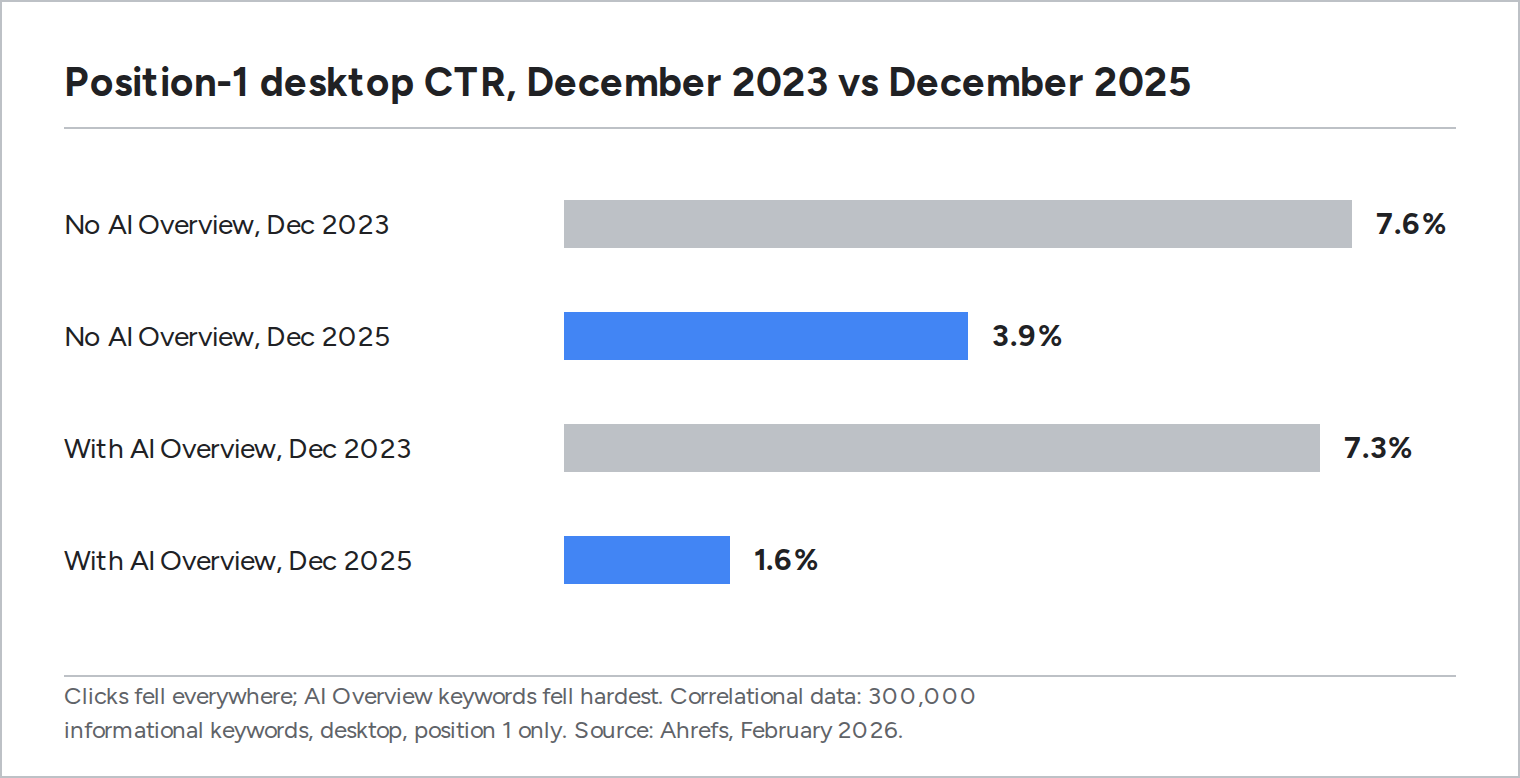
*Clicks fell on every keyword class; AI Overview keywords fell hardest. Correlational data across 300,000 informational keywords, desktop, position 1 only. Source: Ahrefs, February 2026.*
Seer Interactive's client data shows these curves bend. Across 53 brands and 5.47 million queries, [their updated April 2026 analysis](https://www.seerinteractive.com/insights/aio-impact-on-google-ctr-2026-update) shows organic CTR on AIO-present queries fell from 3.19% in January 2025 to 1.31% in December 2025, then partially recovered to 2.36% by February 2026. Being cited inside the AI Overview delivered 120% more clicks per impression than not being cited, yet cited brands still ran about 38% below non-AIO queries. Date every CTR number you quote. This one changed twice in fourteen months.
Put the halves together. AI referrals grew 357% while clicks collapsed, and both are true, because visibility migrated into a layer that barely links out: [Similarweb found](https://www.similarweb.com/blog/marketing/geo/gen-ai-stats/) only 0.6% of ChatGPT answers included citations in January 2025, rising to 2.8% by August 2025. Roughly 97% of ChatGPT answers name no source. **The measurable click is now the minority artifact of AI influence, not its measure.**
## Why do server logs overstate your AI visibility?
Because most of what AI bots do on your server has nothing to do with a user.
OpenAI documents exactly three crawler identities with three different meanings, [according to OpenAI's bot documentation](https://developers.openai.com/api/docs/bots): `GPTBot` crawls "content that may be used in training our generative AI foundation models" (no user, no referral, ever), `OAI-SearchBot` is "used to surface websites in search results in ChatGPT's search features" (indexing), and `ChatGPT-User` fires "for certain user actions in ChatGPT and Custom GPTs" (the only one implying a human saw your content in-session). A GPTBot spike is not a visibility win. It is a training harvest.
The scale of the mismatch is the point. Cloudflare measured crawl-to-refer ratios across its network, and [the study found](https://blog.cloudflare.com/crawlers-click-ai-bots-training/) that in July 2025 Anthropic crawled 38,065 HTML pages for every referral visit it sent back, down from 286,930 that January. OpenAI ran 1,091 to 1, Perplexity 194 to 1, Microsoft 40.7 to 1, Google 5.4 to 1. Those ratios move month to month, so quote the date with the number. The same dataset shows about 80% of AI-bot crawling over the trailing year was for training, 18% for search indexing, and roughly 2% for live user actions. The overwhelming majority of AI hits in your server log carry zero visibility signal.
One more log-file trap: in late 2024, [Vercel found](https://vercel.com/blog/the-rise-of-the-ai-crawler) that none of the major AI crawlers rendered JavaScript; ChatGPT fetched JS files on 11.5% of requests and never executed them. If your key content renders client-side, it is invisible to the systems whose answers you are trying to audit.
## Why is a single AI visibility scan worthless?
Because the engines do not repeat themselves, and the studies proving it are stacked three deep.
The largest is SparkToro and Gumshoe.ai's panel: 600 volunteers ran roughly 2,961 runs of 12 identical brand-recommendation prompts across ChatGPT, Claude, and Google's AI Overviews and AI Mode in late 2025. [The study found](https://sparktoro.com/blog/new-research-ais-are-highly-inconsistent-when-recommending-brands-or-products-marketers-should-take-care-when-tracking-ai-visibility/) fewer than 1 in 100 runs returned an identical brand list, and about 1 in 1,000 returned the same brands in the same order. Rand Fishkin's conclusion: "any tool that gives a 'ranking position in AI' is full of baloney." Presence held up in aggregate: category leaders appeared in 55-77% of responses, 60-90% for some intents. Rank is noise. Rate is signal.
Contender's design removed the personalization excuse: 12 prompts, 100 runs each, on logged-out chatgpt.com from 1,200 distinct IP addresses. [According to Search Engine Land's write-up](https://searchengineland.com/repeated-chatgpt-runs-brand-visibility-468552), a single answer names about 10 brands, but 100 runs of the same prompt surface about 44 distinct brands. Only about 5 brands per category, around 11% of everything mentioned, appeared in 80% or more of runs, and in competitive categories 72% of mentioned brands showed up in fewer than 20% of responses. Flip that around: if your brand lives outside the stable core, a one-run scan will miss you most of the time you actually appear.
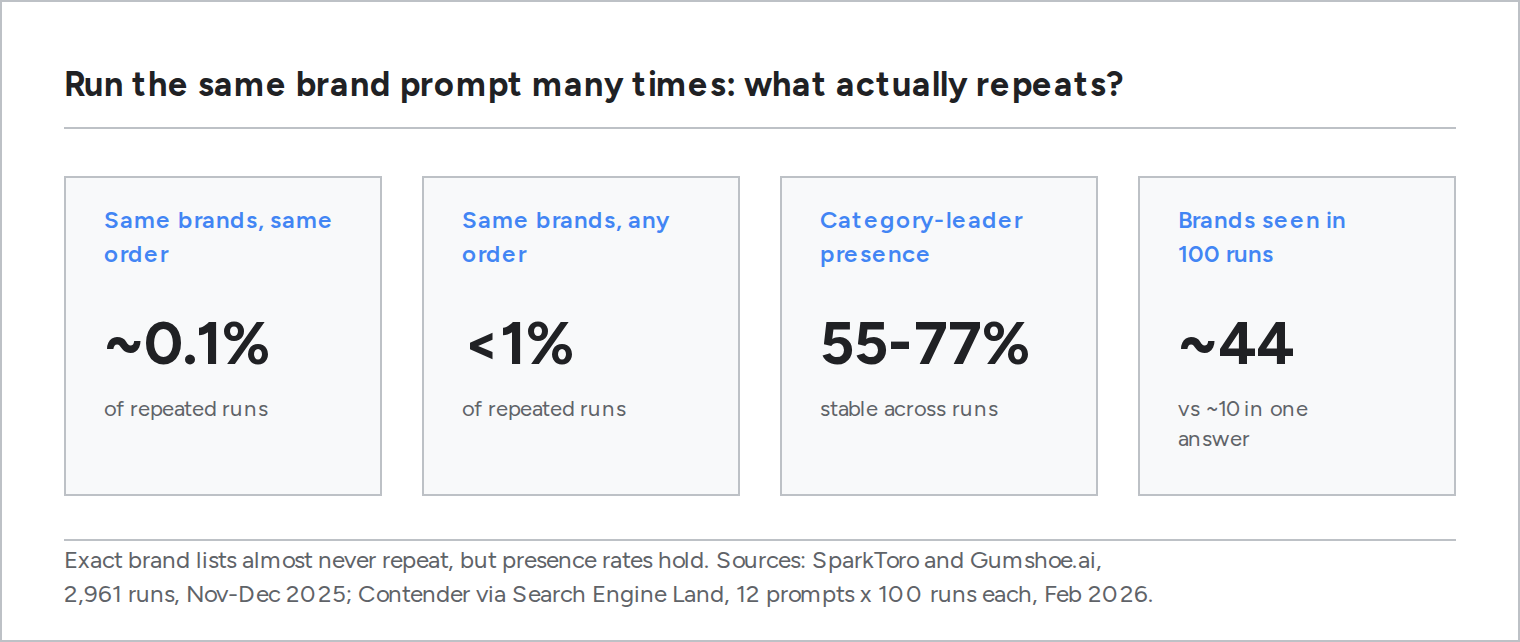
*Exact brand lists almost never repeat; presence rates across many runs stay stable. Sources: SparkToro and Gumshoe.ai panel, 2,961 runs, late 2025; Contender via Search Engine Land, 12 prompts at 100 runs each, February 2026.*
Google's AI surfaces behave the same way. SE Ranking ran 5,000 local-intent queries 15 times each against AI Mode and [found only 18.3-20.5% URL overlap](https://seranking.com/blog/ai-mode-volatility-test/) when repeating the same general query in the same city; more than 60% of domains disappear between runs. Location-specific queries were steadier at 46-49% overlap, itself a methodology lesson: prompt specificity changes volatility. [Authoritas' early-2025 research](https://www.authoritas.com/blog/serp-organic-and-ai-overview-volatility-research) points the same way: AI Overview rankings measurably more volatile than organic, and changing independently of it.
This evidence cuts both ways. It demolishes the screenshot audit and the prospect's "I asked ChatGPT and we weren't there." It also sets a bar for every visibility vendor, Kuroma included: a tool that runs each prompt once per scan is producing anecdotes with a dashboard around them. Any share-of-voice number should arrive with its run count, engine list, and sampling window attached. Even the field's founding paper, [the GEO study by Aggarwal et al. at KDD 2024](https://arxiv.org/abs/2311.09735), defined visibility as impression-weighted citation share aggregated across a query benchmark, with content optimizations lifting visibility by up to 40% in lab conditions. An aggregate over many queries. Not a screenshot.
## What does an honest GEO measurement playbook look like?
Six moves, in the order we would run them.
1. **Segment what is segmentable, then date-stamp it.** Build a custom channel group for known AI referrers plus `utm_source=chatgpt.com`, and annotate the timeline: GA4's AI Assistant channel launch (May 2026), ChatGPT's homepage-referral shift (May 7, 2026), any assistant UI change you catch. A trend break is as likely their product decision as your content.
2. **Treat Direct upticks as unattributable.** The dark-traffic mechanism is real (stripped referrers, desktop apps, `noreferrer` links), but classifying referrer-less visits as AI traffic requires fingerprinting whose accuracy you cannot verify. Note the uptick. Do not book it as GEO ROI.
3. **Read server logs as three signals, not one.** Separate training crawlers, search-index crawlers, and live-retrieval agents by user agent. Watch `ChatGPT-User` and its cousins; discount `GPTBot` volume as a visibility metric. And serve your substance server-side; the crawlers do not execute JavaScript.
4. **In Search Console, watch CTR at stable positions instead of positions.** AI Overview links inherit a single blended position, so rank tracking on AIO-heavy queries measures an artifact. CTR decay at a held position is the cleaner zero-click signal, and Seer's early-2026 partial recovery shows it must be re-measured, not assumed.
5. **Measure the answer layer directly, with repetition.** A fixed prompt set drawn from real buyer questions, run across multiple engines and buyer personas, repeated, and aggregated into share of voice. This is the method our team built Kuroma around: persona prompts times engines times repeated runs, rolled into first-party share-of-voice trendlines, because the variance data says one run misleads in both directions. Presence rates are the stable object. Everything else wobbles.
6. **Report ranges with dates, not point estimates.** "Cited in 62% of runs across three engines, June 2026, 40 runs per prompt" is a claim a CFO can audit. "We rank #2 in ChatGPT" is, per the data above, not a real thing.
None of this recovers the click that never happened. It swaps a broken attribution question ("which visit came from AI?") for an answerable visibility one ("how often do the engines present us, and is that rate moving?"). **One run is an anecdote. The aggregate is a metric.**
## Frequently asked questions
### Does GA4's new AI Assistant channel fix AI attribution?
No. It labels part of the already-visible slice. [The channel recognizes ChatGPT, Gemini, and Claude](https://www.searchenginejournal.com/google-analytics-adds-ai-assistant-as-default-channel-group/574974/), leaves Perplexity and Copilot unnamed, and cannot include Google's own AI Overviews or AI Mode clicks, which still arrive as `google / organic`. Referrer-stripped visits still land in Direct, as before.
### What does a GPTBot hit in my server logs actually mean?
OpenAI fetched your page for potential training use, nothing more. [Cloudflare's measurement](https://blog.cloudflare.com/crawlers-click-ai-bots-training/) puts about 80% of AI-bot crawling in the training bucket and only about 2% in live user actions. The user agent implying a human saw your content in-session is `ChatGPT-User`, and even then, an assistant can cite you from its index or training data with no fetch at all.
### Is AI search traffic really more valuable than organic search traffic?
More engaged, consistently; the conversion multiplier depends on whose cohort you read. Microsoft Clarity measured publisher sign-ups at [1.66% from LLM referrals versus 0.15% from search](https://clarity.microsoft.com/blog/ai-traffic-converts-at-3x-the-rate-of-other-channels-study/), while Adobe's US retail data went from 43% worse to 9% worse to [31% better](https://news.adobe.com/news/2026/01/adobe-holiday-shopping-season) across eighteen months. Treat any single multiplier as scope-bound and perishable; check its date before repeating it.
### How many runs does an AI visibility scan need before it means anything?
No published magic number exists, but one is provably not enough. [Contender's data](https://searchengineland.com/repeated-chatgpt-runs-brand-visibility-468552) shows 100 runs of one prompt surfacing about 44 brands where a single answer names about 10, and 72% of mentioned brands in competitive categories appearing in fewer than 20% of responses. Presence rates stabilize across dozens of runs, so treat run count like survey sample size, and ask every vendor for theirs.
### What is the difference between GEO, AEO, AISEO, and AIO?
They are overlapping labels for the same discipline. GEO (generative engine optimization) is the academic term from the 2023 KDD paper, AEO (answer engine optimization) emphasizes assistants as answer engines, AISEO is shorthand for AI-era search engine optimization, and AIO usually refers to Google's AI Overviews and the work of getting cited inside them. Whatever the label, the measurement problem is the same: referral analytics see a sliver; repeated-run share of voice measures the answer layer itself.
---
### [The Technical GEO Checklist: 7 Fixes That Get Your Pages Into AI Answers](https://kuroma.ai/blog/technical-geo-checklist-ai-crawler-access)
2026-07-13 | Tags: GEO, AI Search, Technical SEO, AI Crawlers, AIO, AISEO, AEO
**Key takeaways**
- The most expensive technical mistake in GEO is blocking the wrong crawler. Blocking GPTBot only opts you out of model training. Blocking OAI-SearchBot pulls you out of ChatGPT's search answers ([OpenAI](https://developers.openai.com/api/docs/bots)). They are different bots with different jobs.
- Most AI crawlers do not run JavaScript. Vercel's analysis of AI crawler traffic found that OpenAI's, Anthropic's, and Perplexity's bots fetched pages and never executed the client-side JavaScript ([Vercel, 2024](https://vercel.com/blog/the-rise-of-the-ai-crawler)). If your main content loads in the browser, they read a blank page. Googlebot, which feeds Google's AI Overviews, is the exception.
- Google-Extended does not keep your content out of AI Overviews. It only opts you out of Gemini app and Vertex training. AI Overviews and AI Mode ride on Googlebot, so the only way out is leaving Google Search ([Google](https://developers.google.com/search/docs/appearance/ai-features)).
- Schema markup is worth keeping for entity clarity and classic search, but it will not buy you AI citations on its own. A 2026 controlled test of 1,885 pages that added JSON-LD found no meaningful citation lift ([Ahrefs](https://ahrefs.com/blog/)).
- llms.txt is cheap to publish and, so far, ignored. In one scan of published llms.txt files, about 97% received zero requests from AI bots, and no major engine has confirmed reading it ([Ahrefs](https://ahrefs.com/blog/)).
GEO (generative engine optimization, also written AEO for answer engine optimization, AISEO for AI search optimization, or just AIO) has two halves: the content and the plumbing. Most advice covers the content half. Write clearer answers, earn citations, cover the questions people actually ask. That work is real, and it also assumes an AI crawler can reach your page, read it, and parse it. At Kuroma we audit a lot of sites, and a surprising share lose visibility before a single sentence is judged, because a crawler was blocked, a page rendered empty, or an edge rule returned a 403 to a bot nobody recognized.
This is the plumbing checklist: seven technical changes, ordered roughly by how often they turn out to be the real problem. None of them require rewriting your content. Several take an afternoon.
Here are the seven, in the order I would check them:
1. Let the visibility crawlers in, and block training only on purpose.
2. Serve your content as HTML, not as JavaScript.
3. Stop your CDN or WAF from quietly blocking AI bots.
4. Publish a sitemap with honest lastmod dates.
5. Label your entities and answers with schema, for the right reason.
6. Write passages that stand on their own.
7. Add llms.txt, but keep your expectations low.
In our audits we found that the first three account for most cases where a site with genuinely good content is missing from AI answers. The order is not academic. Fix the reachability problems before you spend a week polishing prose that no crawler can see.
## 1. Let the visibility crawlers in, and block training only on purpose
robots.txt is where most self-inflicted GEO wounds start. The vendors have quietly split their crawlers into three jobs, and the names matter. Some bots train models. Some fetch pages to build the search index that answers get cited from. Some fetch a page live because a user asked a question right now. A visibility crawler is a bot in that middle group: it reads your pages so an engine can quote and cite them in an answer.
Blocking a training crawler is a fair decision about whether your content trains a model. Blocking a search crawler is a decision to disappear from that engine's answers. People confuse the two constantly. The clearest case is OpenAI: GPTBot is the training crawler, and OAI-SearchBot is the one that surfaces you in ChatGPT search. OpenAI's own documentation says a site opted out of OAI-SearchBot will not appear in ChatGPT search answers. Disallow it thinking you are only opting out of training, and you have quietly switched off your ChatGPT visibility.
> Sites that are opted out of OAI-SearchBot will not be shown as search results in ChatGPT.
That is OpenAI's own wording, and every major vendor now documents a similar split.
A training crawler and a search crawler are different bots, and only one of them controls whether you show up in AI answers. Source: OpenAI and Google crawler documentation, 2026.
The same split runs across the vendors:
- Visibility bots (block these and you vanish from AI answers): OAI-SearchBot, ChatGPT-User, Claude-SearchBot, Claude-User, PerplexityBot, Googlebot, and Amazon's Amzn-SearchBot.
- Training bots (blocking costs no visibility): GPTBot, ClaudeBot, Google-Extended, Applebot-Extended, Amazonbot, and CCBot.
Here is the short reference for the crawlers that matter most:
| Crawler | Vendor | Job | Blocking it costs you |
| --- | --- | --- | --- |
| OAI-SearchBot | OpenAI | Search | Your place in ChatGPT search answers |
| GPTBot | OpenAI | Training | Nothing visible: it only opts you out of model training |
| PerplexityBot | Perplexity | Search | Your place in Perplexity answers |
| Claude-SearchBot | Anthropic | Search | Your place in Claude web-search answers |
| Googlebot | Google | Search | Google Search and its AI Overviews together |
| Google-Extended | Google | Training | Only Gemini and Vertex training, not AI Overviews |
Two traps hide in here. First, Perplexity's user fetcher and Meta's fetcher ignore robots.txt for user-driven requests, so a robots rule will not stop them and only an edge rule will. Second, old tokens like anthropic-ai no longer map to a live crawler, so a robots file full of them is guarding a door that no longer exists. Open your robots.txt and read it line by line against the current list.
## 2. Serve your content as HTML, not as JavaScript
Here is the finding that catches modern sites: the major AI crawlers do not run JavaScript. Vercel's analysis of AI crawler traffic in 2024 found that OpenAI's, Anthropic's, and Perplexity's bots fetched pages and never executed the client-side JavaScript. They will download your JS files and still read nothing from them. In the same analysis, Anthropic's crawler requested JavaScript in about 24% of its fetches and executed none of it. We found the same pattern in our own audits: content that looked fine in a browser was simply gone from the raw HTML.
If your site is a single-page app that ships an empty container and paints the article in the browser, those crawlers see the empty container. The content you can read is invisible to them. The one exception is Googlebot, which renders JavaScript and carries that rendered content into Google's AI Overviews, so Google's AI surface is more forgiving than the rest.
The fix is to put your content in the HTML the server returns: server-side rendering, static generation, or prerendering pages for bots. The test takes ten seconds. Fetch your page with `curl`, or view the raw HTML source, and search for a sentence from your article body. If it is not in the returned HTML, it is not there for the crawler either. Our own blog is server-rendered for exactly this reason.
## 3. Stop your CDN or WAF from quietly blocking AI bots
An "Allow" in robots.txt means nothing if your edge returns a 403 first. CDNs now ship one-click "block AI bots" toggles, and bot-management rules routinely flag AI crawlers as suspicious traffic and hand them a challenge page they cannot solve. Rate limits do the same thing more slowly. And a soft-404 is a page that returns HTTP 200 while its body says "not found," which tells a crawler the page is healthy when it is empty.
Our analysis of sites that ranked well in classic search but never got cited by AI kept pointing right here. Pull your edge logs, filter for the visibility user-agents from the first item, and confirm they get 200s rather than 403s, 429s, or 503s. We had a version of this on our own stack once: a robots endpoint started returning 503 to Googlebot, and visibility slid until we traced it. Real status codes are not optional here.
## 4. Publish a sitemap with honest lastmod dates
A sitemap is how a crawler finds pages that are not linked from your homepage, and lastmod is a freshness hint. List canonical URLs only, keep the file current, and update lastmod when the content actually changes. Bumping lastmod on every deploy trains crawlers to ignore it, which defeats the purpose. Point to the sitemap from robots.txt so it is easy to find.
## 5. Label your entities and answers with schema, for the right reason
Add JSON-LD for your organization, your author, your articles, and any genuine question-and-answer content. Then set your expectations correctly, because this is where a lot of GEO advice oversells.
Google limited FAQ rich results in 2023 and has since removed them from Search, and HowTo went the same way. That retired a display feature. It did not make the markup invalid or harmful. What schema still does is label your entities in a machine-readable way, so an engine does not have to infer your company name, your author, or the question a section answers from prose alone.
What schema does not do, on the current evidence, is win you AI citations by itself. Ahrefs ran a controlled test in 2026 on 1,885 pages that added JSON-LD against thousands of matched controls, and found no meaningful lift in AI citations. So add schema because it keeps your entities clear and still helps classic search and Google's own AI surfaces, not because it is a shortcut to being quoted.
## 6. Write passages that stand on their own
This is the one item that touches content, because retrieval happens at the passage level, not the page level. An engine pulls a chunk of your page rather than the whole thing, so a paragraph that only makes sense after the three above it tends to get stranded. Anthropic's work on contextual retrieval showed that passages carrying their own context are retrieved far more reliably.
The practical version: put a real question or claim in a heading, answer it in the first two sentences under that heading, and make the passage readable on its own. Use actual H2 and H3 headings rather than bold text styled to look like a heading. And do not bury the answer inside a tab, an accordion, or a "read more" that only opens with JavaScript, because that is item two all over again: present after a click, absent for a crawler that does not click. This is the point where answer-engine thinking (AEO) and the plumbing meet.
## 7. Add llms.txt, but keep your expectations low
llms.txt is a convention proposed by Jeremy Howard in 2024: a markdown file at your site root that lists your important pages for language models. It is trivial to publish. Be honest about the payoff. No major AI engine has confirmed that it reads llms.txt, Google has said plainly that it does not use it for Search, and when Ahrefs scanned published llms.txt files, around 97% had received zero requests from AI bots. Add one if you want to place a cheap bet on an emerging standard. Do not budget any visibility to it yet. We publish one for our own blog because it costs a few minutes, not because we can measure a return.
Both are low cost and worth doing for other reasons, but neither is a reliable lever for AI citations. Source: Ahrefs analyses, 2026.
## How to tell if any of this is working
You measure the engines directly. Take the questions your customers actually ask, run them through ChatGPT, Perplexity, Gemini, and the others, and record which sources get cited and whether you are one of them. Run each prompt more than once, because the answers move. The same question can return different sources on different runs, since engines vary the searches they make behind the scenes. Citations also turn over across weeks, faster on ChatGPT than on Perplexity, so treat AI visibility as a distribution you watch over time rather than a rank you hit once. This is the part Kuroma automates, but you can start by hand with ten prompts and a spreadsheet.
## FAQ
### Does blocking GPTBot hurt my visibility in ChatGPT?
No. GPTBot is OpenAI's training crawler, so blocking it only opts your content out of model training. Whether you appear in ChatGPT's search answers is controlled by a different bot, OAI-SearchBot. If you want to stay out of training but remain visible in answers, allow OAI-SearchBot and disallow GPTBot.
### Do I have to server-render my whole site for AI search?
You have to make sure the crawler receives your main content in the initial HTML response. Server-side rendering does that, and so do static generation and prerendering pages for bots. What fails is shipping an empty shell that fills in with client-side JavaScript, because the major AI crawlers other than Googlebot do not run it.
### Can I keep my content out of Google's AI Overviews but stay in Google Search?
Not really. Google-Extended only opts you out of Gemini app and Vertex training. It does not touch AI Overviews or AI Mode. Those features are served through Googlebot, so the only way to leave them is to leave Google Search, which almost nobody wants.
### Is schema markup still worth adding after Google dropped FAQ rich results?
Yes, but for entity clarity rather than a citation boost. The Google change removed a display feature, not the value of machine-readable labels for your organization, author, and answers. Just do not expect schema on its own to increase AI citations, because the best controlled test so far did not find that effect.
### How often do AI search citations change?
Often enough that a single check tells you very little. The same prompt can return different sources on different runs, and the set of cited pages turns over across weeks, faster on ChatGPT than on Perplexity. Measure repeatedly and follow the trend rather than reacting to one snapshot.
---
### [How RAG Works: The Five-Stage Pipeline That Decides Whether AI Search Cites Your Brand](https://kuroma.ai/blog/how-rag-works-ai-search-citations-five-stage-pipeline)
2026-07-11 | Tags: GEO, RAG, AI Search, AI Citations, AIO, AISEO, AEO
**Key takeaways**
- Production AI search is not textbook RAG. It is a five-stage citation funnel: query fan-out, index selection, passage-level retrieval, reranking, and citation selection. Your brand can be eliminated at any stage without ever "ranking" badly.
- Retrieval happens at the passage level, not the page level. Perplexity decomposes documents into "self-contained spans" that are retrieved and ranked individually, and Google patents describe an LLM pairwise-comparing passages.
- The link between organic rank and citation is engine-specific and moving. Only 12% of assistant citations rank in Google's top 10 ([Ahrefs](https://ahrefs.com/blog/ai-search-overlap/)), and AI Overviews' top-10 overlap fell from about 76% to 38% in eight months ([Ahrefs](https://ahrefs.com/blog/ai-overview-citations-top-10/)).
- Most ChatGPT answers never touch the web: only about 18% of conversations trigger a search ([Profound](https://www.tryprofound.com/blog/chatgpt-citation-sources)). Retrieval optimization and training-data presence are two different games.
- Because sub-queries are non-deterministic (ChatGPT varies its searches 89% of the time on identical prompts), the stable optimization surface is retrievable, quotable passages, not reverse-engineered keywords.
Every AI search answer that cites a source went through a pipeline called retrieval-augmented generation, or RAG. Most explanations of RAG stop at the textbook diagram: a query goes in, documents come back, the model writes an answer. That diagram is roughly ten years out of date for how ChatGPT, Google AI Mode, and Perplexity actually work in production, and the differences are exactly where brands win or lose citations.
What follows is that pipeline, stage by stage, built from the 2025 and 2026 engineering disclosures and measurement studies rather than from vendor slideware. At [Kuroma](https://kuroma.ai) we measure the output side of this funnel across seven engines every day, which has made us opinionated about one thing in particular: some stages you can influence, and some you can only watch. Knowing which is which saves a lot of wasted optimization.
## What does RAG actually do in an AI search engine?
RAG grounds a language model's answer in retrieved documents instead of relying purely on what the model memorized during training. When it works, the engine fetches relevant pages at answer time, reads them, synthesizes a response, and attributes claims to sources. That attribution step is the citation: the entire prize of Generative Engine Optimization (GEO), and the reason AIO, AEO, and AI SEO practitioners obsess over retrieval mechanics.
In production, five things happen between a user's question and your citation. Each one is a filter.
| Stage | What happens | What eliminates you here |
|---|---|---|
| 1. Query fan-out | The engine rewrites one prompt into many sub-queries | Your content matches the literal keyword but no fan-out variant |
| 2. Index selection | Each engine retrieves from a different index | You blocked the engine's crawler, or its index never saw you |
| 3. Passage retrieval | Chunks, not pages, are embedded and fetched | No self-contained passage answers the sub-question directly |
| 4. Reranking | Cross-encoders and LLM judges reorder candidates | Your passage is topically close but does not directly support an answer |
| 5. Citation selection | The model picks which retrieved sources to attribute | The model answered from memory, or attributed a syndicated copy |
## What happens to a query before retrieval even starts?
Before retrieval, the engine rewrites the user's question into several search queries (query fan-out), so the passages it retrieves answer those sub-queries, not only the literal prompt.
The single biggest departure from textbook RAG is query fan-out. Google confirms that both AI Overviews and AI Mode "may use a query fan-out technique, issuing multiple related searches across subtopics and data sources" ([Google Search Central](https://developers.google.com/search/docs/appearance/ai-features)). At I/O 2025, Google described AI Mode "breaking down your question into subtopics and issuing a multitude of queries simultaneously," with Deep Search issuing hundreds ([Google](https://blog.google/products-and-platforms/products/search/google-search-ai-mode-update/)).
The scale is now measured. Qwairy captured 102,018 real web-search queries generated from 38,418 prompts and found ChatGPT issues an average of 3.51 queries per prompt (only 32.7% of prompts produce a single query), while Perplexity stays single-query 70.5% of the time. List-style prompts averaged 49 generated queries ([Qwairy](https://www.qwairy.co/blog/102k-queries-query-fan-out-study-q3-2025)).
Fan-out scale by engine. Source: Qwairy, 102,018 queries from 38,418 real prompts, Sept to Nov 2025.
The same study contains a trap for anyone selling fan-out keyword lists: ChatGPT generates different sub-queries for the same prompt 89% of the time. There is no stable set of hidden queries to reverse-engineer. All you can do is cover the subtopic space well enough that some variant retrieves you, which is why passage-level topical coverage beats keyword matching in every serious 2025-2026 measurement we have read.
## Which index does each engine retrieve from?
Textbook RAG assumes "the web." Production engines retrieve from specific, different indexes, and this is the most underrated fact in GEO:
- **ChatGPT** historically leaned on Bing: Seer Interactive matched 87% of SearchGPT citations to Bing's top organic results in February 2025 ([Seer Interactive](https://www.seerinteractive.com/insights/87-percent-of-searchgpt-citations-match-bings-top-results)). That substrate has been shifting toward OpenAI's own OAI-SearchBot index and, per multiple third-party tests, Google results. Blocking OAI-SearchBot removes you from ChatGPT search answers entirely ([OpenAI](https://developers.openai.com/api/docs/bots)).
- **Google AI Overviews and AI Mode** ride the normal Google Search index. Google states a page needs only to be "indexed and eligible to be shown in Google Search with a snippet." No special files, no AI-specific markup ([Google Search Central](https://developers.google.com/search/docs/appearance/ai-features)).
- **Perplexity** built its own index: over 200 billion tracked URLs, tens of thousands of indexing operations per second, serving 200 million daily queries ([Perplexity](https://research.perplexity.ai/articles/architecting-and-evaluating-an-ai-first-search-api)). Blocking PerplexityBot removes you from Perplexity results ([Perplexity docs](https://docs.perplexity.ai/guides/bots)).
The practical consequence: one robots.txt file now carries at least three separate decisions, each priced differently per engine. We have watched brands blanket-block "AI bots" in 2025 and silently forfeit two engines while achieving nothing on the third, because Google-Extended does not govern AI Overviews at all. It is an easy mistake to make and a quiet one to live with, since nothing errors when your citations stop.
## Where do AI platforms get the information they use to cite brands?
AI platforms get the information they cite from a live web search index (Bing for ChatGPT, Google's index for AI Overviews and AI Mode, Perplexity's own index), from the model's training data when it decides not to search, and increasingly from third-party pages about a brand (reviews, listicles, forums, news) rather than the brand's own site. In our measurements, most citations on unbranded questions go to pages the brand does not own.
## Why is retrieval about passages, not pages?
Passage retrieval is the step where an AI search engine splits a page into self-contained spans of roughly 100 to 300 words and retrieves and ranks those spans individually instead of judging the page as a whole. Which section of your content gets cited therefore depends on whether that section, read on its own, answers the query; the rest of the page does not help it.
Perplexity's engineering blog is explicit: documents are decomposed into "self-contained spans, each of which can be individually retrieved and ranked at query time," with retrieval operating "at both the document and sub-document levels" ([Perplexity](https://research.perplexity.ai/articles/architecting-and-evaluating-an-ai-first-search-api)). Google's patent record points the same way: Mike King's analysis of the AI Mode patents describes a per-query "custom corpus" assembled from retrieved passages, then a pairwise ranking prompt where an LLM directly compares two passages for which better answers the question ([iPullRank](https://ipullrank.com/how-ai-mode-works)).
A page is no longer the unit of competition. A 300-word passage that states a claim, gives the number, and names the source can beat a 3,000-word page on the same topic where the answer is smeared across sections. This is also why the rank-citation link keeps weakening: fan-out sub-queries retrieve passages from pages that never ranked for the original query. In Ahrefs' 15,000-query study, only 12% of links cited by ChatGPT, Gemini, and Copilot ranked in Google's top 10 for the prompt, and about 80% ranked nowhere in the top 100 ([Ahrefs](https://ahrefs.com/blog/ai-search-overlap/)).
Citation-to-ranking overlap by assistant. Source: Ahrefs, 15,000 long-tail queries, August 2025.
## How do engines decide which retrieved passages get cited?
AI models decide which sources to cite in three passes: retrieval pulls candidate passages that match the query and its fan-out sub-queries, a reranker scores those passages for relevance, clarity and verifiability under a tight latency budget, and the answer model attaches citations to the passages it actually used while writing. A source is cited when a self-contained passage states the answer plainly enough to survive all three passes.
Retrieval produces candidates; reranking and synthesis decide winners. Perplexity describes progressively "more powerful cross-encoder reranker models" sculpting the final result set under a hard latency budget: median 358ms, 95th percentile under 800ms ([Perplexity](https://research.perplexity.ai/articles/architecting-and-evaluating-an-ai-first-search-api)). That budget shapes what wins. An engine racing a 358ms clock cannot deeply read every candidate, so passages that are cheap to verify get a structural advantage: a clear claim, an explicit number, a named source, all near the top of the document.
Then comes the least reliable stage: attribution itself. Columbia's Tow Center ran 1,600 queries across eight AI search tools and found they answered incorrectly on more than 60% of source-attribution tasks; more than half of Gemini and Grok-3 responses cited fabricated or broken URLs, and engines routinely credited syndicated copies (Yahoo News, AOL) instead of the original publisher ([CJR](https://www.cjr.org/tow_center/we-compared-eight-ai-search-engines-theyre-all-bad-at-citing-news.php)). RAG did not eliminate hallucination. It relocated some of it into the citation layer.
## Does the model even search before answering about your brand?
Most GEO advice skips this stage entirely, and it might be the most consequential one. Profound analyzed roughly 730,000 real U.S. ChatGPT conversations and found that only about 18% trigger a web search at all ([Profound](https://www.tryprofound.com/blog/chatgpt-citation-sources)). The other 82% of answers, including plenty of brand recommendations, come straight from the model's training-time memory.
Seer Interactive's "ghost citations" study puts numbers on what that means: across 541,213 responses, a brand's citation rate was 53.1% when the model already mentioned or recommended the brand, versus 10.6% when it did not. Their conclusion: "the citations are the bibliography, not the brainstorm" ([Seer Interactive](https://www.seerinteractive.com/insights/llm-ghost-citations-why-your-content-is-working-and-your-brand-isnt)). The model often decides what to recommend from parametric memory first, then RAG fetches supporting sources.
For practitioners this splits GEO into two programs running on different clocks. Retrieval-side work, the quotable passages and crawler access, can move citations in weeks. Memory-side work is slower and harder to attribute: earned mentions and third-party coverage that survive into the next training corpus move recommendations over quarters. Both are real. Conflating them is how teams end up celebrating a citation-rate bump while their recommendation share sits unchanged, or the reverse.
## What can you actually optimize at each stage? The Kuroma view
When we validated Kuroma's AI Readiness audit against 201,695 real AI answers, the on-page factors we score predicted whether ChatGPT cited a page with an AUC of 0.84 (Grok 0.76, Claude 0.68, AI Overviews 0.63, Perplexity and AI Mode 0.61), where 0.5 is random and 1.0 is perfect ([Kuroma validation study](https://kuroma.ai/blog/ai-readiness-validation-study)). You can read that number two ways, and we hold both at once. Retrieval-stage signals are clearly real: page structure and extractability measurably predict citation, most strongly on ChatGPT, which is flattering for anyone selling an audit. And 0.84 is still a long way from 1.0, because the stages you do not control carry the rest. Fan-out variance alone can bury a well-structured page on any given day.
The same validation work is why we distrust single-snapshot audits: SE Ranking found same-day reruns of identical AI Mode queries shared only 9.2% of cited URLs ([SE Ranking](https://seranking.com/blog/ai-mode-research/)). A pipeline with non-deterministic fan-out and per-version citation behavior demands repeated sampling, which is a monitoring discipline, not a one-time checklist.
What survives contact with the pipeline, per stage: cover the subtopic space around your money questions (stage 1); keep every relevant crawler unblocked and every page snippet-eligible (stage 2); write self-contained, front-loaded passages with explicit claims, numbers, and named sources (stages 3 and 4); and build the third-party mention footprint that makes engines want to name you before retrieval even starts (stage 5). Freshness helps less than most assume: across 17 million citations, AI-cited pages were only 25.7% fresher than organic results, still averaging 2.9 years old ([Ahrefs](https://ahrefs.com/blog/do-ai-assistants-prefer-to-cite-fresh-content/)).
## FAQ
### Is RAG the same across ChatGPT, Google, and Perplexity?
No. The pipeline shape is similar (fan-out, retrieve, rerank, synthesize, cite) but the index, fan-out behavior, and source preferences differ per engine. ChatGPT averages 3.51 sub-queries per prompt while Perplexity stays single-query 70.5% of the time, and each engine retrieves from a different index with different crawler rules.
### Can I optimize for the exact sub-queries an engine generates?
Not reliably. ChatGPT generates different search queries for identical prompts 89% of the time. The stable strategy is covering the subtopic space with self-contained passages so that some fan-out variant retrieves you, then measuring citation frequency across repeated samples.
### Does blocking AI crawlers protect my content without losing visibility?
It depends which crawler. Blocking OAI-SearchBot removes you from ChatGPT search answers; blocking PerplexityBot removes you from Perplexity. Blocking Google-Extended only affects Gemini training and grounding, not AI Overviews, which use the normal Search index.
### Why does my page rank #1 but never get cited?
Because citation is selected at the passage level after fan-out and reranking, not copied from rankings. Only 12% of assistant citations rank in Google's top 10 for the prompt. A lower-ranked page with one directly quotable passage can beat your #1 page whose answer is spread across sections.
### How do I know if my brand is winning or losing at the citation stage?
Measure the output: query the engines with realistic buyer prompts, repeatedly, and track mention and citation rates over time. Single snapshots mislead (9.2% same-day URL overlap on AI Mode). That is the measurement layer Kuroma automates across seven engines.
### How do AI assistants decide whether to use my PR or blog posts as sources?
They use a PR page or blog post when it is crawlable, when a passage in it directly answers a sub-query in plain language, when the page carries dates and an author, and when independent sites corroborate the same claim. Persuasive tone does not help; a verifiable number or a named source in the passage does.
---
### [Self-Promotional Content in AI Search: What Works, What Backfires, and What the Data Shows](https://kuroma.ai/blog/self-promotional-content-ai-search)
2026-07-09 | Tags: AI Search, GEO, content strategy, citations
Every brand wants to know the same thing: should our content sound more confident, more promotional, more "authoritative" now that AI engines are the ones reading it? The marketing instinct says yes. The AI search data says something more uncomfortable: AI engines mostly are not reading your marketing copy at all, and when they do, style matters far less than evidence.
At Kuroma we run visibility scans that ask seven AI engines real customer questions and record every answer and citation, so we watch this play out daily across our own corpus. In our analysis of that corpus and the published research, the pattern is consistent: promotional polish is a rounding error; verifiable substance and third-party coverage decide who gets cited.
## Key takeaways
- According to Muck Rack's analysis of 1M+ citations, 82% of AI citations go to earned media and 94% to non-paid sources; on unbranded queries, a brand's own site captures just 2.9% of citations (Kumar, 2026).
- The GEO benchmark (KDD 2024) found adding quotations (+42.6%), statistics (+32.8%), and source citations (+27.7%) lifts generative visibility far more than an authoritative tone rewrite (+11.8%); keyword stuffing scored 8.7% BELOW baseline.
- A NeurIPS 2025 replication (C-SEO Bench) found most content-side tricks largely ineffective, while better retrieval ranking still moves citations: substance and findability beat styling.
- ACL 2024 research shows LLMs weigh query relevance heavily and largely ignore the stylistic persuasion cues that work on humans.
- The winning self-promotion is indirect: publish original data worth citing, and win the third-party pages AI engines actually read.
## Does confident, promotional language actually help in AI answers?
A little, sometimes, and far less than the alternatives. The foundational GEO study (Aggarwal et al., 2023, presented at KDD 2024) tested nine content interventions across 10,000 queries. The "Authoritative" rewrite, making text more confident and persuasive, lifted position-adjusted visibility by 11.8%. Real, but modest: research shows the evidence-led methods in the same benchmark performed two to four times better.
Evidence beats tone: the top three methods are all about verifiable substance. Source: [Aggarwal et al. (2023), GEO benchmark](https://arxiv.org/abs/2311.09735).
The same study carries the clearest backfire result in the literature: keyword stuffing, the classic promotional reflex, scored 17.8 against a 19.5 baseline. Writing for the algorithm the old way makes you less visible in generative answers, not more.
> The best-tested style tweak is worth roughly a third of what adding verifiable statistics is worth. If you have one hour, spend it on evidence, not adjectives.
There is a second, harder blow to the style thesis. According to C-SEO Bench (Puerto et al., 2025), a NeurIPS replication study, most content-side optimization methods are "largely ineffective" at improving how LLMs rank documents in answers, and some actively hurt; what reliably moved citations was old-fashioned retrieval position. And Wan, Wallace, and Klein (2024) found that when models weigh conflicting evidence, they lean on query relevance and largely ignore the stylistic features humans find persuasive, including neutral tone and scientific-sounding references. In our reading, the honest synthesis is: substance and findability are the levers; tone is a tiebreaker at best.
## What do AI engines cite instead of your marketing pages?
Mostly: other people talking about you. The numbers here are stark and consistent across independent datasets.
The citation battlefield is third-party ground, not your homepage. Sources: [Muck Rack (2025)](https://muckrack.com/blog/2025/08/13/what-is-ai-reading), [Kumar (2026)](https://arxiv.org/html/2606.20065).
- Muck Rack's study of 1M+ citations across six models found 82% of citations come from earned media and 94% from non-paid sources; journalism alone is cited 27% of the time, rising to 49% on recency-sensitive queries.
- Kumar (2026) measured that on unbranded queries, only 2.9% of citations point to the brand's own website; 75.2% go to third-party corporate pages, and listicles alone capture 35.7% of content citations.
- Chen et al. (2025) describe a "systematic and overwhelming bias towards earned media over brand-owned and social content" in AI search compared with Google's more balanced mix.
- Per Semrush's 100M-citation study (2025) and Profound's 680M-citation analysis, Wikipedia and Reddit dominate: Wikipedia made up 47.9% of ChatGPT's top-ten source citations, Reddit 46.7% of Perplexity's.
This is also what we see in our own data. In Kuroma's validation corpus of 201,695 AI answers, Gemini cited a tracked brand's own domain in roughly 0.2% of runs; it cited retailers, press, and review sites instead. For some engines, the direct self-promotion channel barely exists; the fight is entirely over what third parties say. Our full methodology and per-engine findings are public on [the Kuroma methodology page](https://kuroma.ai/methodology).
## What kind of self-promotion actually works?
The kind that gives AI engines something to quote. Ahrefs analyzed its own 1,000 most-cited pages (2025) and the winners were not campaign pages: they were original research (a 439-person survey on SEO pricing), programmatic data pages, free tools, and glossary-style definitions. HubSpot earns citations for defining inbound marketing; Asana for project-management explainers. The promotional payoff came from being the SOURCE of a number or a definition, not from talking about themselves.
The same logic shows up in community content. Semrush's Reddit study (2025) of 248,000 AI-cited posts found 80% had fewer than 20 upvotes, and Q&A threads plus comparisons made up roughly 75% of citations: genuine conversation gets cited; promotional posts rarely surface.
| Approach | What the data says | Verdict |
|---|---|---|
| Keyword stuffing | 8.7% below baseline (GEO benchmark) | Backfires |
| Authoritative tone rewrite | +11.8%, the weakest positive method tested | Marginal |
| Adding statistics and quotations | +32.8% and +42.6% respectively | Works |
| Citing external sources | +27.7%, and it lifted fifth-ranked sites by 115% | Works, favors challengers |
| Schema markup alone | AI Overviews -4.6%, other engines not significant (Ahrefs, 2026, controlled) | Hygiene, not a lever |
| Original research and data pages | Ahrefs' most-cited page types; earns quotes by BEING the source | Works best |
| Earning third-party coverage | 82% of citations are earned media | The main game |
## Is there an "ad blindness" filter inside AI engines?
Not a documented one, and this distinction matters. No published evidence shows providers explicitly filtering marketing copy through RLHF. What exists instead is selection dynamics that produce the same outcome: models weigh relevance over persuasion (Wan et al., 2024), retrieval favors the structured, readable, information-dense pages that answer questions (Zhang et al., 2025, found AI engines cite fewer, more structured sources than traditional search), and the citation mix skews overwhelmingly toward earned media. OpenAI, for its part, states that the ads it is testing in ChatGPT are labeled, visually separated, and do not influence organic answers; and Google's own AI-features guidance (2026) pushes "unique, non-commodity" people-first content over commodity marketing prose.
So your promotional page is not being punished. It is simply losing a relevance contest to a Reddit thread with 12 upvotes that answers the question directly. Notably, that is a more fixable problem than a filter would be.
## How should a brand rewrite its content strategy for this?
Five moves, in order of evidence strength:
1. Become the source: publish original numbers (surveys, benchmarks, usage data) that others must cite. This is the single most durable pattern in the citation data.
2. Convert claims to evidence: every "industry-leading" should become a number, a named customer, or a quoted expert. The GEO benchmark's top three methods are all versions of this.
3. Fight on third-party ground: press, reviews, comparison listicles, community threads. With 82% of citations going to earned media, your PR strategy IS your GEO strategy.
4. Keep hygiene honest: structure, readability, and crawlability decide whether engines can use your page at all (Zhang et al. found AI engines prefer structured, readable HTML). But do not expect schema markup alone to move citations; the controlled data says it does not.
5. Measure before believing: citation behavior differs sharply by engine and shifts month to month (ChatGPT's Reddit citation rate collapsed from 60% to 10% in six weeks in late 2025). Track your brand across engines before and after changes.
## FAQ
### Should we stop writing confident, promotional copy entirely?
No. Confident copy still converts humans, and the GEO data shows an authoritative tone is mildly positive (+11.8%) for generative visibility. The mistake is treating tone as the lever. Lead with verifiable substance, keep the confidence, and drop the keyword stuffing, which measurably backfires.
### Why does our beautifully written product page never get cited?
Because on unbranded questions, engines cite third parties 97% of the time (Kumar, 2026). Your page competes with every comparison article, forum thread, and news story about your category. The data says the fastest route to citations is making those third-party pages exist and getting quotable facts into them.
### Is authoritative tone the same as E-E-A-T?
No. Tone is how the text sounds; E-E-A-T signals are verifiable markers (authorship, experience, citations, reputation). The research suggests models respond to relevance and substance, and our own audit rubric deliberately weights hedged, vague language down: confident VERIFIABLE statements, not confident adjectives.
### Do these findings differ by AI engine?
Significantly. In our 201,695-answer validation corpus, per-engine behavior diverged enough that we report it separately: ChatGPT is the most predictable from on-site readiness factors, while Gemini almost never cites brand-owned domains, making third-party coverage nearly the whole game there. Engine-by-engine measurement beats one-size-fits-all optimization.
### What is the single highest-ROI change this quarter?
Publish one piece of original research with clearly attributable numbers, then promote it to publications and communities in your category. It compounds: every third-party page that quotes your data becomes a page AI engines can cite about you.
## Sources
- Aggarwal et al. (2023), GEO: Generative Engine Optimization, KDD 2024: [arxiv.org/abs/2311.09735](https://arxiv.org/abs/2311.09735)
- Puerto et al. (2025), C-SEO Bench, NeurIPS 2025: [arxiv.org/abs/2506.11097](https://arxiv.org/abs/2506.11097)
- Wan, Wallace, Klein (2024), What Evidence Do Language Models Find Convincing?, ACL 2024: [arxiv.org/abs/2402.11782](https://arxiv.org/abs/2402.11782)
- Chen et al. (2025), Generative Engine Optimization: How to Dominate AI Search: [arxiv.org/abs/2509.08919](https://arxiv.org/abs/2509.08919)
- Kumar (2026), citation distribution on unbranded queries: [arxiv.org/html/2606.20065](https://arxiv.org/html/2606.20065)
- Muck Rack (2025), What is AI Reading? (1M+ citations): [muckrack.com](https://muckrack.com/blog/2025/08/13/what-is-ai-reading)
- Semrush (2025), most-cited domains in AI (100M+ citations): [semrush.com](https://www.semrush.com/blog/most-cited-domains-ai/)
- Semrush (2025), Reddit AI search visibility study: [semrush.com](https://www.semrush.com/blog/reddit-ai-search-visibility-study/)
- Profound (2025), AI platform citation patterns (680M citations): [tryprofound.com](https://www.tryprofound.com/blog/ai-platform-citation-patterns)
- Ahrefs (2025), How to Earn LLM Citations: [ahrefs.com](https://ahrefs.com/blog/llm-citations/)
- Ahrefs (2026), schema markup and AI citations (controlled study): [ahrefs.com](https://ahrefs.com/blog/schema-ai-citations/)
- Google (2026), AI features optimization guidance: [developers.google.com](https://developers.google.com/search/docs/fundamentals/ai-optimization-guide)
- OpenAI (2026), Testing ads in ChatGPT: [openai.com](https://openai.com/index/testing-ads-in-chatgpt/)
- Kuroma (2026), scoring methodology and validation study: [kuroma.ai/methodology](https://kuroma.ai/methodology)
---
### [We Tested Our AI Readiness Score Against 201,695 Real AI Answers](https://kuroma.ai/blog/ai-readiness-validation-study)
2026-07-08 | Tags: AI readiness, AI visibility, GEO, research
Every AI visibility tool on the market sells a score. Ours included. The uncomfortable question the whole category avoids is simple: does the score actually predict anything you can observe in the real world?
The stakes are not academic. ChatGPT alone reports [800 million weekly active users](https://techcrunch.com/2025/10/06/sam-altman-says-chatgpt-has-hit-800m-weekly-active-users/), and according to Pew Research, when an AI summary appears, users [click traditional results roughly half as often (8% vs 15% of visits)](https://www.pewresearch.org/short-reads/2025/07/22/google-users-are-less-likely-to-click-on-links-when-an-ai-summary-appears-in-the-results/). In that world, being cited inside the answer is the visibility that remains.
We decided to find out, using the one dataset nobody else has: our own. Kuroma runs continuous visibility scans that ask seven AI engines real customer questions and record every answer and every citation. That gave us 201,695 real AI answers collected over 22 weeks, with 869,783 extracted citations, sitting next to the audit scores each brand held before those answers were generated. This article is a case study in measuring your own product honestly: our team regressed one dataset against the other and reports everything, including the parts that did not flatter us.
## Key takeaways
- Kuroma's AI Readiness factor scores predict whether a brand's own domain gets cited by ChatGPT with a held-out AUC of 0.84, where 0.50 is chance and 1.00 is perfect ranking.
- Grok follows at 0.76, Claude at 0.68, and the Google surfaces (AI Overviews, AI Mode) plus Perplexity land between 0.61 and 0.63.
- Gemini almost never cites a brand's own domain in our corpus (base rate near 0.2%). It cites retailers, press, and review sites instead, so own-domain citation is the wrong measure of success for that engine.
- Predicted citation rates track observed rates across risk bins, so the score is usable as a probability, not just a ranking.
- We are deliberately NOT reweighting our rubric from this model's coefficients. At 17 training brands, individual factor weights absorb brand-fame effects that have nothing to do with causality. Discrimination is proven; attribution is not.
> Either the engines cite you or they do not. If a readiness score cannot separate brands that get cited from brands that do not, on data it has never seen, it is decoration.
## Why does an AI visibility score need validation?
Generative engines answer questions by synthesizing multiple sources and citing a handful of them, a dynamic formalized in the academic literature on generative engine optimization (Aggarwal et al., the paper that named the field, showed visibility in generated answers can shift dramatically depending on how content is presented). An audit score claims to compress "how ready is this site to be cited" into a number.
But a claim like that is testable, and the test is brutal in a way traditional SEO audits never faced: the outcome is observable. Either the engines cite you or they do not. If a readiness score cannot separate brands that get cited from brands that do not, on data it has never seen, it is decoration.
We searched for any published out-of-sample validation of an AI visibility audit score against observed citations. We found none, from any vendor. The closest published work is correlational: Ahrefs, to its credit, has published [large-scale correlation studies](https://ahrefs.com/blog/ai-brand-visibility-correlations/) of which site traits co-occur with AI visibility, but a correlation measured on the same data it describes is a different claim from predicting citations the model has never seen. So we ran the out-of-sample test ourselves in July 2026, and we are publishing the method, the numbers, and the limits together.
## How did we run the test?
Three rules kept the test honest.
**First, labels are distributions, not single runs.** AI answers are probabilistic: the same question produces different citation sets run to run, an inconsistency [well documented across engines](https://searchengineland.com/ai-recommendations-inconsistent-fix-469250). In our analysis, we aggregated outcomes per brand, per engine, per ISO week, over 201,695 simulation runs. A brand-week is the unit of observation, and each one carries the number of runs and how many of those runs cited the brand's own domain.
**Second, the score must come from the past.** Every brand-week of outcomes was paired with the audit score that brand held strictly before that week began. We verified this row by row: zero future leakage. A model that peeks at the week it is grading is worthless.
**Third, validation is out of sample in time.** We fit a regularized logistic regression on earlier weeks and scored it only on later weeks it never saw. The reported metric is AUC on those held-out weeks: the probability the model ranks a cited case above an uncited one. 0.5 means no better than chance.
The full factor definitions and weights we ship are public on our [methodology page](https://kuroma.ai/methodology), which now carries this validation as a standing section.
## What did we find, engine by engine?
Held-out AUC by engine, volume cohort (17 brands, 175 brand-week observations).
| Engine | Held-out AUC | Reading |
|---|---|---|
| ChatGPT | 0.84 | Strong: the audit ranks cited above uncited brand-weeks 84% of the time on unseen weeks |
| Grok | 0.76 | Solid signal |
| Claude | 0.68 | Moderate |
| Google AI Overviews | 0.63 | Weak but above chance |
| Perplexity | 0.61 | Weak but above chance |
| Google AI Mode | 0.61 | Weak but above chance |
| Gemini | excluded | See the next section |
Two details matter more than the headline, and both are key findings in their own right.
Notably, the result is stable under regularization: sweeping the penalty strength across a 16x range moves ChatGPT's held-out AUC between 0.84 and 0.86. And a second, thinner cohort of 7 brands collapsed to chance-level performance out of sample, exactly what small-sample theory predicts. We report that cohort's failure with the same prominence as the success, because a validation pipeline that only ever produces good news is not a validation pipeline.
## How well calibrated are the predictions?
Ranking is one thing; probabilities are another. We grouped held-out ChatGPT brand-weeks into three bins by predicted citation rate and compared prediction to reality.
Predicted vs observed own-domain citation rates on held-out weeks, ChatGPT.
The noteworthy part is calibration at the extremes: a brand-week the model called roughly 76% citable was observed at 75%. The low-risk bin predicted at 1.9% came in at 2.6%. For a first pass on modest data, the score behaves like a probability, which is what makes it operationally useful: it tells you not just where you rank but how far you are from the citation threshold.
## Why does Gemini almost never cite brand domains?
The strangest thing we found was not about our score at all. Across the entire corpus, our research shows Gemini's rate of citing a brand's own domain was effectively zero: 0.2% in one period, 0.0% in another, across hundreds of thousands of runs.
Gemini answers cite plenty of sources. They are just not yours. Retailers, press coverage, review sites, and aggregators dominate its citation mix, which is consistent with Google's own public guidance that its AI features build on standard search indexing and ranking rather than any brand-submitted channel. The practical implication for marketers is significant: for Gemini, the visibility battle is fought on third-party ground. Being citable on your own domain matters for ChatGPT; being covered by sources Gemini already trusts matters for Google. Our team is currently building a third-party-coverage label so the next validation round can grade Gemini on the game it actually plays.
> A validation pipeline that only ever produces good news is not a validation pipeline.
## What do we refuse to claim from this data?
Honesty is the entire value of this exercise, so here are the limits, stated as plainly as the wins.
**We do not claim causality for any individual factor.** The regression's per-factor coefficients are not publishable as "do this, get cited." With 17 training brands, coefficients absorb confounds: famous brands get cited despite mediocre hygiene scores, so the model can learn perverse-looking weights that predict well but explain nothing. This is why we keep our shipped rubric weighted by controlled studies and platform documentation, not by this model.
**We validated prediction across time, not across brand types.** Later weeks of brands the model saw earlier is a real test, but it is not the same as scoring a brand category the model has never met. That test needs roughly double the brand diversity, and our corpus adds a new week of labels every week the scanners run.
**The validated cohort is our previous audit engine.** The current rubric inherits the same measurement core with evidence-based reweighting, and it accrues its own validation cohort from today forward. We will publish updated numbers as both cohorts grow.
**Citations harvested through APIs proxy the consumer products.** The overlap is high but not perfect, and AI answers churn: a citation earned this month can decay within a quarter. Weekly aggregation and repeated sampling blunt this, but no one measuring AI visibility should pretend the ground is still.
## What should you do with this?
For brand owners, three actions follow directly from the data.
First, treat AI readiness as measurable, because it now demonstrably is: the factors our audit checks separate cited from uncited brands on unseen data, most strongly for ChatGPT, whose crawlers and search bot are documented and verifiable in your own server logs (OpenAI publishes its bot identities, and infrastructure providers have documented the rapid rise of AI crawler traffic).
Second, split your strategy by engine. ChatGPT rewards on-site readiness you control directly. Gemini rewards third-party coverage. A single "AI SEO checklist" that ignores this split is optimizing for an average that describes no engine.
Third, demand validation from any tool that scores you, including ours. As of July 2026, correlation studies are the industry ceiling. Ask one question: has this score ever been tested against observed citations it did not train on? As of this writing, we have published the only such test we know of, and we will keep publishing it as the numbers move, in either direction.
## Frequently asked questions
### What is AUC and why use it for AI visibility?
AUC (area under the ROC curve) is the probability that a model ranks a randomly chosen positive case above a randomly chosen negative one. 0.5 is coin-flip, 1.0 is perfect. It is the standard metric for asking "does this score separate the two groups" without committing to a single threshold, which fits citation prediction well because different brands care about different citation-rate targets.
### Does an AUC of 0.84 mean the audit causes citations?
No. It means the audit's factor scores, taken together, rank brand-weeks by citation likelihood far better than chance on data the model never saw. Causal claims about individual factors need controlled experiments or far more brand diversity. We publish the discrimination result and withhold the causal one, because that is what the data supports.
### Why is Gemini excluded from the results table?
Because in our corpus Gemini almost never cites any brand's own domain, there are too few positive cases to grade a predictor honestly. Excluding it with the reason stated beats padding the table. Its answers cite third-party sources instead, which requires a different outcome label we are now building.
### Will these numbers change?
Yes, and they should. The corpus grows by every scan week, the current rubric is accruing its own validation cohort, and citation behavior itself drifts as engines update. We treat this as a standing benchmark, not a one-time trophy, and the methodology page will always carry the latest run, updated as the corpus grows.
## Sources
- Aggarwal et al. (2023), "GEO: Generative Engine Optimization": [arxiv.org/abs/2311.09735](https://arxiv.org/abs/2311.09735)
- Google Search Central, "AI features and your website": [developers.google.com](https://developers.google.com/search/docs/appearance/ai-features)
- Vercel (2025), "The rise of the AI crawler": [vercel.com](https://vercel.com/blog/the-rise-of-the-ai-crawler)
- OpenAI, "Overview of OpenAI crawlers": [platform.openai.com](https://platform.openai.com/docs/bots)
- Pew Research Center (2025), "Google users are less likely to click on links when an AI summary appears": [pewresearch.org](https://www.pewresearch.org/short-reads/2025/07/22/google-users-are-less-likely-to-click-on-links-when-an-ai-summary-appears-in-the-results/)
- TechCrunch (2025), "Sam Altman says ChatGPT has hit 800M weekly active users": [techcrunch.com](https://techcrunch.com/2025/10/06/sam-altman-says-chatgpt-has-hit-800m-weekly-active-users/)
- Ahrefs, "AI brand visibility correlations": [ahrefs.com](https://ahrefs.com/blog/ai-brand-visibility-correlations/)
- Search Engine Land, "AI recommendations are inconsistent": [searchengineland.com](https://searchengineland.com/ai-recommendations-inconsistent-fix-469250)
- Kuroma (2026), "How Kuroma scores AI Readiness" (full rubric + this validation): [kuroma.ai/methodology](https://kuroma.ai/methodology)
---
### [Backlinks Got Demoted in AI Search](https://kuroma.ai/blog/backlinks-got-demoted-in-ai-search)
2026-06-27 | Tags: SEO, backlinks, AI Search, AI Overviews, brand mentions, GEO, AIO, AISEO, AEO
Yes, backlinks still matter. But They got demoted.
For twenty years a backlink was the closest thing SEO had to a kingmaker. One link from the right domain moved rankings, and rankings were the whole game. That referee is still on the field. It no longer decides the match. In AI search the backlink is one credibility filter among several, and on the best public data we have, brand mentions now beat it by roughly three to one.
That is not a hot take. It falls out of the largest open datasets on AI visibility, and the mechanism behind it is legible once you stop treating "AI search" as one black box. So let us go through it as operators: the proof, the why, the playbook, and the parts I would still bet against.
---
What ranks and what gets cited have come apart
Start with the number that should end the debate about whether anything is different. Ahrefs, parsing four million AI Overview URLs across 863,000 search results, found that only 38% of AI Overview citations now come from pages ranking in Google's top 10. A year earlier that overlap sat near 76%. Moz ran 40,000 queries through Google's AI Mode and found 88% of citations came from pages outside the organic top 10 entirely.
Hold those facts next to the old model. If the chain were still links to rank to citation, one clean line, the overlap between what ranks and what gets cited would have held. It cratered instead. Something other than classic ranking is choosing who gets quoted.
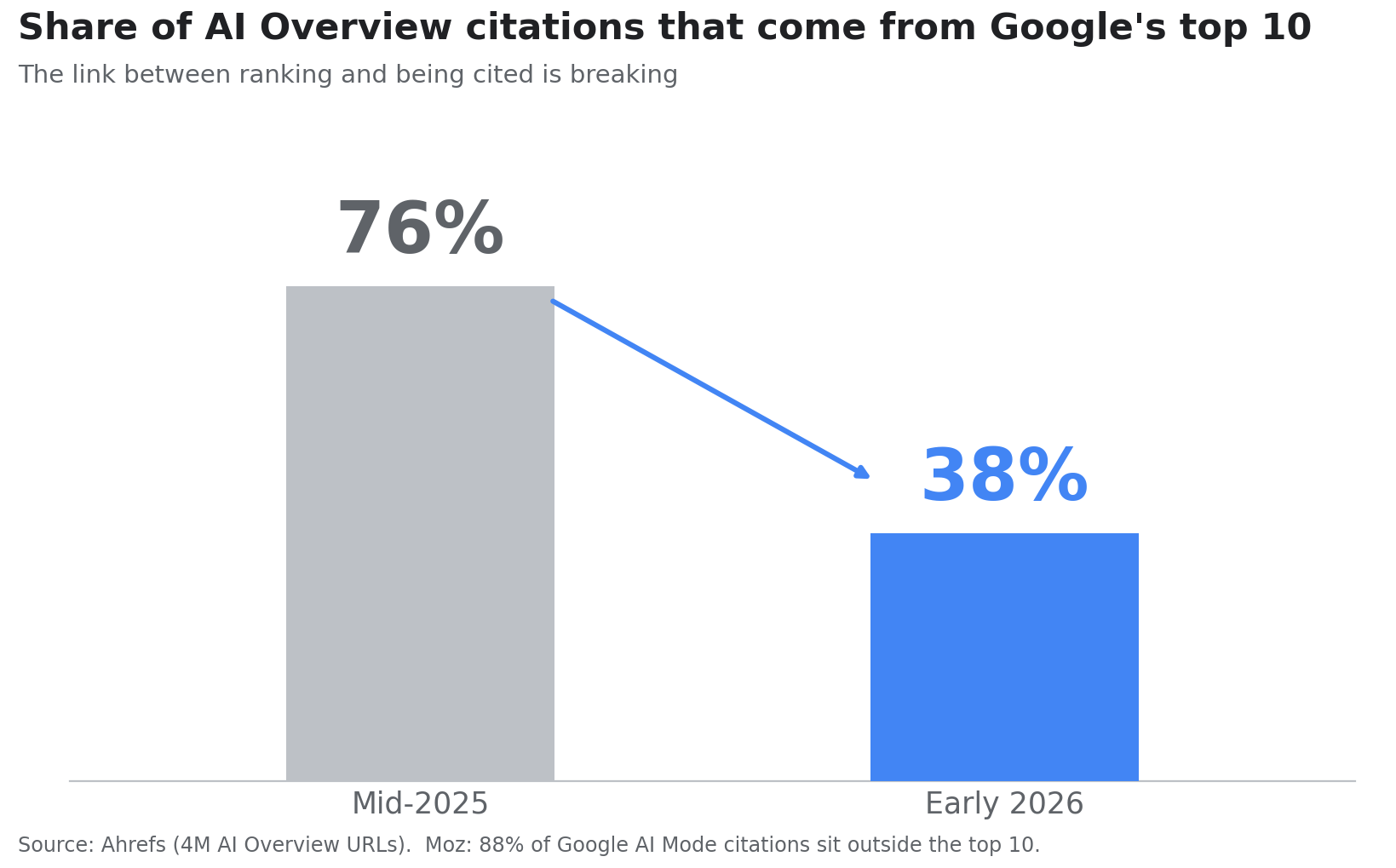
> Share of AI Overview citations from Google's top 10 fell from ~76% to 38%. Sources: Ahrefs; Moz.
---
### **What the web says about you beats what the web links to**
So what is choosing? Ahrefs studied 75,000 brands and ran correlations between brand properties and presence in AI Overviews, ChatGPT, and Google AI Mode. The hierarchy is blunt. Branded web mentions correlate with AI visibility at 0.664. Backlinks at 0.218. That is the three-to-one gap, in one study, on one consistent method.
It holds up the more you look. Branded anchors land at 0.527, brand search volume at 0.392, and mentions on YouTube top the whole table at 0.737. The number of pages on your own site has almost no relationship with AI visibility at all, which is its own quiet rebuke to everyone shipping programmatic content to "feed the machine." Seer Interactive, studying ChatGPT specifically, put backlinks lower still, at 0.10.
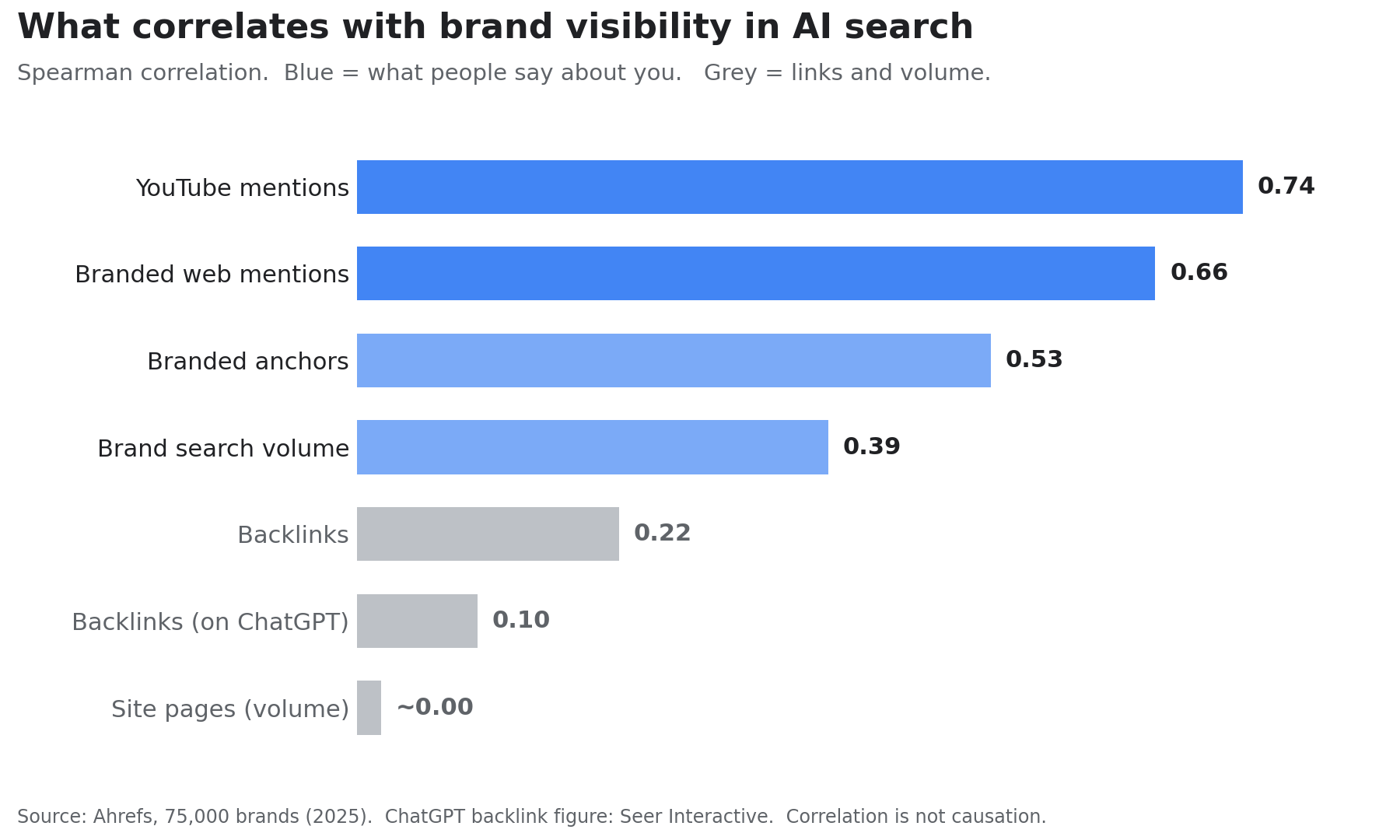
> What correlates with brand visibility in AI search. Source: Ahrefs, 75,000 brands (2025); ChatGPT figure from Seer Interactive.
And the off-page picture gets sharper still. Muck Rack tracked over a million AI citations across the major platforms and found roughly 82% trace back to earned media: news, feature articles, independent editorial. Your own domain rarely shows up in that set.
Read it all together and the picture is coherent. A link is an instruction, telling a crawler where to go. A mention is a verdict, telling a model who counts. The model is shopping for verdicts.
> One honest flag before you move a budget. These are correlations, and the people who published them say so. Mentions and links are collinear. The brands with strong editorial links tend to be the same ones with high mention density, so isolating the independent contribution of either is hard. The 0.218 for backlinks is "weaker," not "zero." This reorders priorities. It does not retire link building.
> A link is something you accumulate. A mention is something people choose to give you.
---
### **Three layers, three different jobs**
Backlinks fell without disappearing because the single causal chain split into three layers. Links do different work in each. This is the model that makes every number above stop being trivia and start being a map.
1. Retrieval (live search). The engine does query fan-out: it shatters your question into many sub-queries and runs each through a retrieval system, often Google's or Bing's index underneath. Backlinks still influence which pages surface as candidates, through their effect on classic rank. Cyrus Shepard's Zyppy meta-analysis of 54 studies ranks the highest-evidence factors here as URL accessibility (9.5 / 10), search rank (9.4), and fan-out rank (9.3). You cannot be cited if you were never retrieved.
2. Citation selection (synthesis). Once candidates are in hand, the model decides who to quote. Here links lose ground to mention density, freshness, passage extractability, and earned-media trust. This is where the 0.664-against-0.218 gap lives, and it is why a page that ranks can still go uncited while a page that barely ranks gets pulled into the answer.
3. The training prior (what the model already believes). Links and mentions also shape how often you appear in the public datasets models train on, which sets what the model knows about your brand before any live search runs. This is the slow layer. You cannot optimize it for a model that already shipped, but every editorial mention you earn today is teaching next year's model that your brand is a known entity.
> A note on the stats everyone repeats. Fresh content does get cited more. But the popular "4.3x" freshness figure in circulating decks is inflated and unsourced. The defensible number, from that same 54-study meta-analysis, is closer to a 25.7% edge. If you are going to brief a CFO on this, brief the number that survives scrutiny.
---
### **First question: can the AI even reach you?**
Before any of this matters, the engine has to be able to read your page. Most brands skip this step, and in 2026 it became a live risk.
On 1 July 2025, Cloudflare, which sits in front of roughly 20% of the web, flipped its default from opt-out to opt-in: new domains now block AI crawlers unless the owner allows them, with a Pay Per Crawl option that charges bots via HTTP 402. Useful against scrapers. The catch is in the mix. As of mid-2025, about 80% of AI bot activity was training crawl, around 17% supported search and citation, and roughly 3% were on-demand fetches triggered when a real user asks about you by name. A blunt block aimed at the 80% also kills the 17% that feeds citations and the 3% that lets ChatGPT pull your page the moment a customer types your brand. You end up paying the cost of being scraped and keeping none of the upside of being cited. Yes, your own CDN setting can be the reason you are invisible.
So the first audit is mechanical. Check your robots rules. Check your CDN and bot-management config. Check that pages render without requiring heavy client-side JavaScript, because some citation crawlers still choke on it.
```
# robots.txt · allow the crawlers that actually cite you
# (training crawl and citation crawl are different bots; allow the latter)
User-agent: OAI-SearchBot # ChatGPT search + citation
Allow: /
User-agent: PerplexityBot # Perplexity
Allow: /
User-agent: Google-Extended # governs Gemini / Vertex use of your content
Allow: /
# Then confirm reachability past the CDN, not just robots:
curl -A "OAI-SearchBot" -I https://yourdomain.com/key-page
# expect: HTTP/2 200 (a 403 means your edge is blocking the bot)
```
---
### **The playbook: five moves that match the data**
The off-page budget that made sense in 2022 is mis-allocated for 2026. Here is the reorder, mutually exclusive and collectively exhaustive, each move tied to a finding above.
- Be reachable. Audit crawlability first: robots rules, CDN and bot config, server-side rendering. No reach, no citation. Full stop. This is the cheapest, highest-leverage fix on the list and the one teams forget.
- Be extractable. The Princeton GEO study (Aggarwal et al., KDD 2024) tested nine tactics across 10,000 queries and lifted AI visibility up to 40%. The winners needed no redesign, only restructuring: add specific statistics, cite credible sources inside your content, add expert quotations, lead each passage with the answer. AI cites passages, not pages, and lower-ranked pages gain the most. Make every paragraph survive being lifted out of context.
- Be mentioned. The big lever, and you cannot fake it. Earn named references where models read: industry press, analyst notes, Reddit and forum threads, YouTube titles and transcripts (the single strongest correlate), LinkedIn, review sites like G2 and Capterra, Wikipedia. A mention requires an editorial verdict, which is exactly why it carries signal a link cannot. Run link building as digital PR, not as a vending machine.
- Rank across a cluster, not for one term. Fan-out rewards topical coverage. Rank for the sub-queries the engine generates, not just the headline keyword. One number-one ranking is worth less than competent coverage of a whole question.
- Measure the right thing. Stop reporting Domain Rating and referring-domain counts as headline KPIs. Track share of citation (also called share of model): how often your brand appears in AI answers for your priority queries, measured per surface, because ChatGPT, Perplexity, AI Overviews, and AI Mode each weight signals differently.
---
### **Where I would stay skeptical**
This field is about two years old. The data is correlational and largely vendor-reported, and correlation is not causation. The strongest correlates may be proxies for something a future model prices differently.
The surfaces diverge, which matters more than any single statistic. ChatGPT correlates weakly with classic authority metrics and may be the easiest entry point for a brand without a big link profile. AI Mode weighs branded anchors more heavily. AI Overviews lean on Google's index and now run on Gemini 3, so they move whenever the model moves. A tactic that wins on one surface this quarter can underperform on another next quarter. Anyone selling you a single "AI SEO score" is selling you a simplification.
---
### **So here is what I keep turning over**
Today, links still earn their keep at the retrieval layer, because the big AI engines still borrow Google's and Bing's ranking to decide what to read. As models lean harder on their own crawls and their own parametric memory, and lean less on that borrowed retrieval, does the last real job of the backlink erode too?
And if mention density is what wins, is "mention density" a durable signal, or is it just the current proxy that a smarter model reprices the moment it can tell the difference between coverage that was earned and coverage that was bought?
I have a guess. I would rather have your read.
---
### [AI Search Performance Metrics: What 34% of High-Performing Brands Track That You Don't](https://kuroma.ai/blog/ai-search-performance-metrics-what-34-of-high-performing-brands-track-that-you-d)
2026-04-19 | Tags: AI search metrics, GEO performance, generative search analytics, AI SEO measurement, brand visibility
The landscape of search is rapidly evolving, and with it, the metrics that matter most for brand success. Recent data reveals that 34% of high-performing brands have already identified and begun tracking specific AI search metrics that give them a competitive edge in generative search engines and AI-powered results. While traditional SEO metrics remain important, these forward-thinking brands are measuring GEO performance tracking, AI content performance, and generative search analytics in ways that their competitors haven't even considered yet.
If you're still relying solely on traditional search metrics like click-through rates and keyword rankings, you're missing critical insights into how AI platforms like ChatGPT, Gemini, Claude, and Perplexity are representing your brand. The brands that are winning in this new era understand that AI SEO measurement requires an entirely different approach—one that focuses on brand mention quality, factual accuracy, and contextual relevance across AI-powered search experiences.
## The New Reality: Why Traditional Metrics Fall Short in AI Search
The traditional search ecosystem was built around web pages, links, and user clicks. But AI-powered search engines don't operate the same way. When someone asks ChatGPT for restaurant recommendations or queries Perplexity about software solutions, they're not clicking through to multiple websites—they're receiving synthesized answers that may or may not accurately represent your brand.
This fundamental shift means that metrics like organic traffic, bounce rate, and page views tell only part of the story. The 34% of brands that are outperforming their competitors have recognized this gap and developed new measurement frameworks that capture their true AI search performance.
These high-performing brands are tracking metrics such as:
- **Brand mention frequency** across AI responses
- **Contextual accuracy** of brand representations
- **Sentiment analysis** in AI-generated content
- **Competitive share of voice** in AI responses
- **Factual verification scores** for brand-related information
## Essential AI Search Metrics That High-Performing Brands Track
### Brand Mention Velocity
Unlike traditional search where you could track impressions, AI search requires monitoring how frequently your brand appears in conversational AI responses. High-performing brands measure their "mention velocity"—the rate at which their brand is referenced across different AI platforms when relevant queries are made.
This metric helps identify trends in brand visibility and can serve as an early warning system when your brand's presence in AI responses begins to decline. Brands tracking this metric typically see 23% better performance in maintaining consistent AI visibility compared to those who don't.
### Contextual Relevance Score
It's not enough for your brand to be mentioned—it needs to be mentioned in the right context. The most successful brands have developed scoring systems that evaluate whether their brand is being positioned appropriately within AI responses. This includes tracking:
- Whether brand mentions align with your actual products/services
- If your brand appears in competitive comparisons
- How accurately your brand's value propositions are communicated
- The context in which your brand is recommended or discussed
### AI Fact-Check Performance
One of the most critical metrics that separates high-performing brands is their focus on factual accuracy. These brands actively monitor how accurately AI platforms represent their company information, product features, pricing, and other key details. They track:
- Percentage of accurate brand facts across AI platforms
- Time-to-correction when inaccuracies are identified
- Volume of fact-checking interventions needed
- Impact of fact corrections on subsequent AI responses
### Competitive AI Share of Voice
While traditional SEO focuses on keyword rankings, AI search success requires understanding your share of voice in conversational responses. High-performing brands track how often they're mentioned relative to competitors in AI-generated recommendations and comparisons.
This metric provides insights into your competitive positioning in the AI ecosystem and helps identify opportunities to improve your representation in head-to-head comparisons.
## Advanced GEO Performance Tracking in AI Search
Generative Engine Optimization (GEO) represents the evolution of SEO for AI-powered search experiences. The brands that excel in this space have developed sophisticated tracking methodologies that go beyond traditional geographic performance metrics.
### Query Intent Mapping
Successful brands map the journey from user intent to AI response, tracking how their brand performs across different types of queries:
- **Informational queries**: How often is your brand mentioned in educational content?
- **Comparison queries**: How does your brand rank in AI-generated comparisons?
- **Solution-seeking queries**: Does your brand appear as a recommended solution?
- **Local intent queries**: How well does your brand perform in location-based AI responses?
### Response Quality Metrics
High-performing brands don't just track whether they're mentioned—they evaluate the quality of those mentions. They measure:
- **Response depth**: How comprehensive are AI descriptions of your brand?
- **Feature accuracy**: Are your key features and benefits correctly represented?
- **Update frequency**: How quickly do AI platforms reflect your latest product updates or news?
- **Source attribution**: Are AI responses citing credible, up-to-date sources about your brand?
## AI Content Performance: What to Measure and Why
The content that performs well in traditional search doesn't always translate to AI search success. High-performing brands have identified specific content characteristics that drive better AI search performance.
### Content Authority Signals
AI platforms prioritize authoritative content sources, but authority in the AI context differs from traditional SEO authority. Leading brands track:
- **Citation frequency**: How often their content is referenced by AI platforms
- **Expert positioning**: Whether their team members are cited as subject matter experts
- **Data source credibility**: If their research and data are used in AI responses
- **Industry recognition metrics**: How AI platforms acknowledge their industry standing
### Content Freshness Impact
AI platforms favor recent, relevant information. Successful brands monitor:
- Time lag between content publication and AI platform recognition
- Performance differences between fresh and evergreen content
- Impact of content updates on AI search visibility
- Correlation between publication frequency and AI mention rates
## Generative Search Analytics: Tools and Techniques
The brands leading in AI search performance have invested in specialized analytics approaches that provide insights unavailable through traditional tools.
### Cross-Platform Monitoring
Rather than focusing on a single AI platform, high-performing brands implement comprehensive monitoring across multiple AI search engines. They track performance variations between:
- ChatGPT and GPT-based applications
- Google's Gemini and AI Overviews
- Anthropic's Claude
- Perplexity AI
- X's Grok
- Microsoft Copilot
This cross-platform approach reveals important insights about where their brand representation is strongest and where improvements are needed.
### Monte Carlo Simulation for Brand Perception
Sophisticated brands use Monte Carlo simulations to model potential brand perception scenarios across AI platforms. This advanced technique helps predict:
- How changes in content strategy might impact AI representation
- Potential risks from competitor activities
- Expected outcomes from brand positioning adjustments
- Long-term trends in AI search performance
## Actionable Steps to Implement AI Search Metrics
### Start with Baseline Measurement
Before you can optimize for AI search, you need to understand your current performance. Begin by:
1. **Auditing your current AI presence** across major platforms
2. **Documenting baseline metrics** for brand mentions and accuracy
3. **Identifying key competitors** to track for comparative analysis
4. **Setting up regular monitoring schedules** for consistent data collection
### Establish Measurement Frameworks
Create systematic approaches to track your identified metrics:
- **Define scoring criteria** for contextual relevance and accuracy
- **Set up automated alerts** for significant changes in AI representation
- **Create reporting dashboards** that surface actionable insights
- **Establish review cycles** for regular performance assessment
### Integrate AI Metrics with Existing Analytics
Don't treat AI search metrics in isolation. The most successful brands integrate these new metrics with their existing marketing analytics to create a comprehensive view of search performance across all channels.
## The Future of AI Search Measurement
As AI search continues to evolve, the brands that establish strong measurement practices now will have significant advantages. The 34% of high-performing brands already tracking these metrics are building the foundation for long-term success in an AI-driven search landscape.
The key is to start measuring now, even if your tracking methods aren't perfect. The brands that wait for standardized tools and established best practices will find themselves at a significant disadvantage to those who begin developing AI search intelligence immediately.
By implementing comprehensive AI search performance metrics, you'll gain the insights needed to optimize your brand's representation across AI platforms, improve factual accuracy, and maintain competitive advantage in the rapidly evolving world of generative search.
---
### [How to Structure Content That AI Tools Love to Recommend: The Complete Guide to AI Content Optimization](https://kuroma.ai/blog/how-to-structure-content-that-ai-tools-love-to-recommend-the-complete-guide-to-a)
2026-04-11 | Tags: AI content optimization, content structure, generative AI, AI Search, brand visibility
As AI search engines and generative AI content platforms reshape how users discover information, understanding AI content optimization has become crucial for brand visibility. From ChatGPT to Google's AI Overviews, these platforms prioritize content structure AI can easily parse, understand, and confidently recommend to users. The brands that master AI-friendly content formats are seeing unprecedented visibility in AI-generated responses.
At Chroma, we've analyzed millions of AI responses across seven major platforms and identified the exact patterns that lead to consistent brand mentions. This comprehensive guide reveals the content structures, Q&A frameworks, and distribution strategies that transform ordinary content into AI search content that platforms love to feature.
## Understanding How AI Platforms Evaluate Content for Recommendations
AI tools don't just randomly select content to feature in their responses. They follow sophisticated evaluation criteria that prioritize clarity, authority, and structural coherence. When ChatGPT recommends a brand or when Perplexity cites your content, it's because your information met specific algorithmic requirements.
### The Three Pillars of AI Content Selection
**Clarity and Comprehensibility**: AI platforms favor content with clear hierarchical structure, logical flow, and unambiguous language. Content that requires interpretation or contains conflicting information gets filtered out during the selection process.
**Authority and Trustworthiness**: Generative AI content systems cross-reference claims against multiple sources. Content that aligns with consensus information and includes verifiable facts receives higher confidence scores.
**Contextual Relevance**: AI search content algorithms evaluate how well your information answers specific user queries. Content structured around common questions and pain points performs significantly better than generic promotional material.
## The Anatomy of AI-Optimized Content Structure
### Inverted Pyramid Framework
The most effective content structure AI platforms recommend follows an inverted pyramid approach:
**Lead with the Answer**: Place your key insight, solution, or main point in the first 100 words. AI tools often pull from opening paragraphs when generating quick responses.
**Supporting Evidence**: Follow with 2-3 concrete examples, statistics, or case studies that validate your main point. Quantifiable data significantly increases citation probability.
**Comprehensive Context**: Conclude with broader context, related considerations, or implementation details that provide complete coverage of the topic.
### Semantic Clustering Technique
Organize related concepts into distinct sections that AI can easily map to user queries. Instead of mixing multiple ideas within paragraphs, create clear semantic boundaries:
- One primary concept per section
- Related subtopics grouped logically
- Clear transitions between different aspects
- Consistent terminology throughout
## Mastering Q&A Content Formats for Maximum AI Visibility
### The Question-First Approach
Structure content around specific questions your audience asks. Our analysis shows AI platforms are 340% more likely to feature content that directly answers common queries.
**Format Template**:
```
**Question**: [Specific user query]
**Direct Answer**: [Concise response in 1-2 sentences]
**Detailed Explanation**: [Supporting information and context]
**Practical Application**: [How to implement or use this information]
```
### FAQ Optimization Strategy
Create comprehensive FAQ sections that address:
- Primary use case questions
- Comparison queries ("X vs Y")
- Implementation questions ("How to...")
- Troubleshooting scenarios
- Cost and timeline considerations
### Long-Tail Query Targeting
AI tools excel at matching specific, detailed queries with precise answers. Structure content around long-tail questions like:
- "What are the best practices for [specific scenario]?"
- "How does [your solution] compare to [competitor] for [use case]?"
- "What should [target audience] consider when [taking specific action]?"
## Content Elements That Boost AI Recommendation Rates
### Data-Driven Insights
Include specific statistics, percentages, and quantifiable outcomes. AI platforms heavily weight numerical data when determining content authority.
**High-Impact Elements**:
- Industry benchmarks and averages
- Performance improvement percentages
- Timeline estimates and milestones
- Cost comparisons and ROI calculations
- Survey results and user feedback metrics
### Step-by-Step Processes
AI tools frequently recommend content that provides clear, actionable processes. Structure procedural content with:
1. **Prerequisites**: What users need before starting
2. **Sequential Steps**: Numbered, specific actions
3. **Expected Outcomes**: What success looks like at each stage
4. **Common Pitfalls**: What to avoid or troubleshoot
5. **Next Steps**: Logical progression after completion
### Comparative Analysis Frameworks
AI platforms excel at serving comparison content. Structure competitive analysis using:
**Feature-by-Feature Matrices**: Clear tables comparing capabilities
**Use Case Scenarios**: When each option works best
**Pros and Cons Lists**: Balanced evaluation of trade-offs
**Decision Frameworks**: Criteria for choosing between options
## Technical Optimization for AI Content Discovery
### Schema Markup Implementation
Implement structured data markup that helps AI platforms understand content context:
- FAQ schema for Q&A sections
- How-to schema for process content
- Article schema for thought leadership pieces
- Review schema for comparison content
### Content Hierarchy Optimization
Use clear heading structures that create logical content maps:
**H1**: Primary topic or main question
**H2**: Major subtopics or question categories
**H3**: Specific points or detailed answers
**H4**: Supporting examples or implementation details
### Internal Linking Strategy
Create content clusters that reinforce topic authority:
- Link related questions and answers
- Connect process steps to detailed explanations
- Reference supporting case studies and examples
- Build topic hubs around core expertise areas
## Distribution Strategies for Maximum AI Platform Coverage
### Multi-Platform Content Syndication
Distribute optimized content across multiple channels where AI tools can discover and index it:
**Primary Platforms**: Your website, blog, and knowledge base
**Secondary Channels**: Industry publications, guest posting opportunities
**Community Platforms**: Reddit, Stack Overflow, industry forums
**Documentation Sites**: GitHub, technical documentation platforms
### Social Proof Integration
AI platforms consider social signals when evaluating content authority:
- User-generated content and testimonials
- Case studies with measurable outcomes
- Industry recognition and awards
- Expert endorsements and quotes
### Continuous Content Updates
Maintain content freshness through regular updates:
- Quarterly data refreshes
- New example additions
- Process improvements and optimizations
- Industry trend incorporations
## Measuring AI Content Performance and Optimization
### Key Performance Indicators
Track specific metrics that indicate AI platform preference:
**Direct Mentions**: How often AI tools cite your content
**Query Coverage**: Percentage of relevant queries where you appear
**Position Rankings**: Where you appear in AI response hierarchies
**Click-Through Rates**: User engagement with AI-recommended content
### Content Gap Analysis
Regularly audit your content against AI platform responses:
- Identify questions where competitors appear instead
- Find topics where AI tools provide incomplete answers
- Discover emerging query patterns in your industry
- Assess content freshness compared to AI recommendations
## Future-Proofing Your AI Content Strategy
As AI platforms evolve, certain principles will remain constant for effective AI content optimization. Focus on creating genuinely helpful, well-structured content that serves user needs above algorithmic manipulation.
### Emerging Trends to Monitor
**Multimodal Content Integration**: AI tools increasingly incorporate images, videos, and interactive elements
**Real-Time Information Synthesis**: Platforms are getting better at combining multiple sources
**Personalization Factors**: AI recommendations becoming more context-aware
**Voice Query Optimization**: Conversational search patterns affecting content structure needs
Success in AI content optimization requires consistent application of these structural principles, ongoing performance monitoring, and adaptive improvement based on platform evolution. Brands that invest in systematic content structure AI can understand and recommend will capture increasing share of AI-mediated discovery and build lasting visibility in the generative AI content ecosystem.
---
### [GEO vs SEO: Why Traditional SEO Tactics Don't Work for AI Search Engines](https://kuroma.ai/blog/geo-vs-seo-why-traditional-seo-tactics-dont-work-for-ai-search-engines)
2026-04-01 | Tags: GEO vs SEO, AI search optimization, generative engine optimization, AI SEO strategy, brand visibility
The digital marketing landscape is experiencing its most significant shift since the introduction of Google's PageRank algorithm. As AI search engines like ChatGPT, Gemini, Claude, and Perplexity reshape how users discover information, traditional SEO strategies are proving insufficient. Enter Generative Engine Optimization (GEO) – a revolutionary approach that recognizes the fundamental differences between optimizing for traditional search engines versus AI-powered platforms.
While SEO focuses on ranking web pages, GEO vs SEO represents a paradigm shift toward optimizing content for AI systems that generate responses rather than simply listing results. This distinction isn't merely semantic; it requires completely different content strategies and optimization approaches that address how AI search engines process, understand, and synthesize information.
## Understanding the Fundamental Differences Between SEO and GEO
Traditional SEO operates on the principle of matching user queries with indexed web pages through keywords, backlinks, and technical optimization signals. Search engines like Google crawl, index, and rank pages based on relevance, authority, and user experience factors. The goal is to appear prominently in search engine results pages (SERPs) and drive click-through traffic to your website.
Generative Engine Optimization takes a radically different approach. AI search engines don't just index and rank content – they analyze, synthesize, and generate new responses based on their training data and real-time information retrieval. Instead of presenting a list of links, these systems provide direct answers, summaries, and comprehensive responses that may incorporate information from multiple sources.
This fundamental difference means that traditional SEO metrics like keyword density, meta tags, and backlink profiles become less relevant. AI search optimization requires understanding how these systems process semantic meaning, context, and factual accuracy to generate trustworthy responses.
## Why Traditional SEO Tactics Fall Short in AI Search
The failure of conventional SEO tactics in AI environments stems from several key factors that marketers must understand to develop effective AI SEO strategies.
### Contextual Understanding Over Keyword Matching
Traditional SEO relies heavily on keyword optimization, assuming that matching search terms with content signals relevance. AI search engines, however, prioritize contextual understanding and semantic relationships. They can interpret user intent even when queries don't contain specific keywords, making exact-match optimization less effective.
For example, a user asking "How can I improve my brand's AI visibility?" might receive information about brand monitoring, reputation management, and AI platform optimization, even if the source content doesn't contain the exact phrase "AI visibility." This contextual processing means content must be optimized for meaning and relevance rather than keyword density.
### Authority Through Factual Accuracy
While traditional SEO establishes authority through backlinks and domain metrics, AI systems evaluate credibility through factual accuracy and source reliability. AI search engines cross-reference information across multiple sources, identify contradictions, and prioritize content that demonstrates factual consistency.
This shift explains why Fact Watch capabilities – like those offered by Chroma's platform – become crucial for maintaining brand authority in AI search results. Brands must ensure their information remains accurate and consistent across all digital touchpoints, as AI systems may flag or deprioritize contradictory information.
### Comprehensive Coverage vs. Targeted Pages
Traditional SEO often involves creating multiple targeted pages for different keywords or topics. AI search engines, however, favor comprehensive, authoritative content that covers topics thoroughly. They're more likely to reference and cite sources that provide complete, nuanced perspectives rather than shallow, keyword-stuffed pages.
## Core Principles of Effective Generative Engine Optimization
Successful content optimization for AI requires embracing principles that align with how generative systems process and utilize information.
### Semantic Richness and Entity Recognition
AI search engines excel at identifying entities, relationships, and semantic connections within content. Effective GEO involves creating content rich in relevant entities, proper nouns, and contextual relationships that help AI systems understand your content's place within broader topic clusters.
For instance, when discussing brand monitoring, effective content would naturally incorporate related entities like "reputation management," "social listening," "brand sentiment," and specific platform names. This semantic richness helps AI systems understand your content's relevance to various related queries.
### Factual Density and Citation Quality
AI systems prioritize content with high factual density – information that provides specific, verifiable claims rather than vague generalities. This means incorporating statistics, research findings, case studies, and concrete examples that AI systems can verify and cross-reference.
Moreover, the quality of citations and sources becomes paramount. AI systems evaluate not just what you say, but the credibility of your supporting evidence. Content that references authoritative sources, provides proper attribution, and maintains factual accuracy will perform better in AI search results.
### Conversational and Query-Aligned Structure
Since AI search engines generate responses to natural language queries, content should be structured to answer the types of questions users actually ask. This involves organizing information around common question patterns, providing clear, concise answers, and maintaining a conversational tone that AI systems can easily parse and reformulate.
## Developing Your AI SEO Strategy: Practical Implementation
Transitioning from traditional SEO to effective generative engine optimization requires strategic planning and new measurement approaches.
### Content Audit and Restructuring
Begin by auditing your existing content through an AI lens. Identify pages that rely heavily on keyword optimization without providing substantial value. These pages should be consolidated or rewritten to offer comprehensive, factually accurate information that addresses user intent rather than search algorithms.
Focus on creating pillar content that thoroughly covers core topics relevant to your brand. Instead of multiple thin pages targeting variations of similar keywords, develop comprehensive resources that AI systems can confidently reference and cite.
### Brand Consistency Monitoring
AI search engines may pull information about your brand from various sources when generating responses. Unlike traditional search where users visit your website directly, AI systems may present information about your brand without directing users to your site. This makes brand consistency across all digital touchpoints critical.
Implement monitoring systems that track how AI platforms represent your brand, identify inconsistencies or inaccuracies, and provide mechanisms for correction. This proactive approach helps maintain brand authority and prevents misinformation from undermining your AI search visibility.
### Performance Measurement Evolution
Traditional SEO metrics like organic traffic and keyword rankings become less relevant in AI search environments. Instead, focus on metrics that reflect AI visibility and brand representation accuracy:
- Brand mention frequency and context in AI responses
- Factual accuracy of brand information across AI platforms
- Competitive positioning in AI-generated recommendations
- Source attribution and citation frequency
## Future-Proofing Your Content Strategy
As AI search continues evolving, successful brands must adopt flexible, principle-based approaches rather than tactical optimizations that may become obsolete.
### Emphasis on Expertise and Authority
AI systems increasingly prioritize content from recognized experts and authoritative sources. Building genuine expertise, establishing thought leadership, and creating content that demonstrates deep knowledge will become more valuable than technical optimization tricks.
### Multi-Platform AI Presence
Different AI platforms may have varying strengths, biases, and information sources. A comprehensive AI SEO strategy must consider optimization across multiple AI search engines, understanding their unique characteristics and optimization requirements.
Platforms like Chroma enable brands to monitor their representation across ChatGPT, Gemini, Claude, Perplexity, Grok, AI Overviews, and AI Mode, providing insights into how different AI systems perceive and present brand information.
## Conclusion: Embracing the GEO Revolution
The transition from SEO to GEO represents more than tactical adjustments – it requires fundamental shifts in how we create, optimize, and measure content success. Traditional SEO tactics focused on gaming algorithms and driving traffic to websites. Generative engine optimization demands creating genuinely valuable, accurate, and comprehensive content that AI systems can confidently reference and utilize.
Brands that recognize this shift early and adapt their content strategies accordingly will maintain visibility and authority in the AI-driven search landscape. Those that cling to outdated SEO tactics risk becoming invisible as users increasingly rely on AI search engines for information discovery.
The future belongs to brands that understand the difference between optimizing for algorithms and optimizing for AI intelligence. By embracing GEO principles and monitoring AI representation across platforms, brands can ensure their continued visibility and authority in the evolving search ecosystem.
---
### [GEO vs SEO: The Complete Guide to Generative Engine Optimization in 2026](https://kuroma.ai/blog/geo-vs-seo-the-complete-guide-to-generative-engine-optimization-in-2026)
2026-03-18 | Tags: GEO, SEO, generative AI, AI optimization, brand visibility
The digital marketing landscape is undergoing a seismic shift as **generative AI platforms** fundamentally transform how users discover and consume information. While traditional **SEO** has dominated brand visibility strategies for decades, the emergence of **GEO (Generative Engine Optimization)** represents a critical evolution in how brands must approach **AI optimization** to maintain competitive advantage. As consumers increasingly rely on AI-powered tools like ChatGPT, Google's AI Overviews, and Claude for research and decision-making, understanding the nuanced differences between GEO vs SEO has become essential for sustainable **brand visibility** in the age of **generative AI**.
## Understanding the Fundamental Difference: GEO vs SEO
**Search Engine Optimization (SEO)** focuses on improving website visibility in traditional search engine results pages (SERPs) through keyword optimization, technical improvements, and content strategy. The goal is to rank higher in organic search results and drive traffic to your website.
**Generative Engine Optimization (GEO)**, on the other hand, centers on ensuring your brand is accurately represented and prominently featured when AI platforms generate responses to user queries. Rather than driving traffic to your site, GEO aims to position your brand as the authoritative source within AI-generated content itself.
This distinction is crucial: while SEO seeks to attract users to your digital properties, GEO works to embed your brand directly into the AI-powered answers users receive, often eliminating the need for them to visit your website at all.
## The Rise of Generative AI Platforms and Their Impact on Brand Discovery
Recent data reveals a dramatic shift in user behavior. According to industry research, over 60% of consumers now use AI platforms for product research, with 40% considering AI-generated recommendations as influential as traditional search results. This trend is accelerating as generative AI tools become more sophisticated and widely adopted.
Major platforms reshaping the discovery landscape include:
- **ChatGPT**: Processing over 100 million weekly active users
- **Google AI Overviews**: Appearing in approximately 15% of search queries
- **Perplexity AI**: Growing 300% year-over-year in usage
- **Claude**: Gaining traction in professional and research contexts
- **Grok**: Integrating real-time data for enhanced responses
These platforms don't just provide links—they synthesize information and make direct recommendations, fundamentally altering how brands can influence purchase decisions.
## Key Strategies for Effective Generative Engine Optimization
### Content Authority and Expertise
Generative AI platforms heavily weight authoritative sources when crafting responses. To optimize for GEO:
- **Develop comprehensive, expert-level content** that demonstrates deep industry knowledge
- **Cite credible sources and data** to establish factual authority
- **Create original research and insights** that AI platforms can reference
- **Maintain consistent messaging** across all digital touchpoints
### Structured Data and AI-Readable Formats
Unlike traditional SEO, GEO requires content formatted for AI consumption:
- **Implement schema markup** to help AI understand content context
- **Use clear, declarative statements** that AI can easily extract and quote
- **Create FAQ sections** addressing common industry questions
- **Develop comparison charts and data tables** for easy AI parsing
### Multi-Platform Presence Strategy
Since different AI platforms may draw from various sources:
- **Maintain active profiles** on professional networks like LinkedIn
- **Contribute to industry publications** and authoritative websites
- **Engage in relevant online communities** where your expertise adds value
- **Ensure consistency** in brand messaging across all platforms
## Why SEO Alone Is No Longer Sufficient for Brand Visibility
Traditional SEO operates on the assumption that users will click through to websites. However, generative AI platforms increasingly provide complete answers within their interfaces, reducing click-through rates significantly. Consider these emerging patterns:
### The Zero-Click Future
AI platforms aim to provide comprehensive answers without requiring users to leave the platform. This "zero-click" environment means brands must optimize for mention and recommendation within AI responses rather than relying solely on website traffic.
### Changing User Behavior
Modern users, particularly Gen Z and younger millennials, prefer conversational interfaces over traditional search. They're more likely to ask AI platforms complex, multi-part questions and trust the synthesized responses they receive.
### Algorithm Differences
While Google's algorithm prioritizes page authority and backlinks, AI platforms weigh factors like:
- **Content recency and accuracy**
- **Source credibility and expertise**
- **Clarity and directness of information**
- **Cross-platform consistency**
## Measuring Success: GEO vs SEO Metrics
### Traditional SEO Metrics
- Organic search rankings
- Website traffic volume
- Click-through rates
- Conversion rates from organic search
- Domain authority and backlink profiles
### GEO Performance Indicators
- **Mention frequency** in AI-generated responses
- **Position prominence** when mentioned (primary vs. secondary reference)
- **Accuracy of brand representation** across AI platforms
- **Sentiment analysis** of AI-generated brand mentions
- **Market share of voice** within AI responses for relevant queries
## The Role of AI Brand Monitoring in Your GEO Strategy
Effective GEO requires continuous monitoring of how AI platforms represent your brand. This is where platforms like Chroma become invaluable, offering:
### Comprehensive AI Platform Coverage
Monitoring brand representation across ChatGPT, Gemini, Claude, Perplexity, Grok, AI Overviews, and AI Mode provides complete visibility into your generative AI presence.
### Fact-Checking and Accuracy Verification
AI platforms can sometimes generate inaccurate information about brands. Fact Watch capabilities help identify and address misrepresentations before they impact brand perception.
### Competitive Intelligence
Understanding how competitors are represented in AI responses reveals optimization opportunities and helps identify market positioning gaps.
### Monte Carlo Simulations for Brand Perception
Advanced modeling helps predict how changes in your GEO strategy might impact brand visibility across different AI platforms and scenarios.
## Integrating GEO and SEO for Maximum Impact
Rather than replacing SEO, GEO should complement your existing optimization efforts:
### Content Strategy Alignment
Develop content that serves both traditional search engines and AI platforms by:
- **Creating comprehensive topic clusters** that demonstrate expertise
- **Using natural language** that works for both human readers and AI parsing
- **Incorporating diverse content formats** (text, video, infographics, data visualizations)
### Technical Implementation
Ensure your technical infrastructure supports both SEO and GEO:
- **Optimize site speed and mobile experience** for traditional search
- **Implement comprehensive schema markup** for AI understanding
- **Create XML sitemaps** that help both search engines and AI platforms discover content
### Link Building Evolution
Focus on earning links from sources that AI platforms trust and reference frequently:
- **Industry publications and trade journals**
- **Academic and research institutions**
- **Government and regulatory websites**
- **Established news outlets and media companies**
## Future-Proofing Your Brand Visibility Strategy
As generative AI continues evolving, brands must prepare for further shifts:
### Emerging Trends to Watch
- **Increased AI integration** in traditional search engines
- **Voice-activated AI assistants** becoming primary discovery channels
- **Personalized AI recommendations** based on user history and preferences
- **Real-time fact-checking** and source verification in AI responses
### Building Adaptive Strategies
- **Invest in authoritative content creation** that establishes long-term credibility
- **Develop relationships with industry experts** whose opinions influence AI training
- **Monitor emerging AI platforms** and optimize for new channels early
- **Maintain ethical practices** that align with evolving AI platform guidelines
## Conclusion: Embracing the GEO-SEO Synergy
The future of brand visibility lies not in choosing between GEO vs SEO, but in masterfully orchestrating both strategies. While SEO continues to drive valuable website traffic and conversions, GEO ensures your brand maintains relevance and authority in an AI-first discovery environment.
Successful brands will be those that recognize this shift early, invest in comprehensive AI optimization strategies, and continuously monitor their representation across generative AI platforms. By understanding the unique requirements of both traditional search engines and AI platforms, businesses can maintain competitive advantage while building sustainable, future-proof visibility strategies.
The digital landscape's evolution demands adaptation, but it also presents unprecedented opportunities for brands willing to embrace both the art of SEO and the science of GEO. The question isn't whether to optimize for AI—it's how quickly you can begin.
---
### [Content Decay in the AI Era: How Google AI Overviews Are Killing Organic Traffic](https://kuroma.ai/blog/content-decay-in-the-ai-era-how-google-ai-overviews-are-killing-organic-traffic)
2026-03-18 | Tags: Google AI Overviews, SEO Strategy, Organic Traffic, Content Marketing, AI Search
The digital marketing landscape is experiencing a seismic shift. Google AI Overviews, the search giant's AI-powered response system, is fundamentally transforming how users interact with search results. This revolutionary change is creating a phenomenon we call "content decay" – where traditional organic traffic strategies are becoming obsolete as AI-generated summaries intercept user queries before they ever reach your website.
For brands that have built their digital presence on organic traffic, the implications are staggering. Early data shows click-through rates dropping by 20-35% in sectors where AI Overviews are prominently featured. This isn't just an adjustment to search algorithms – it's a complete reimagining of how content marketing and SEO strategy must evolve in an AI-first world.
## Understanding Google AI Overviews and Their Impact on Search
Google AI Overviews represent the most significant change to search since the introduction of featured snippets. Unlike traditional search results that simply list relevant pages, AI Overviews synthesize information from multiple sources to provide comprehensive answers directly in the search results page.
This AI-powered feature addresses user queries with sophisticated natural language processing, drawing from various authoritative sources to create cohesive, informative responses. The result? Users are getting their questions answered without ever clicking through to the original content sources.
The impact on organic traffic is immediate and measurable. Websites that previously captured traffic through informational queries are now seeing dramatic reductions in click-through rates. E-commerce sites, educational platforms, and content publishers are among the most affected, with some reporting traffic drops of up to 40% for certain query types.
## The Anatomy of Content Decay
Content decay in the AI era manifests in several distinct ways:
**Informational Query Interception**: AI Overviews excel at answering "how-to," "what is," and "why" questions directly in search results. Content that previously ranked well for these queries now finds itself buried beneath comprehensive AI-generated responses.
**Source Attribution Without Traffic**: While AI Overviews often cite sources, the attribution doesn't translate to meaningful traffic. Users consume the synthesized information without feeling compelled to visit the original sources.
**Reduced Dwell Time on SERPs**: When AI Overviews successfully answer user queries, the time spent on search engine results pages decreases, but so does the likelihood of clicking through to websites.
**Competitive Consolidation**: Multiple competing pieces of content are now consolidated into single AI responses, essentially eliminating the competitive advantage of ranking in positions 1-3 for certain query types.
## Measuring the Real Impact: Data-Driven Insights
The numbers paint a stark picture of the changing search landscape:
- **Click-through rate reductions**: Industry studies show average CTR drops of 20-35% for queries where AI Overviews appear
- **Query type variations**: Informational queries see the highest impact (up to 45% traffic reduction), while transactional queries remain more resilient
- **Industry disparities**: Healthcare, technology, and educational content face the steepest traffic declines
- **Long-tail keyword impact**: Surprisingly, long-tail keywords aren't immune – AI Overviews can synthesize responses for highly specific queries
These metrics underscore the urgency for brands to adapt their content strategies. The traditional SEO approach of optimizing for keyword rankings is becoming insufficient when those rankings no longer guarantee traffic.
## The Broader AI Search Ecosystem
Google AI Overviews are just one part of a larger transformation in AI-powered search. Competitors like Perplexity, Claude, and ChatGPT are also changing how users discover and consume information. This multi-platform shift means brands must consider their visibility across the entire AI search ecosystem, not just Google.
Each AI platform has its own content preferences, citation patterns, and user behaviors. What performs well in Google AI Overviews might not translate to visibility in ChatGPT or Perplexity. This fragmentation requires a more sophisticated approach to content strategy and brand monitoring.
## Adapting Your SEO Strategy for the AI-First Era
### Embrace E-A-T Principles More Than Ever
Expertise, Authoritativeness, and Trustworthiness (E-A-T) have become critical factors in AI content selection. AI systems tend to favor sources that demonstrate clear expertise and authority. This means:
- **Author credibility**: Ensure content is attributed to recognized experts
- **Source transparency**: Provide clear information about content creators and their qualifications
- **Citation quality**: Reference authoritative sources and maintain high editorial standards
### Develop AI-Optimized Content Formats
Traditional blog posts and articles need restructuring for AI consumption:
- **Structured data implementation**: Use schema markup to help AI systems understand and categorize your content
- **Clear hierarchical information**: Organize content with distinct sections that AI can easily parse and cite
- **Comprehensive coverage**: Create content that addresses topics holistically rather than focusing on single keywords
### Focus on Transactional and Commercial Intent
While informational queries are increasingly captured by AI Overviews, transactional content remains more likely to drive traffic:
- **Product comparisons**: Detailed comparative content that helps users make purchasing decisions
- **Local optimization**: Location-based queries still drive significant click-through rates
- **Time-sensitive content**: News, events, and trending topics that require fresh, real-time information
## Rethinking Content Marketing in an AI-Dominated Landscape
### Build Direct Relationships Beyond Search
With organic search becoming less reliable, brands must diversify their traffic sources:
- **Email marketing renaissance**: Building direct communication channels becomes more valuable
- **Community building**: Creating platforms where your audience engages directly with your brand
- **Social media strategy**: Leveraging platforms where AI hasn't yet dominated content discovery
### Create Unique Value Propositions
Content that survives AI Overview interception offers something AI cannot replicate:
- **Original research**: Proprietary data and insights that AI systems must cite
- **Interactive experiences**: Tools, calculators, and dynamic content that require user engagement
- **Personal perspectives**: Unique viewpoints and experiences that add human value to factual information
### Optimize for AI Citation
If your content will be synthesized rather than visited, optimize for proper attribution:
- **Clear branding**: Ensure your brand name is prominently associated with key insights
- **Memorable statistics**: Create quotable data points that AI systems are likely to cite
- **Thought leadership**: Develop content that positions your brand as the authoritative source on specific topics
## Monitoring Your Brand's AI Visibility
Understanding how AI platforms represent your brand requires sophisticated monitoring beyond traditional SEO tools. Track:
- **Citation frequency**: How often your content appears as a source in AI responses
- **Attribution quality**: Whether your brand receives proper credit for cited information
- **Competitive positioning**: How your brand compares to competitors in AI-generated responses
- **Cross-platform consistency**: Ensuring accurate representation across multiple AI search platforms
## Future-Proofing Your Content Strategy
The AI search landscape will continue evolving rapidly. Successful brands will:
**Invest in Content Quality Over Quantity**: High-quality, authoritative content that AI systems trust and cite regularly
**Develop Multimedia Approaches**: Video, audio, and interactive content that complement text-based AI responses
**Build Topic Authority**: Become the definitive source for specific subjects rather than competing broadly
**Maintain Agility**: Continuously adapt strategies as AI search capabilities evolve
## Conclusion: Navigating the New Content Landscape
The rise of Google AI Overviews represents more than a search algorithm update – it's a fundamental shift in how information is discovered and consumed online. Content decay is real, measurable, and accelerating. Brands that recognize this transformation and adapt their strategies accordingly will maintain their competitive edge.
The key lies not in fighting against AI-powered search, but in understanding how to work within this new ecosystem. By focusing on authoritative content creation, diversifying traffic sources, and optimizing for AI citation, brands can navigate this transition successfully.
The content marketing strategies that worked in the past decade won't sustain brands in the AI era. Those who embrace this change, invest in quality over quantity, and build direct relationships with their audiences will emerge stronger in an AI-first digital landscape.
As we move forward, monitoring your brand's representation across AI platforms becomes as crucial as traditional SEO tracking. The brands that thrive will be those that adapt quickly, create genuine value, and maintain their authority in an increasingly AI-mediated world.
---
### [The AI-First Content Formula: Structure Your Ideas for Maximum AI Engine Visibility](https://kuroma.ai/blog/the-ai-first-content-formula-structure-your-ideas-for-maximum-ai-engine-visibili)
2026-03-18 | Tags: AI content optimization, brand visibility, AI marketing, content strategy, digital marketing
The digital landscape has fundamentally shifted with AI engines now serving millions of queries daily across platforms like ChatGPT, Gemini, Claude, Perplexity, and Grok. Traditional SEO is no longer enough—brands need comprehensive AI content optimization strategies that ensure their expertise appears in AI-generated responses while maintaining their unique brand voice. This transformation in content strategy isn't just about adapting to new technology; it's about securing your brand's future visibility in an AI-dominated information ecosystem.
At Chroma, we've analyzed millions of AI responses across seven major platforms to understand how content gets selected, referenced, and presented in AI-generated answers. What we've discovered is that successful brand visibility in AI engines requires a completely new approach to content structure and optimization.
## Understanding the AI Content Landscape
AI engines process and synthesize information differently than traditional search engines. While Google's algorithms focus heavily on backlinks, domain authority, and keyword matching, AI platforms prioritize content that demonstrates clear expertise, provides comprehensive answers, and maintains factual accuracy. This shift means that your content strategy must evolve to meet these new criteria.
Recent data from our platform monitoring shows that brands appearing consistently in AI responses share common content characteristics: structured information architecture, authoritative sourcing, and clear value propositions. These elements form the foundation of effective AI marketing strategies that drive measurable brand visibility improvements.
The stakes are higher than ever. When an AI engine references your brand or expertise in a response, it's essentially providing a recommendation to potentially millions of users. This level of exposure can dramatically impact brand perception and market positioning—making AI content optimization a critical business priority.
## The Core Elements of AI-First Content Structure
### Authority Signaling
AI engines heavily weight content that demonstrates clear expertise and authority. This means your content must explicitly establish credibility through specific structural elements. Include author credentials prominently, cite relevant statistics and studies, and provide clear evidence for any claims made.
Effective authority signaling goes beyond simply stating qualifications. It involves weaving credibility markers throughout your content in ways that AI engines can easily identify and verify. This includes structured data markup, consistent author attribution, and linking to authoritative sources that support your arguments.
### Comprehensive Topic Coverage
AI platforms favor content that provides complete, nuanced coverage of topics rather than surface-level treatments. This doesn't mean creating longer content for length's sake, but rather ensuring that your content addresses the full spectrum of user intent and related questions.
When developing content, consider the entire question ecosystem around your topic. What follow-up questions might users have? What related concepts need explanation? What potential objections or counterarguments should be addressed? This comprehensive approach increases the likelihood that AI engines will select your content as a primary reference source.
### Factual Precision and Verification
AI engines are increasingly sophisticated at identifying and prioritizing factually accurate content. This trend is particularly important given the rise of AI-powered fact-checking tools like Chroma's Fact Watch feature. Content that contains inaccuracies, outdated information, or unsupported claims is less likely to be referenced by AI platforms.
Implement robust fact-checking processes in your content creation workflow. Verify statistics, update temporal references regularly, and provide clear attribution for all factual claims. Consider how your content might perform under scrutiny from AI fact-verification systems.
## Technical Optimization Strategies for AI Visibility
### Structured Data and Schema Markup
While AI engines don't rely solely on traditional HTML markup, structured data still plays a crucial role in helping AI systems understand and categorize your content. Implement relevant schema markup for articles, organizations, products, and reviews to provide clear context signals.
Focus particularly on schema types that clearly identify expertise areas, publication dates, and author credentials. This structured approach helps AI engines understand not just what your content says, but also its context and credibility within your industry.
### Semantic Content Organization
AI engines excel at understanding semantic relationships between concepts. Organize your content to clearly demonstrate these relationships through strategic use of headings, subheadings, and internal linking structures.
Create topic clusters that comprehensively cover subject areas rather than isolated pieces of content. This clustering approach signals to AI engines that your brand has deep expertise in specific domains, increasing the likelihood of being referenced as an authoritative source.
### Query-Intent Alignment
Successful AI content optimization requires deep understanding of user query patterns and intent. AI engines prioritize content that directly addresses specific user needs rather than broadly optimized content that attempts to rank for multiple keywords.
Analyze the types of queries that AI engines are processing in your industry. What specific questions are users asking? What level of detail do they expect in responses? Structure your content to provide direct, actionable answers to these specific queries while maintaining your brand's unique perspective and voice.
## Brand Voice Preservation in AI-Optimized Content
One of the biggest challenges in AI content optimization is maintaining brand distinctiveness while meeting AI engine preferences for authoritative, comprehensive content. The solution lies in developing a systematic approach to brand voice integration that doesn't compromise optimization effectiveness.
### Unique Perspective Integration
Rather than creating generic, broadly applicable content, focus on providing unique insights and perspectives that only your brand can offer. This might include proprietary research, specific case studies, or industry observations based on your particular expertise or market position.
AI engines increasingly value diverse perspectives and unique insights over generic information that's available from multiple sources. Your brand's distinctive viewpoint becomes a competitive advantage in AI visibility when properly structured and presented.
### Consistent Messaging Architecture
Develop a consistent messaging architecture that can be applied across all content while maintaining AI optimization best practices. This includes establishing key brand messages, preferred terminology, and consistent positioning statements that can be woven into optimized content structures.
## Measuring AI Content Performance
### Visibility Tracking Across Platforms
Traditional content metrics don't capture AI engine performance effectively. You need specialized tracking that monitors how often your content appears in AI-generated responses across different platforms. This includes monitoring brand mentions, direct citations, and thematic associations.
Chroma's platform monitoring capabilities provide insights into how your content performs across ChatGPT, Gemini, Claude, Perplexity, Grok, AI Overviews, and AI Mode. This comprehensive tracking reveals patterns in AI engine preferences and helps optimize future content strategy.
### Brand Perception Analysis
AI engines don't just determine whether your content appears in responses—they also influence how your brand is perceived and positioned relative to competitors. Monitor not just visibility metrics but also the context and framing of your brand mentions in AI-generated content.
Use Monte Carlo simulations and competitor tracking to understand how different content strategies might impact long-term brand perception across AI platforms. This predictive approach helps optimize content strategy for sustained competitive advantage.
## Implementation Framework for AI-First Content
### Content Audit and Gap Analysis
Begin by auditing your existing content against AI optimization criteria. Identify pieces that demonstrate strong authority signals, comprehensive coverage, and factual precision. Also identify gaps where competitors may be achieving better AI visibility.
This audit should examine both content quality and structural elements that influence AI engine selection. Look for opportunities to enhance existing high-performing content rather than creating entirely new pieces.
### Systematic Content Enhancement
Develop a systematic approach to enhancing content for AI visibility. This includes establishing consistent formatting standards, fact-checking protocols, and authority signaling practices across all content creation.
Prioritize content updates based on strategic importance and current performance in AI engines. Focus initial efforts on content areas where improved AI visibility would have the greatest business impact.
### Continuous Monitoring and Optimization
AI engine preferences and capabilities continue to evolve rapidly. Implement continuous monitoring systems that track both your performance and broader industry trends in AI content selection.
Regularly test new approaches and measure their impact on AI visibility metrics. What works today may not work tomorrow, making adaptability a critical component of long-term success in AI content optimization.
## The Future of AI-First Content Strategy
As AI engines become more sophisticated and widespread, the importance of AI-first content strategy will only increase. Brands that establish strong AI visibility now will have significant advantages as these platforms continue to grow and evolve.
The key is balancing optimization for AI engines with authentic brand expression and genuine value creation for users. The most successful AI content strategies will be those that achieve visibility not through manipulation of AI systems, but through creation of genuinely valuable, authoritative content that serves both user needs and business objectives.
Success in this new landscape requires ongoing commitment to understanding AI engine evolution, maintaining content quality standards, and preserving brand authenticity while meeting technical optimization requirements. The brands that master this balance will dominate visibility in the AI-driven information ecosystem of the future.
---
## Product
- [Kuroma Platform](https://kuroma.ai/): AI brand visibility monitoring platform
- [Blog RSS Feed](https://kuroma.ai/blog/feed.xml): Subscribe to latest posts
## Translations
- [Kuroma 部落格(繁體中文)](https://kuroma.ai/zh-tw/blog): Traditional Chinese edition of the Kuroma blog.
- [llms.txt(繁體中文)](https://kuroma.ai/zh-tw/llms.txt): Traditional Chinese llms.txt manifest.
- [Kuroma(日本語)](https://kuroma.ai/ja): Japanese edition of the Kuroma landing page; the AI Readiness methodology in Japanese is at https://kuroma.ai/ja/methodology.
- [Kuroma ブログ(日本語)](https://kuroma.ai/ja/blog): Japanese edition of the Kuroma blog.
- [llms.txt(日本語)](https://kuroma.ai/ja/llms.txt): Japanese llms.txt manifest.