 Kuroma
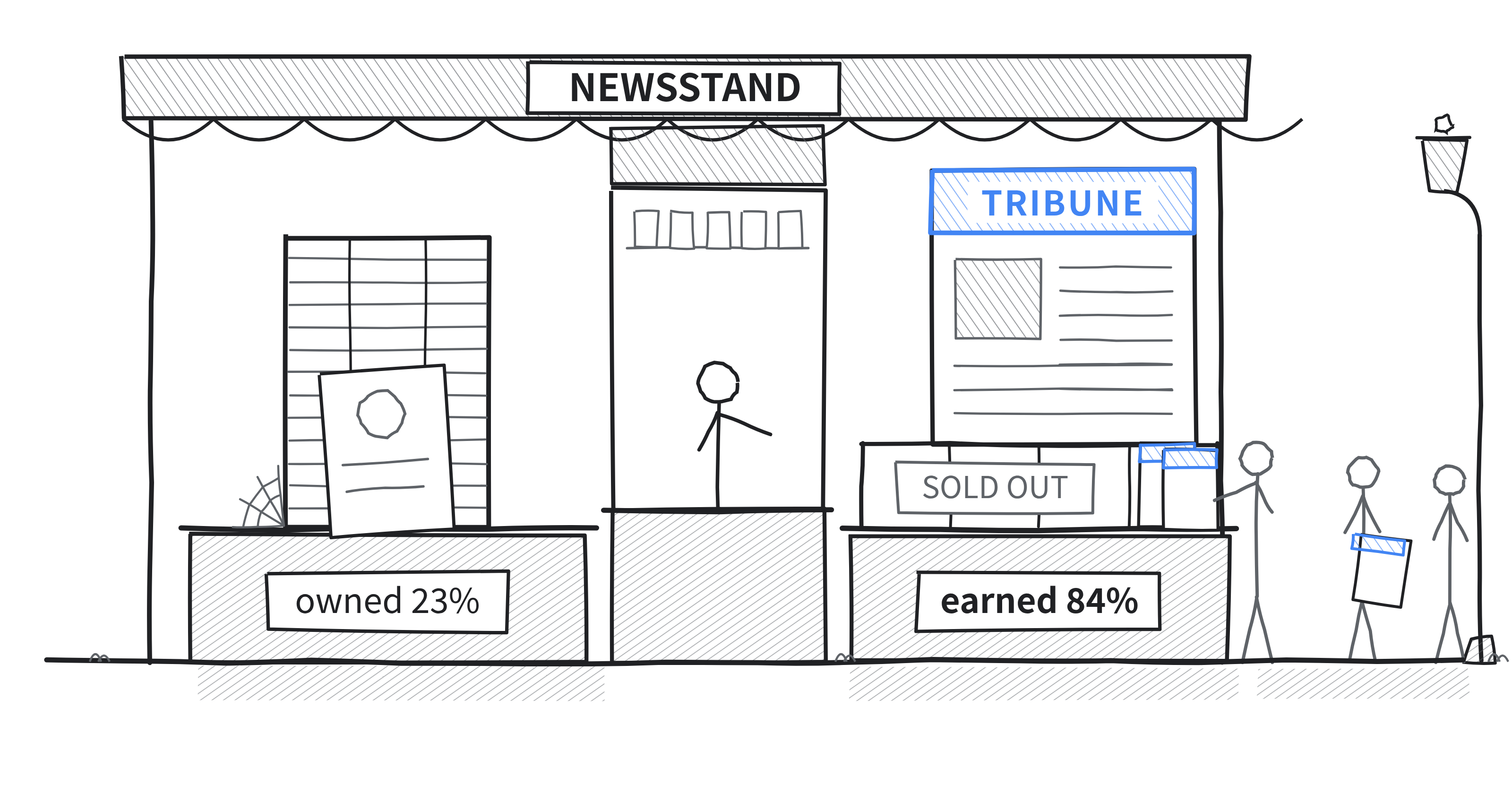
Every brand wants to know the same thing: should our content sound more confident, more promotional, more "authoritative" now that AI engines are the ones reading it? The marketing instinct says yes. The AI search data says something more uncomfortable: AI engines mostly are not reading your marketing copy at all, and when they do, style matters far less than evidence.
At Kuroma we run visibility scans that ask seven AI engines real customer questions and record every answer and citation, so we watch this play out daily across our own corpus. In our analysis of that corpus and the published research, the pattern is consistent: promotional polish is a rounding error; verifiable substance and third-party coverage decide who gets cited.
Key takeaways
- According to Muck Rack's analysis of 1M+ citations, 82% of AI citations go to earned media and 94% to non-paid sources; on unbranded queries, a brand's own site captures just 2.9% of citations (Kumar, 2026).
- The GEO benchmark (KDD 2024) found adding quotations (+42.6%), statistics (+32.8%), and source citations (+27.7%) lifts generative visibility far more than an authoritative tone rewrite (+11.8%); keyword stuffing scored 8.7% BELOW baseline.
- A NeurIPS 2025 replication (C-SEO Bench) found most content-side tricks largely ineffective, while better retrieval ranking still moves citations: substance and findability beat styling.
- ACL 2024 research shows LLMs weigh query relevance heavily and largely ignore the stylistic persuasion cues that work on humans.
- The winning self-promotion is indirect: publish original data worth citing, and win the third-party pages AI engines actually read.
Does confident, promotional language actually help in AI answers?
A little, sometimes, and far less than the alternatives. The foundational GEO study (Aggarwal et al., 2023, presented at KDD 2024) tested nine content interventions across 10,000 queries. The "Authoritative" rewrite, making text more confident and persuasive, lifted position-adjusted visibility by 11.8%. Real, but modest: research shows the evidence-led methods in the same benchmark performed two to four times better.
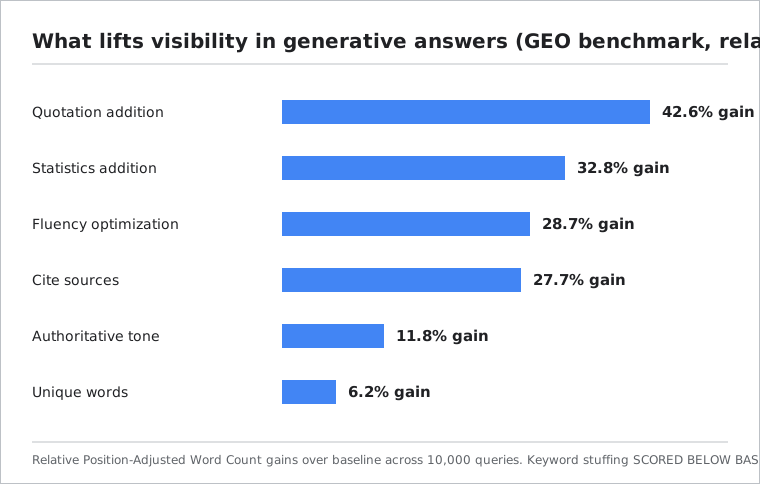
The same study carries the clearest backfire result in the literature: keyword stuffing, the classic promotional reflex, scored 17.8 against a 19.5 baseline. Writing for the algorithm the old way makes you less visible in generative answers, not more.
The best-tested style tweak is worth roughly a third of what adding verifiable statistics is worth. If you have one hour, spend it on evidence, not adjectives.
There is a second, harder blow to the style thesis. According to C-SEO Bench (Puerto et al., 2025), a NeurIPS replication study, most content-side optimization methods are "largely ineffective" at improving how LLMs rank documents in answers, and some actively hurt; what reliably moved citations was old-fashioned retrieval position. And Wan, Wallace, and Klein (2024) found that when models weigh conflicting evidence, they lean on query relevance and largely ignore the stylistic features humans find persuasive, including neutral tone and scientific-sounding references. In our reading, the honest synthesis is: substance and findability are the levers; tone is a tiebreaker at best.
What do AI engines cite instead of your marketing pages?
Mostly: other people talking about you. The numbers here are stark and consistent across independent datasets.
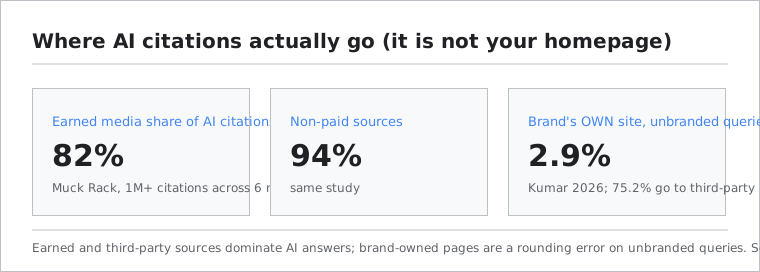
- Muck Rack's study of 1M+ citations across six models found 82% of citations come from earned media and 94% from non-paid sources; journalism alone is cited 27% of the time, rising to 49% on recency-sensitive queries.
- Kumar (2026) measured that on unbranded queries, only 2.9% of citations point to the brand's own website; 75.2% go to third-party corporate pages, and listicles alone capture 35.7% of content citations.
- Chen et al. (2025) describe a "systematic and overwhelming bias towards earned media over brand-owned and social content" in AI search compared with Google's more balanced mix.
- Per Semrush's 100M-citation study (2025) and Profound's 680M-citation analysis, Wikipedia and Reddit dominate: Wikipedia made up 47.9% of ChatGPT's top-ten source citations, Reddit 46.7% of Perplexity's.
This is also what we see in our own data. In Kuroma's validation corpus of 201,695 AI answers, Gemini cited a tracked brand's own domain in roughly 0.2% of runs; it cited retailers, press, and review sites instead. For some engines, the direct self-promotion channel barely exists; the fight is entirely over what third parties say. Our full methodology and per-engine findings are public on the Kuroma methodology page.
What kind of self-promotion actually works?
The kind that gives AI engines something to quote. Ahrefs analyzed its own 1,000 most-cited pages (2025) and the winners were not campaign pages: they were original research (a 439-person survey on SEO pricing), programmatic data pages, free tools, and glossary-style definitions. HubSpot earns citations for defining inbound marketing; Asana for project-management explainers. The promotional payoff came from being the SOURCE of a number or a definition, not from talking about themselves.
The same logic shows up in community content. Semrush's Reddit study (2025) of 248,000 AI-cited posts found 80% had fewer than 20 upvotes, and Q&A threads plus comparisons made up roughly 75% of citations: genuine conversation gets cited; promotional posts rarely surface.
| Approach | What the data says | Verdict |
|---|---|---|
| Keyword stuffing | 8.7% below baseline (GEO benchmark) | Backfires |
| Authoritative tone rewrite | +11.8%, the weakest positive method tested | Marginal |
| Adding statistics and quotations | +32.8% and +42.6% respectively | Works |
| Citing external sources | +27.7%, and it lifted fifth-ranked sites by 115% | Works, favors challengers |
| Schema markup alone | AI Overviews -4.6%, other engines not significant (Ahrefs, 2026, controlled) | Hygiene, not a lever |
| Original research and data pages | Ahrefs' most-cited page types; earns quotes by BEING the source | Works best |
| Earning third-party coverage | 82% of citations are earned media | The main game |
Is there an "ad blindness" filter inside AI engines?
Not a documented one, and this distinction matters. No published evidence shows providers explicitly filtering marketing copy through RLHF. What exists instead is selection dynamics that produce the same outcome: models weigh relevance over persuasion (Wan et al., 2024), retrieval favors the structured, readable, information-dense pages that answer questions (Zhang et al., 2025, found AI engines cite fewer, more structured sources than traditional search), and the citation mix skews overwhelmingly toward earned media. OpenAI, for its part, states that the ads it is testing in ChatGPT are labeled, visually separated, and do not influence organic answers; and Google's own AI-features guidance (2026) pushes "unique, non-commodity" people-first content over commodity marketing prose.
So your promotional page is not being punished. It is simply losing a relevance contest to a Reddit thread with 12 upvotes that answers the question directly. Notably, that is a more fixable problem than a filter would be.
How should a brand rewrite its content strategy for this?
Five moves, in order of evidence strength:
- Become the source: publish original numbers (surveys, benchmarks, usage data) that others must cite. This is the single most durable pattern in the citation data.
- Convert claims to evidence: every "industry-leading" should become a number, a named customer, or a quoted expert. The GEO benchmark's top three methods are all versions of this.
- Fight on third-party ground: press, reviews, comparison listicles, community threads. With 82% of citations going to earned media, your PR strategy IS your GEO strategy.
- Keep hygiene honest: structure, readability, and crawlability decide whether engines can use your page at all (Zhang et al. found AI engines prefer structured, readable HTML). But do not expect schema markup alone to move citations; the controlled data says it does not.
- Measure before believing: citation behavior differs sharply by engine and shifts month to month (ChatGPT's Reddit citation rate collapsed from 60% to 10% in six weeks in late 2025). Track your brand across engines before and after changes.
FAQ
Should we stop writing confident, promotional copy entirely?
No. Confident copy still converts humans, and the GEO data shows an authoritative tone is mildly positive (+11.8%) for generative visibility. The mistake is treating tone as the lever. Lead with verifiable substance, keep the confidence, and drop the keyword stuffing, which measurably backfires.
Why does our beautifully written product page never get cited?
Because on unbranded questions, engines cite third parties 97% of the time (Kumar, 2026). Your page competes with every comparison article, forum thread, and news story about your category. The data says the fastest route to citations is making those third-party pages exist and getting quotable facts into them.
Is authoritative tone the same as E-E-A-T?
No. Tone is how the text sounds; E-E-A-T signals are verifiable markers (authorship, experience, citations, reputation). The research suggests models respond to relevance and substance, and our own audit rubric deliberately weights hedged, vague language down: confident VERIFIABLE statements, not confident adjectives.
Do these findings differ by AI engine?
Significantly. In our 201,695-answer validation corpus, per-engine behavior diverged enough that we report it separately: ChatGPT is the most predictable from on-site readiness factors, while Gemini almost never cites brand-owned domains, making third-party coverage nearly the whole game there. Engine-by-engine measurement beats one-size-fits-all optimization.
What is the single highest-ROI change this quarter?
Publish one piece of original research with clearly attributable numbers, then promote it to publications and communities in your category. It compounds: every third-party page that quotes your data becomes a page AI engines can cite about you.
Sources
- Aggarwal et al. (2023), GEO: Generative Engine Optimization, KDD 2024: arxiv.org/abs/2311.09735
- Puerto et al. (2025), C-SEO Bench, NeurIPS 2025: arxiv.org/abs/2506.11097
- Wan, Wallace, Klein (2024), What Evidence Do Language Models Find Convincing?, ACL 2024: arxiv.org/abs/2402.11782
- Chen et al. (2025), Generative Engine Optimization: How to Dominate AI Search: arxiv.org/abs/2509.08919
- Kumar (2026), citation distribution on unbranded queries: arxiv.org/html/2606.20065
- Muck Rack (2025), What is AI Reading? (1M+ citations): muckrack.com
- Semrush (2025), most-cited domains in AI (100M+ citations): semrush.com
- Semrush (2025), Reddit AI search visibility study: semrush.com
- Profound (2025), AI platform citation patterns (680M citations): tryprofound.com
- Ahrefs (2025), How to Earn LLM Citations: ahrefs.com
- Ahrefs (2026), schema markup and AI citations (controlled study): ahrefs.com
- Google (2026), AI features optimization guidance: developers.google.com
- OpenAI (2026), Testing ads in ChatGPT: openai.com
- Kuroma (2026), scoring methodology and validation study: kuroma.ai/methodology