 Kuroma
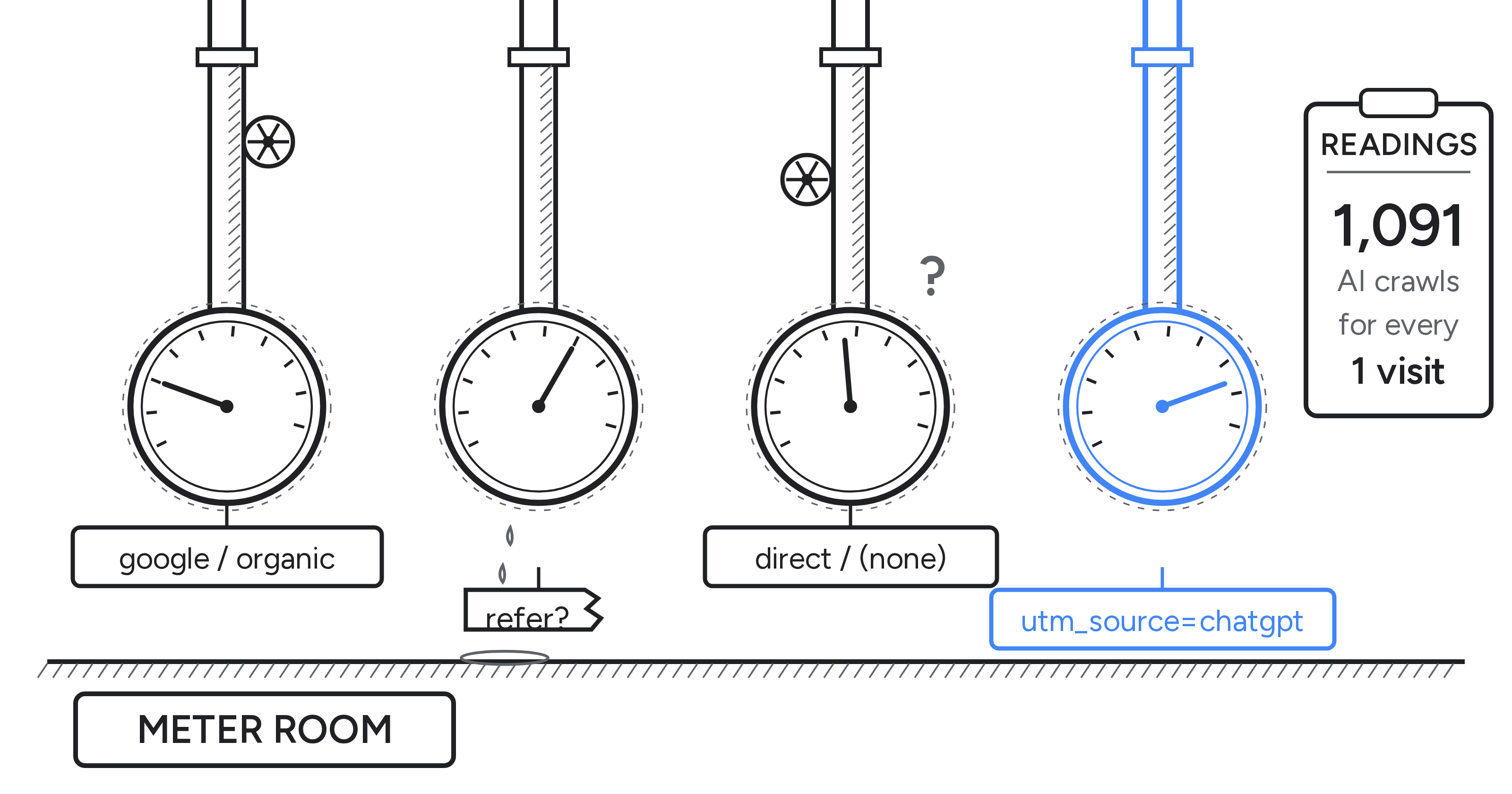
You prove AI search visibility by measuring the answers directly, not by waiting for evidence to surface in GA4. The standard analytics stack only sees the thin slice of AI exposure that ends in a click with a surviving referrer, and roughly 97% of ChatGPT answers cite no source at all, according to Similarweb's latest gen-AI stats report. The defensible metric is run-aggregated share of voice: the same buyer prompts, run repeatedly across engines, because the variance research shows a single scan is statistically an anecdote.
TL;DR
- GA4's first AI channel (May 2026) names only ChatGPT, Gemini, and Claude. Google's own AI Mode clicks still land as
google / organic. - Referrers vanish by design: Ahrefs found
noreferreron ChatGPT's paid-account links, nothing from Perplexity's desktop app, nothing from Grok. - Server logs count fetches, not humans: Cloudflare measured Anthropic at 38,065 pages crawled per referral visit; about 80% of AI-bot crawling serves training.
- Zero-click is measurable: Pew found clicks on 8% of AI-summary searches versus 15% without; Ahrefs found position-1 CTR 58% lower under an AI Overview.
- Single scans are noise: fewer than 1 in 100 repeated runs return the same brand list, yet presence rates hold stable at 55-77% for category leaders.
- The honest playbook: date-stamp the referral slice, split crawler logs into three signals, and measure share of voice with repeated runs. Demand run counts from every vendor, ours included.
Why can't GA4 prove your AI search traffic?
Because a click must survive three lotteries before your analytics can count it: the assistant has to cite a link, the user has to click it, and the referrer has to survive the trip.
That last lottery fails constantly. In May 2025, Patrick Stox at Ahrefs hand-tested every major assistant, and the research shows referrer transmission is inconsistent by design: according to the Ahrefs test, ChatGPT's paid-account in-content links carry noreferrer, its strict-origin-when-cross-origin policy drops the referrer entirely on any HTTPS-to-HTTP link, Perplexity's desktop app and Copilot for Windows pass no referrer (their web versions do), and Grok passed none at all. Claude, Meta AI, and Mistral passed referrers consistently. That was one manual test in spring 2025; assistants change link behavior without notice.
Until May 2026, GA4 had no concept of AI traffic: clicks landed in Referral under chatgpt.com or perplexity.ai, or in Direct whenever the referrer was stripped. Then Google added an "AI Assistant" default channel group, and according to Search Engine Journal's coverage, it names only ChatGPT, Gemini, and Claude as recognized sources. Google has not published the full referrer list; Perplexity and Copilot are absent.
The new channel also cannot contain Google's own AI search traffic. Clicks from AI Overviews and AI Mode arrive with a plain google.com referrer and land in GA4 as google / organic, indistinguishable from a classic blue-link click, per Ahrefs' AI Mode tracking test and Search Engine Land's confirmation. AI Mode links initially fired no referrer at all. Google later fixed that, which merely upgraded the traffic from invisible to unlabelable.
ChatGPT auto-appends utm_source=chatgpt.com to cited links, and on June 13, 2025 OpenAI extended that tagging to the "More" sources section, according to PPC Land. But nobody has documented when citation tagging first began, and it is not guaranteed on every link type.
Even visible trends are hostage to product decisions: after ChatGPT's May 7, 2026 interface change, homepage referrals jumped to roughly 60% of all ChatGPT-referred traffic from a prior 26-32%, according to Similarweb's panel estimates. If your report showed a spike that week, the spike was OpenAI's, not yours.
What can each data source actually see?
Search Console deserves its own indictment first. Google's documentation states AI Overview and AI Mode traffic is "included in the overall search traffic in Search Console... reported on in the Performance report, within the 'Web' search type," per Google Search Central. There is no filter to isolate it. Worse, an AI Overview occupies a single position that every link inside it inherits, and an impression only counts once the link scrolls into view, per Google's metrics documentation. Position data on AIO-heavy queries is structurally non-comparable to classic ranks.
The capability matrix our team keeps taped above the analytics dashboard:
| Data source | What it can see | What it cannot see |
|---|---|---|
| GA4 (Referral + AI Assistant channel) | Clicks arriving with a surviving referrer from named sources: ChatGPT, Gemini, Claude | Stripped-referrer clicks (filed under Direct); Perplexity desktop and Copilot for Windows; every Google AI Overview and AI Mode click |
| Google Search Console | Combined impressions and clicks for the "Web" type, AI features included | Any split between AI Overviews and blue links; comparable positions (a whole AIO counts as one position) |
| Server logs | Every fetch by a declared crawler (GPTBot, OAI-SearchBot, ChatGPT-User) | Whether a human ever saw your content; citations served from an index or training data involve no fetch at all |
utm_source=chatgpt.com |
ChatGPT citation clicks on tagged link types | Untagged link types; every other assistant; the ~97% of answers with no citation |
| Panel estimates (Similarweb, Clarity, Adobe) | Directional cross-site trends by engine and cohort | Your site specifically; panels extrapolate, they do not read your server |
| Repeated prompt scans (share of voice) | Whether engines mention and cite you, and at what rate | Real user query mix; actual traffic; a single run is noise |
No row covers the whole problem. An honest stack uses several at once and labels each number with what it excludes.
How much traffic does AI search actually send, and what is it worth?
The visible slice is small and growing fast. Both halves matter. According to Similarweb, AI platforms generated 1.13 billion referral visits in June 2025, up 357% year over year, with ChatGPT alone at more than 80% of AI referrals to the top 1,000 domains. Google search sent 191 billion referrals in the same month. Those are panel estimates counting only referrer-visible visits; the true AI-influenced number sits somewhere above them.
Microsoft Clarity's telemetry tells the same story: across 1,277 publisher and news domains over eight months, the study found AI-platform referrals grew 155.6% while Search grew 24.0%, yet AI still accounted for less than 1% of overall traffic. Fast growth, tiny base.
Conversion quality is where nobody's number agrees, including the same vendor with itself:
- Adobe Analytics, from over a trillion visits to US retail sites, reported in March 2025 that AI-referred visitors were 8% more engaged, viewed 12% more pages, bounced 23% less, and converted 9% worse. That was an improvement from 43% worse in July 2024.
- Ten months later, Adobe's holiday recap of the $257.8 billion Nov-Dec 2025 US online season had AI-sourced retail traffic up another 693% and converting 31% higher than other channels. The sign flipped within a year.
- Clarity's publisher study found LLM referrals signing up at 1.66% versus 0.15% from search: the real source of the "AI converts 11x" headlines, measured as sign-ups on publisher sites, not ecommerce revenue.
- Semrush's study puts the average AI-search visitor at 4.4 times the value of an organic visitor by conversion rate, measured on Semrush's own funnel across 500+ digital-marketing topics. Their early-2028 "AI overtakes traditional search" projection carries the same scope: marketing and SEO topics only.
- Similarweb's December 2025 release says gen-AI referrals convert at roughly 7% on transactional sites, cohort undefined.
Every one of those numbers is real. None is "the" AI conversion rate. Each is scope-bound and about six months from stale; quoting one as a universal multiplier is doing the thing this article warns about. What the data does support: AI visitors arrive unusually engaged, the channel compounds, and the demand side is enormous. ChatGPT reached 800 million weekly active users by October 2025, according to TechCrunch, on OpenAI's own definition.
Where did the clicks go?
Into the answer layer, which emits almost none of them.
The Pew Research Center gave this its cleanest measurement. Among 900 US adults who shared browsing data, covering 68,879 Google searches in March 2025, the study found users clicked a traditional result on 8% of searches with an AI summary versus 15% without one. Only 1% of AI-summary encounters produced a click on a source cited inside the summary. This was an opt-in US panel and Google disputed the methodology, but nobody has published a counter-measurement.
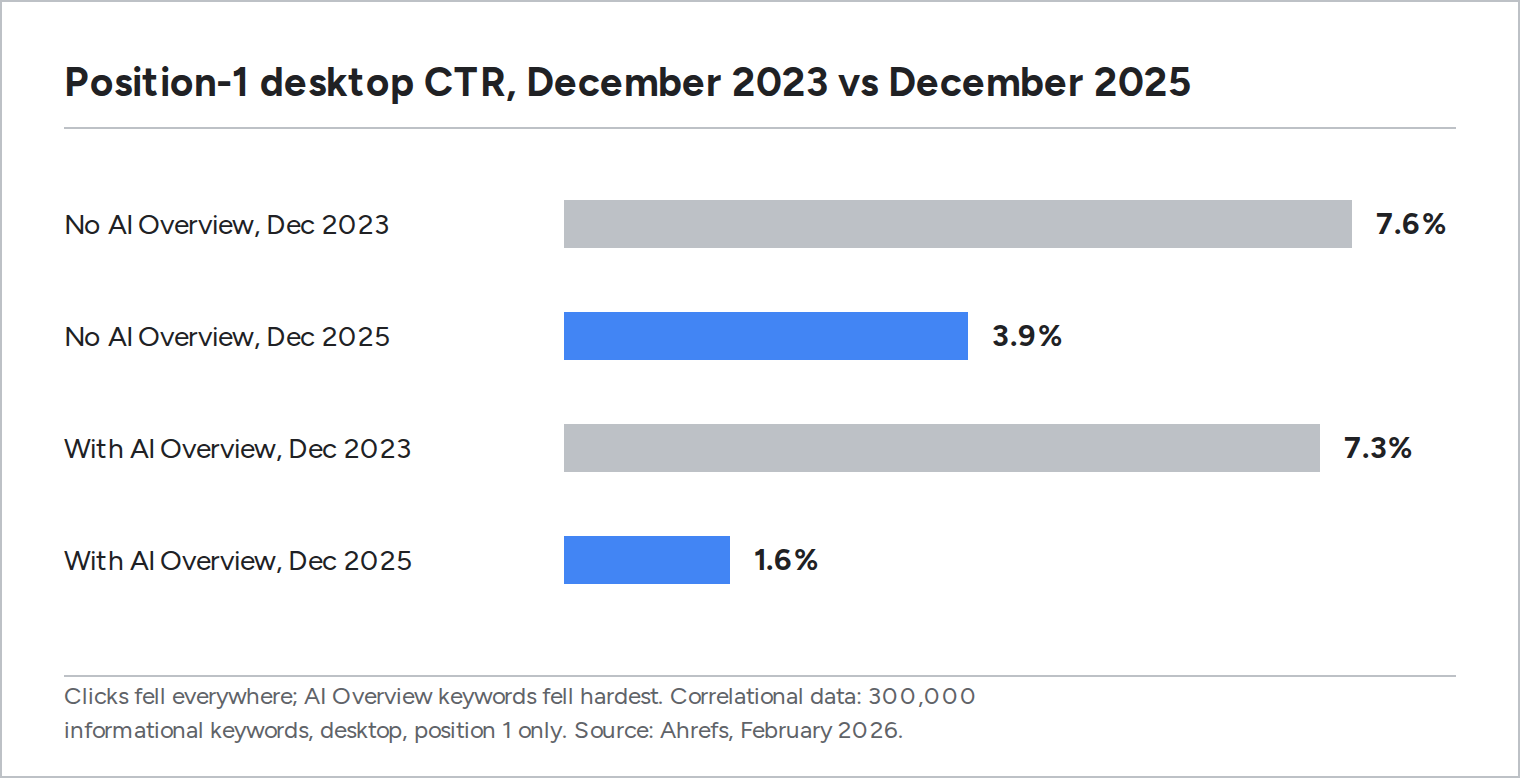
Ahrefs ran the position-1 CTR version twice. Their April 2025 analysis of 300,000 keywords found AI Overview presence correlated with a 34.5% lower CTR for the top-ranking page. The updated February 2026 revision, comparing December 2023 against December 2025, put the gap at 58%: position-1 desktop CTR on AIO keywords fell from 7.3% to 1.6%, and, the quiet second finding, it also fell from 7.6% to 3.9% on keywords with no AI Overview at all. Clicks are eroding everywhere. AIO queries just erode fastest.
Seer Interactive's client data shows these curves bend. Across 53 brands and 5.47 million queries, their updated April 2026 analysis shows organic CTR on AIO-present queries fell from 3.19% in January 2025 to 1.31% in December 2025, then partially recovered to 2.36% by February 2026. Being cited inside the AI Overview delivered 120% more clicks per impression than not being cited, yet cited brands still ran about 38% below non-AIO queries. Date every CTR number you quote. This one changed twice in fourteen months.
Put the halves together. AI referrals grew 357% while clicks collapsed, and both are true, because visibility migrated into a layer that barely links out: Similarweb found only 0.6% of ChatGPT answers included citations in January 2025, rising to 2.8% by August 2025. Roughly 97% of ChatGPT answers name no source. The measurable click is now the minority artifact of AI influence, not its measure.
Why do server logs overstate your AI visibility?
Because most of what AI bots do on your server has nothing to do with a user.
OpenAI documents exactly three crawler identities with three different meanings, according to OpenAI's bot documentation: GPTBot crawls "content that may be used in training our generative AI foundation models" (no user, no referral, ever), OAI-SearchBot is "used to surface websites in search results in ChatGPT's search features" (indexing), and ChatGPT-User fires "for certain user actions in ChatGPT and Custom GPTs" (the only one implying a human saw your content in-session). A GPTBot spike is not a visibility win. It is a training harvest.
The scale of the mismatch is the point. Cloudflare measured crawl-to-refer ratios across its network, and the study found that in July 2025 Anthropic crawled 38,065 HTML pages for every referral visit it sent back, down from 286,930 that January. OpenAI ran 1,091 to 1, Perplexity 194 to 1, Microsoft 40.7 to 1, Google 5.4 to 1. Those ratios move month to month, so quote the date with the number. The same dataset shows about 80% of AI-bot crawling over the trailing year was for training, 18% for search indexing, and roughly 2% for live user actions. The overwhelming majority of AI hits in your server log carry zero visibility signal.
One more log-file trap: in late 2024, Vercel found that none of the major AI crawlers rendered JavaScript; ChatGPT fetched JS files on 11.5% of requests and never executed them. If your key content renders client-side, it is invisible to the systems whose answers you are trying to audit.
Why is a single AI visibility scan worthless?
Because the engines do not repeat themselves, and the studies proving it are stacked three deep.
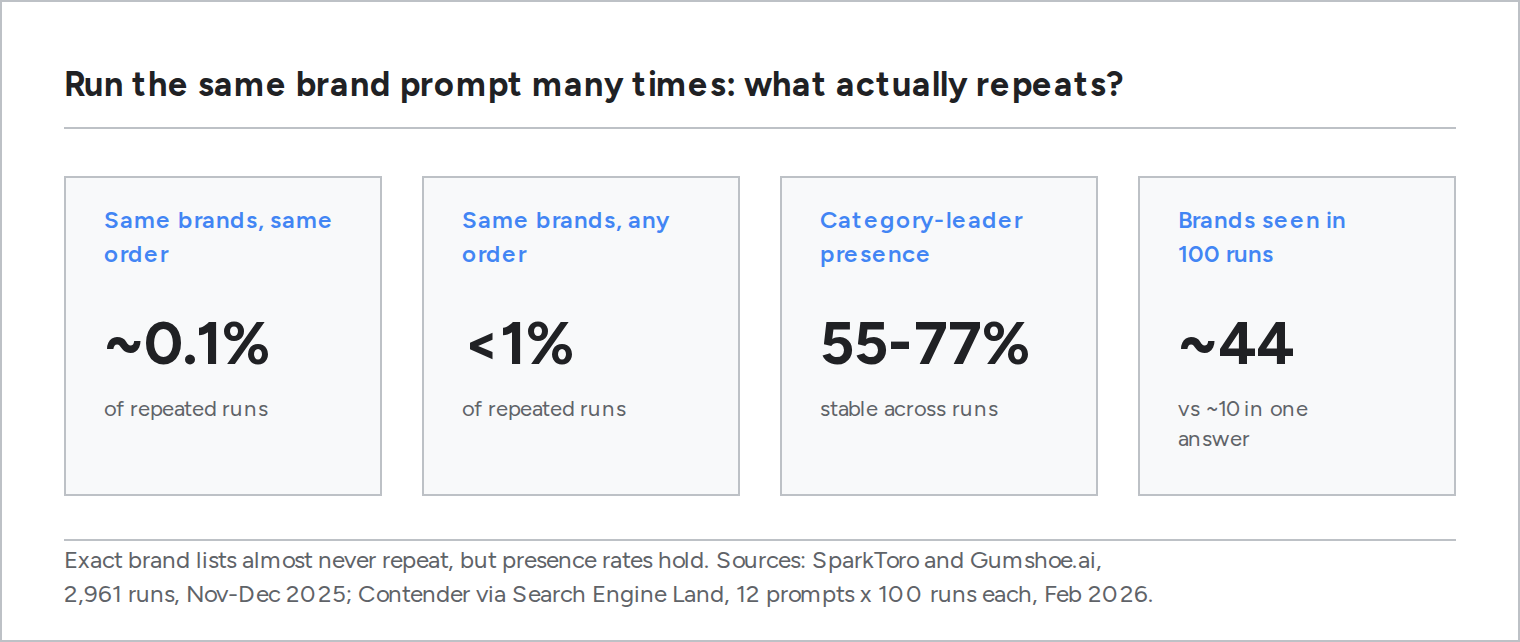
The largest is SparkToro and Gumshoe.ai's panel: 600 volunteers ran roughly 2,961 runs of 12 identical brand-recommendation prompts across ChatGPT, Claude, and Google's AI Overviews and AI Mode in late 2025. The study found fewer than 1 in 100 runs returned an identical brand list, and about 1 in 1,000 returned the same brands in the same order. Rand Fishkin's conclusion: "any tool that gives a 'ranking position in AI' is full of baloney." Presence held up in aggregate: category leaders appeared in 55-77% of responses, 60-90% for some intents. Rank is noise. Rate is signal.
Contender's design removed the personalization excuse: 12 prompts, 100 runs each, on logged-out chatgpt.com from 1,200 distinct IP addresses. According to Search Engine Land's write-up, a single answer names about 10 brands, but 100 runs of the same prompt surface about 44 distinct brands. Only about 5 brands per category, around 11% of everything mentioned, appeared in 80% or more of runs, and in competitive categories 72% of mentioned brands showed up in fewer than 20% of responses. Flip that around: if your brand lives outside the stable core, a one-run scan will miss you most of the time you actually appear.
Google's AI surfaces behave the same way. SE Ranking ran 5,000 local-intent queries 15 times each against AI Mode and found only 18.3-20.5% URL overlap when repeating the same general query in the same city; more than 60% of domains disappear between runs. Location-specific queries were steadier at 46-49% overlap, itself a methodology lesson: prompt specificity changes volatility. Authoritas' early-2025 research points the same way: AI Overview rankings measurably more volatile than organic, and changing independently of it.
This evidence cuts both ways. It demolishes the screenshot audit and the prospect's "I asked ChatGPT and we weren't there." It also sets a bar for every visibility vendor, Kuroma included: a tool that runs each prompt once per scan is producing anecdotes with a dashboard around them. Any share-of-voice number should arrive with its run count, engine list, and sampling window attached. Even the field's founding paper, the GEO study by Aggarwal et al. at KDD 2024, defined visibility as impression-weighted citation share aggregated across a query benchmark, with content optimizations lifting visibility by up to 40% in lab conditions. An aggregate over many queries. Not a screenshot.
What does an honest GEO measurement playbook look like?
Six moves, in the order we would run them.
- Segment what is segmentable, then date-stamp it. Build a custom channel group for known AI referrers plus
utm_source=chatgpt.com, and annotate the timeline: GA4's AI Assistant channel launch (May 2026), ChatGPT's homepage-referral shift (May 7, 2026), any assistant UI change you catch. A trend break is as likely their product decision as your content. - Treat Direct upticks as unattributable. The dark-traffic mechanism is real (stripped referrers, desktop apps,
noreferrerlinks), but classifying referrer-less visits as AI traffic requires fingerprinting whose accuracy you cannot verify. Note the uptick. Do not book it as GEO ROI. - Read server logs as three signals, not one. Separate training crawlers, search-index crawlers, and live-retrieval agents by user agent. Watch
ChatGPT-Userand its cousins; discountGPTBotvolume as a visibility metric. And serve your substance server-side; the crawlers do not execute JavaScript. - In Search Console, watch CTR at stable positions instead of positions. AI Overview links inherit a single blended position, so rank tracking on AIO-heavy queries measures an artifact. CTR decay at a held position is the cleaner zero-click signal, and Seer's early-2026 partial recovery shows it must be re-measured, not assumed.
- Measure the answer layer directly, with repetition. A fixed prompt set drawn from real buyer questions, run across multiple engines and buyer personas, repeated, and aggregated into share of voice. This is the method our team built Kuroma around: persona prompts times engines times repeated runs, rolled into first-party share-of-voice trendlines, because the variance data says one run misleads in both directions. Presence rates are the stable object. Everything else wobbles.
- Report ranges with dates, not point estimates. "Cited in 62% of runs across three engines, June 2026, 40 runs per prompt" is a claim a CFO can audit. "We rank #2 in ChatGPT" is, per the data above, not a real thing.
None of this recovers the click that never happened. It swaps a broken attribution question ("which visit came from AI?") for an answerable visibility one ("how often do the engines present us, and is that rate moving?"). One run is an anecdote. The aggregate is a metric.
Frequently asked questions
Does GA4's new AI Assistant channel fix AI attribution?
No. It labels part of the already-visible slice. The channel recognizes ChatGPT, Gemini, and Claude, leaves Perplexity and Copilot unnamed, and cannot include Google's own AI Overviews or AI Mode clicks, which still arrive as google / organic. Referrer-stripped visits still land in Direct, as before.
What does a GPTBot hit in my server logs actually mean?
OpenAI fetched your page for potential training use, nothing more. Cloudflare's measurement puts about 80% of AI-bot crawling in the training bucket and only about 2% in live user actions. The user agent implying a human saw your content in-session is ChatGPT-User, and even then, an assistant can cite you from its index or training data with no fetch at all.
Is AI search traffic really more valuable than organic search traffic?
More engaged, consistently; the conversion multiplier depends on whose cohort you read. Microsoft Clarity measured publisher sign-ups at 1.66% from LLM referrals versus 0.15% from search, while Adobe's US retail data went from 43% worse to 9% worse to 31% better across eighteen months. Treat any single multiplier as scope-bound and perishable; check its date before repeating it.
How many runs does an AI visibility scan need before it means anything?
No published magic number exists, but one is provably not enough. Contender's data shows 100 runs of one prompt surfacing about 44 brands where a single answer names about 10, and 72% of mentioned brands in competitive categories appearing in fewer than 20% of responses. Presence rates stabilize across dozens of runs, so treat run count like survey sample size, and ask every vendor for theirs.
What is the difference between GEO, AEO, AISEO, and AIO?
They are overlapping labels for the same discipline. GEO (generative engine optimization) is the academic term from the 2023 KDD paper, AEO (answer engine optimization) emphasizes assistants as answer engines, AISEO is shorthand for AI-era search engine optimization, and AIO usually refers to Google's AI Overviews and the work of getting cited inside them. Whatever the label, the measurement problem is the same: referral analytics see a sliver; repeated-run share of voice measures the answer layer itself.