 Kuroma
Key takeaways
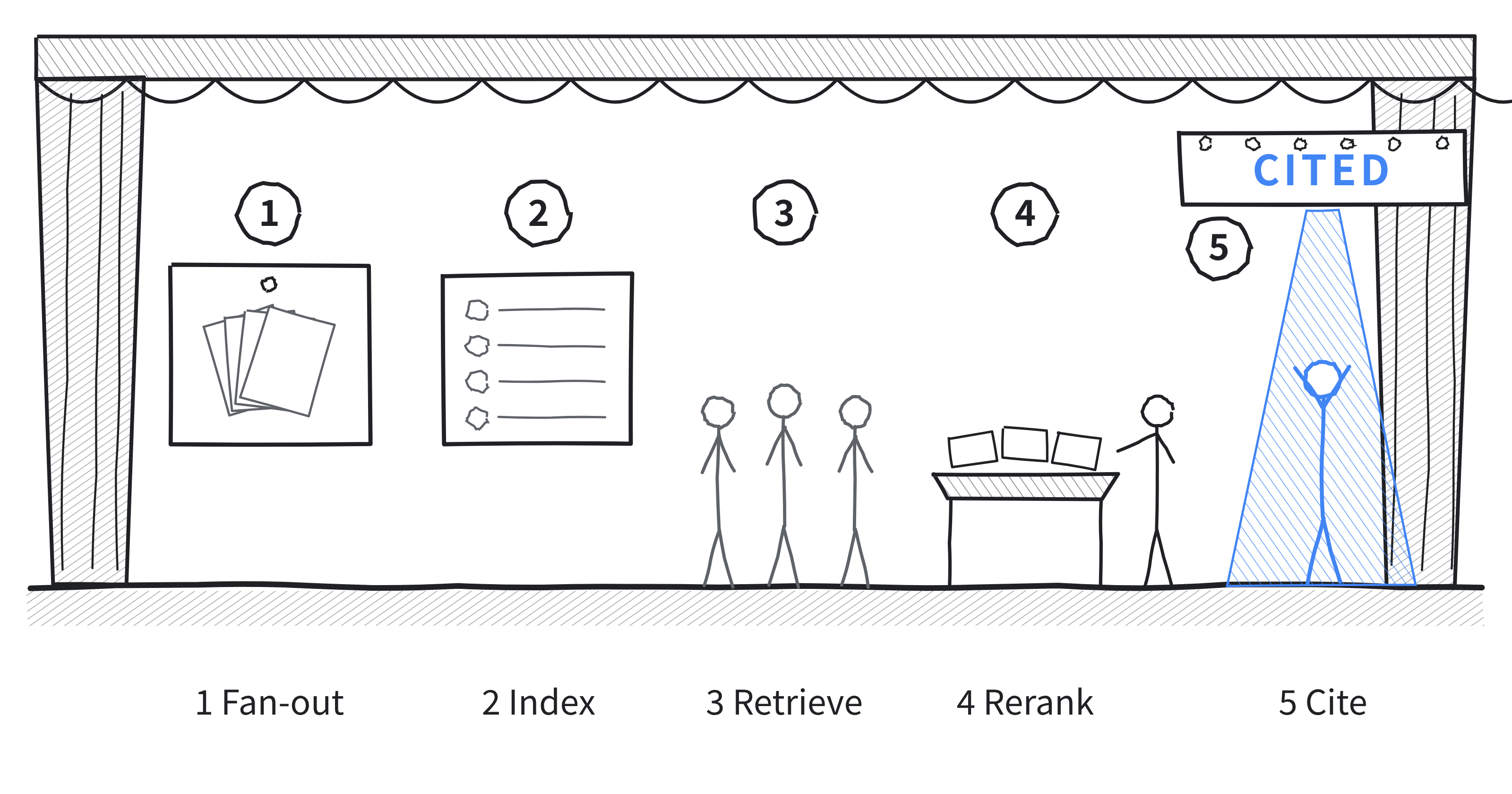
- Production AI search is not textbook RAG. It is a five-stage citation funnel: query fan-out, index selection, passage-level retrieval, reranking, and citation selection. Your brand can be eliminated at any stage without ever "ranking" badly.
- Retrieval happens at the passage level, not the page level. Perplexity decomposes documents into "self-contained spans" that are retrieved and ranked individually, and Google patents describe an LLM pairwise-comparing passages.
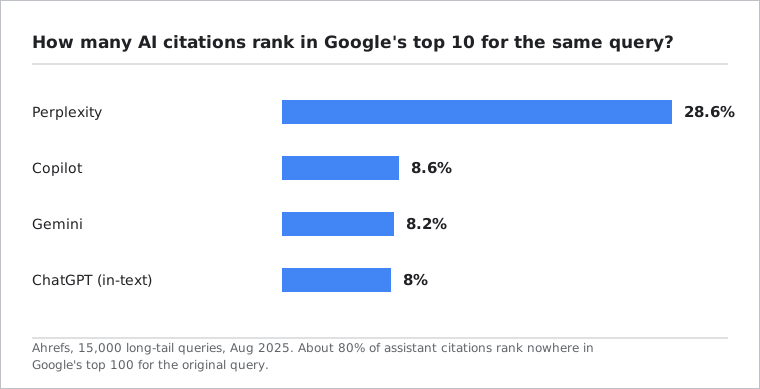
- The link between organic rank and citation is engine-specific and moving. Only 12% of assistant citations rank in Google's top 10 (Ahrefs), and AI Overviews' top-10 overlap fell from about 76% to 38% in eight months (Ahrefs).
- Most ChatGPT answers never touch the web: only about 18% of conversations trigger a search (Profound). Retrieval optimization and training-data presence are two different games.
- Because sub-queries are non-deterministic (ChatGPT varies its searches 89% of the time on identical prompts), the stable optimization surface is retrievable, quotable passages, not reverse-engineered keywords.
Every AI search answer that cites a source went through a pipeline called retrieval-augmented generation, or RAG. Most explanations of RAG stop at the textbook diagram: a query goes in, documents come back, the model writes an answer. That diagram is roughly ten years out of date for how ChatGPT, Google AI Mode, and Perplexity actually work in production, and the differences are exactly where brands win or lose citations.
What follows is that pipeline, stage by stage, built from the 2025 and 2026 engineering disclosures and measurement studies rather than from vendor slideware. At Kuroma we measure the output side of this funnel across seven engines every day, which has made us opinionated about one thing in particular: some stages you can influence, and some you can only watch. Knowing which is which saves a lot of wasted optimization.
What does RAG actually do in an AI search engine?
RAG grounds a language model's answer in retrieved documents instead of relying purely on what the model memorized during training. When it works, the engine fetches relevant pages at answer time, reads them, synthesizes a response, and attributes claims to sources. That attribution step is the citation: the entire prize of Generative Engine Optimization (GEO), and the reason AIO, AEO, and AI SEO practitioners obsess over retrieval mechanics.
In production, five things happen between a user's question and your citation. Each one is a filter.
| Stage | What happens | What eliminates you here |
|---|---|---|
| 1. Query fan-out | The engine rewrites one prompt into many sub-queries | Your content matches the literal keyword but no fan-out variant |
| 2. Index selection | Each engine retrieves from a different index | You blocked the engine's crawler, or its index never saw you |
| 3. Passage retrieval | Chunks, not pages, are embedded and fetched | No self-contained passage answers the sub-question directly |
| 4. Reranking | Cross-encoders and LLM judges reorder candidates | Your passage is topically close but does not directly support an answer |
| 5. Citation selection | The model picks which retrieved sources to attribute | The model answered from memory, or attributed a syndicated copy |
What happens to a query before retrieval even starts?
Before retrieval, the engine rewrites the user's question into several search queries (query fan-out), so the passages it retrieves answer those sub-queries, not only the literal prompt.
The single biggest departure from textbook RAG is query fan-out. Google confirms that both AI Overviews and AI Mode "may use a query fan-out technique, issuing multiple related searches across subtopics and data sources" (Google Search Central). At I/O 2025, Google described AI Mode "breaking down your question into subtopics and issuing a multitude of queries simultaneously," with Deep Search issuing hundreds (Google).
The scale is now measured. Qwairy captured 102,018 real web-search queries generated from 38,418 prompts and found ChatGPT issues an average of 3.51 queries per prompt (only 32.7% of prompts produce a single query), while Perplexity stays single-query 70.5% of the time. List-style prompts averaged 49 generated queries (Qwairy).
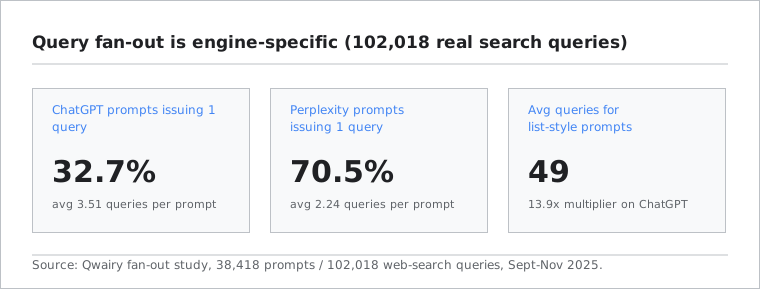
The same study contains a trap for anyone selling fan-out keyword lists: ChatGPT generates different sub-queries for the same prompt 89% of the time. There is no stable set of hidden queries to reverse-engineer. All you can do is cover the subtopic space well enough that some variant retrieves you, which is why passage-level topical coverage beats keyword matching in every serious 2025-2026 measurement we have read.
Which index does each engine retrieve from?
Textbook RAG assumes "the web." Production engines retrieve from specific, different indexes, and this is the most underrated fact in GEO:
- ChatGPT historically leaned on Bing: Seer Interactive matched 87% of SearchGPT citations to Bing's top organic results in February 2025 (Seer Interactive). That substrate has been shifting toward OpenAI's own OAI-SearchBot index and, per multiple third-party tests, Google results. Blocking OAI-SearchBot removes you from ChatGPT search answers entirely (OpenAI).
- Google AI Overviews and AI Mode ride the normal Google Search index. Google states a page needs only to be "indexed and eligible to be shown in Google Search with a snippet." No special files, no AI-specific markup (Google Search Central).
- Perplexity built its own index: over 200 billion tracked URLs, tens of thousands of indexing operations per second, serving 200 million daily queries (Perplexity). Blocking PerplexityBot removes you from Perplexity results (Perplexity docs).
The practical consequence: one robots.txt file now carries at least three separate decisions, each priced differently per engine. We have watched brands blanket-block "AI bots" in 2025 and silently forfeit two engines while achieving nothing on the third, because Google-Extended does not govern AI Overviews at all. It is an easy mistake to make and a quiet one to live with, since nothing errors when your citations stop.
Where do AI platforms get the information they use to cite brands?
AI platforms get the information they cite from a live web search index (Bing for ChatGPT, Google's index for AI Overviews and AI Mode, Perplexity's own index), from the model's training data when it decides not to search, and increasingly from third-party pages about a brand (reviews, listicles, forums, news) rather than the brand's own site. In our measurements, most citations on unbranded questions go to pages the brand does not own.
Why is retrieval about passages, not pages?
Passage retrieval is the step where an AI search engine splits a page into self-contained spans of roughly 100 to 300 words and retrieves and ranks those spans individually instead of judging the page as a whole. Which section of your content gets cited therefore depends on whether that section, read on its own, answers the query; the rest of the page does not help it.
Perplexity's engineering blog is explicit: documents are decomposed into "self-contained spans, each of which can be individually retrieved and ranked at query time," with retrieval operating "at both the document and sub-document levels" (Perplexity). Google's patent record points the same way: Mike King's analysis of the AI Mode patents describes a per-query "custom corpus" assembled from retrieved passages, then a pairwise ranking prompt where an LLM directly compares two passages for which better answers the question (iPullRank).
A page is no longer the unit of competition. A 300-word passage that states a claim, gives the number, and names the source can beat a 3,000-word page on the same topic where the answer is smeared across sections. This is also why the rank-citation link keeps weakening: fan-out sub-queries retrieve passages from pages that never ranked for the original query. In Ahrefs' 15,000-query study, only 12% of links cited by ChatGPT, Gemini, and Copilot ranked in Google's top 10 for the prompt, and about 80% ranked nowhere in the top 100 (Ahrefs).
How do engines decide which retrieved passages get cited?
AI models decide which sources to cite in three passes: retrieval pulls candidate passages that match the query and its fan-out sub-queries, a reranker scores those passages for relevance, clarity and verifiability under a tight latency budget, and the answer model attaches citations to the passages it actually used while writing. A source is cited when a self-contained passage states the answer plainly enough to survive all three passes.
Retrieval produces candidates; reranking and synthesis decide winners. Perplexity describes progressively "more powerful cross-encoder reranker models" sculpting the final result set under a hard latency budget: median 358ms, 95th percentile under 800ms (Perplexity). That budget shapes what wins. An engine racing a 358ms clock cannot deeply read every candidate, so passages that are cheap to verify get a structural advantage: a clear claim, an explicit number, a named source, all near the top of the document.
Then comes the least reliable stage: attribution itself. Columbia's Tow Center ran 1,600 queries across eight AI search tools and found they answered incorrectly on more than 60% of source-attribution tasks; more than half of Gemini and Grok-3 responses cited fabricated or broken URLs, and engines routinely credited syndicated copies (Yahoo News, AOL) instead of the original publisher (CJR). RAG did not eliminate hallucination. It relocated some of it into the citation layer.
Does the model even search before answering about your brand?
Most GEO advice skips this stage entirely, and it might be the most consequential one. Profound analyzed roughly 730,000 real U.S. ChatGPT conversations and found that only about 18% trigger a web search at all (Profound). The other 82% of answers, including plenty of brand recommendations, come straight from the model's training-time memory.
Seer Interactive's "ghost citations" study puts numbers on what that means: across 541,213 responses, a brand's citation rate was 53.1% when the model already mentioned or recommended the brand, versus 10.6% when it did not. Their conclusion: "the citations are the bibliography, not the brainstorm" (Seer Interactive). The model often decides what to recommend from parametric memory first, then RAG fetches supporting sources.
For practitioners this splits GEO into two programs running on different clocks. Retrieval-side work, the quotable passages and crawler access, can move citations in weeks. Memory-side work is slower and harder to attribute: earned mentions and third-party coverage that survive into the next training corpus move recommendations over quarters. Both are real. Conflating them is how teams end up celebrating a citation-rate bump while their recommendation share sits unchanged, or the reverse.
What can you actually optimize at each stage? The Kuroma view
When we validated Kuroma's AI Readiness audit against 201,695 real AI answers, the on-page factors we score predicted whether ChatGPT cited a page with an AUC of 0.84 (Grok 0.76, Claude 0.68, AI Overviews 0.63, Perplexity and AI Mode 0.61), where 0.5 is random and 1.0 is perfect (Kuroma validation study). You can read that number two ways, and we hold both at once. Retrieval-stage signals are clearly real: page structure and extractability measurably predict citation, most strongly on ChatGPT, which is flattering for anyone selling an audit. And 0.84 is still a long way from 1.0, because the stages you do not control carry the rest. Fan-out variance alone can bury a well-structured page on any given day.
The same validation work is why we distrust single-snapshot audits: SE Ranking found same-day reruns of identical AI Mode queries shared only 9.2% of cited URLs (SE Ranking). A pipeline with non-deterministic fan-out and per-version citation behavior demands repeated sampling, which is a monitoring discipline, not a one-time checklist.
What survives contact with the pipeline, per stage: cover the subtopic space around your money questions (stage 1); keep every relevant crawler unblocked and every page snippet-eligible (stage 2); write self-contained, front-loaded passages with explicit claims, numbers, and named sources (stages 3 and 4); and build the third-party mention footprint that makes engines want to name you before retrieval even starts (stage 5). Freshness helps less than most assume: across 17 million citations, AI-cited pages were only 25.7% fresher than organic results, still averaging 2.9 years old (Ahrefs).
FAQ
Is RAG the same across ChatGPT, Google, and Perplexity?
No. The pipeline shape is similar (fan-out, retrieve, rerank, synthesize, cite) but the index, fan-out behavior, and source preferences differ per engine. ChatGPT averages 3.51 sub-queries per prompt while Perplexity stays single-query 70.5% of the time, and each engine retrieves from a different index with different crawler rules.
Can I optimize for the exact sub-queries an engine generates?
Not reliably. ChatGPT generates different search queries for identical prompts 89% of the time. The stable strategy is covering the subtopic space with self-contained passages so that some fan-out variant retrieves you, then measuring citation frequency across repeated samples.
Does blocking AI crawlers protect my content without losing visibility?
It depends which crawler. Blocking OAI-SearchBot removes you from ChatGPT search answers; blocking PerplexityBot removes you from Perplexity. Blocking Google-Extended only affects Gemini training and grounding, not AI Overviews, which use the normal Search index.
Why does my page rank #1 but never get cited?
Because citation is selected at the passage level after fan-out and reranking, not copied from rankings. Only 12% of assistant citations rank in Google's top 10 for the prompt. A lower-ranked page with one directly quotable passage can beat your #1 page whose answer is spread across sections.
How do I know if my brand is winning or losing at the citation stage?
Measure the output: query the engines with realistic buyer prompts, repeatedly, and track mention and citation rates over time. Single snapshots mislead (9.2% same-day URL overlap on AI Mode). That is the measurement layer Kuroma automates across seven engines.
How do AI assistants decide whether to use my PR or blog posts as sources?
They use a PR page or blog post when it is crawlable, when a passage in it directly answers a sub-query in plain language, when the page carries dates and an author, and when independent sites corroborate the same claim. Persuasive tone does not help; a verifiable number or a named source in the passage does.