 Kuroma
You've run the audit. You know your brand's AI visibility score. Now what?
As more brands begin measuring how they appear across AI search, this is becoming the next important question. Knowing whether your brand is mentioned, how often it appears, and where it shows up gives you a useful starting point. But measurement alone doesn’t tell you what to change.
We’re already seeing this gap in Kuroma's early market feedback. Across evaluations and customer discussions with enterprise brands and agencies spanning financial services, real estate, FMCG, advertising, technology, and other sectors, 71% of accounts expressed a clear GEO or AI-search use case, question, or interest. Yet more than 50% raised some version of “We can see the data, now what?” and nearly 60% wanted stronger proof, methodology, or validation before acting on the results.
That’s where the challenge shifts from GEO measurement to GEO execution.
Knowing your score is the easy part. The harder questions are what to change, where to start, and what to prioritize.
A practical way to answer them is to look at three areas that can shape your AI visibility: your website, your content, and the external sources surrounding your brand. Once you start making improvements, competitor benchmarking can help put those changes into context and show whether you’re actually gaining ground.
1.Start with your website: can AI access and understand the right information?
Your website is the part of GEO you have the most direct control over, so it's a natural place to start. The first question is simple: can AI systems actually access the information you want them to find?
A page can look perfectly fine to a visitor while still making important information difficult for machines to access or understand. That makes basic technical foundations important: crawlability, clear page structure, internal linking, readable text, and consistent information across the site.
But accessibility is only half of the picture. A technically healthy website won't help much if it doesn't contain useful answers to the questions people are asking. This is why website readiness is better understood from two sides: technical readiness, or whether AI can access and interpret the page, and content readiness, or whether the page actually contains information worth using. (Source: Google Search Central — guidance on AI features)
Kuroma's Website AI Readiness methodology takes this broader approach, evaluating areas such as on-page content, technical accessibility, how easily information can be used in an answer, and other signals supported by available research and platform guidance.
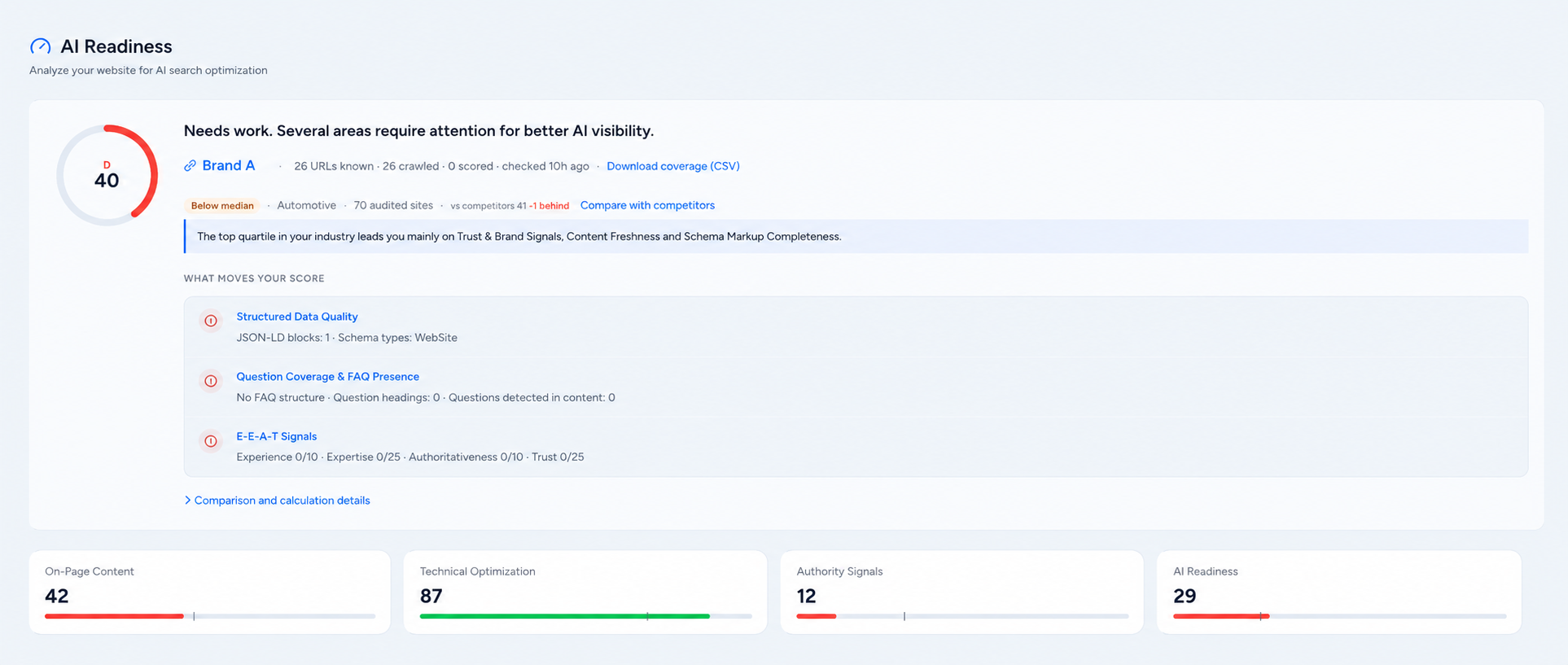
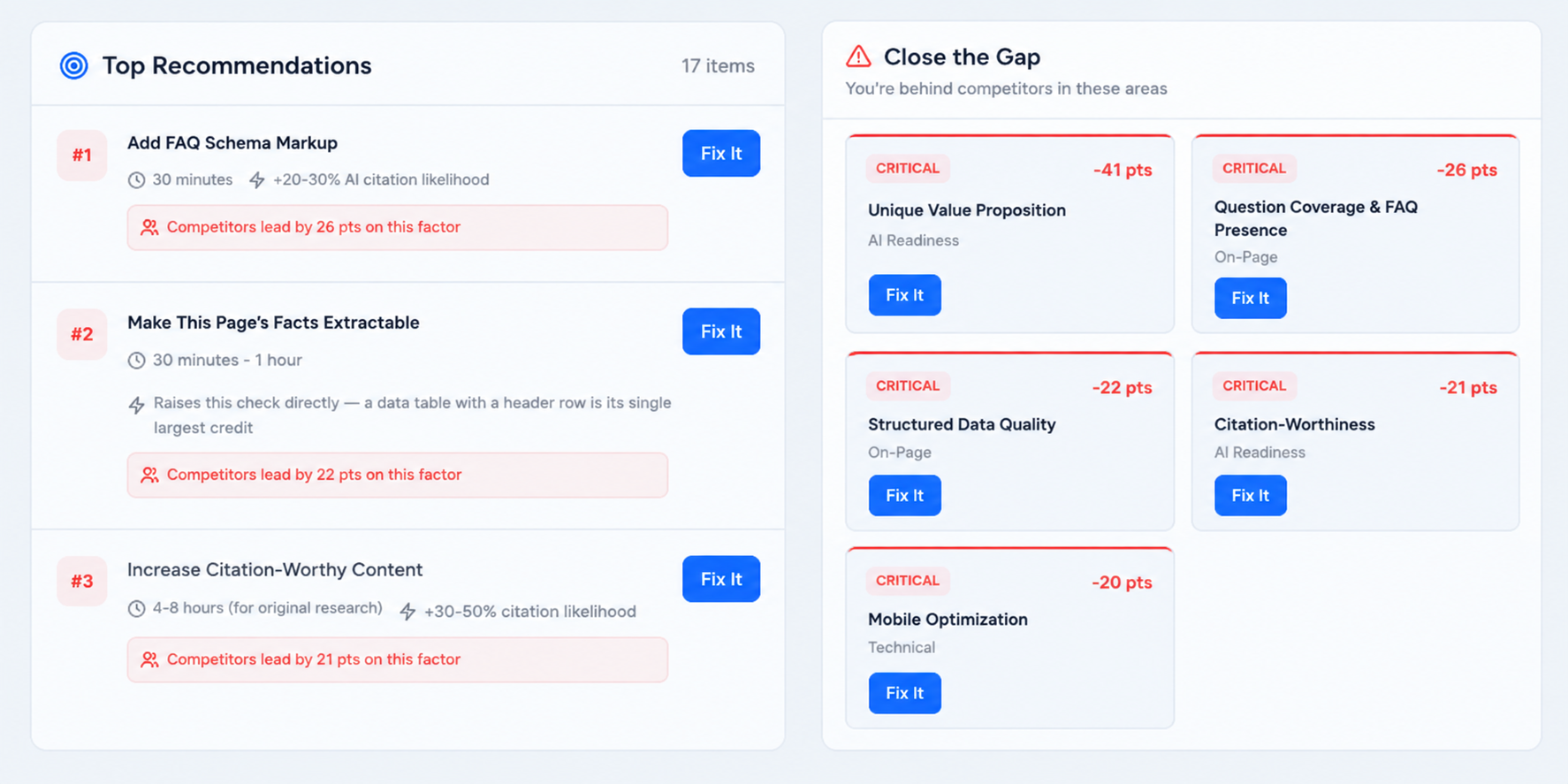
The practical lesson is straightforward: get the fundamentals right before chasing new GEO tactics. Make sure important pages are accessible, information is clear and current, and the questions customers care about are actually answered on the site.
If those foundations are already strong but competitors continue to outperform you, the next place to investigate is the content itself.
2. Find the content gaps that matter
Publishing more content isn't automatically the answer. The better question is: what information are people looking for that you don't currently provide well?
Look at the prompts where competitors appear and your brand doesn't. What are those answers discussing? Maybe customers are looking for product comparisons, implementation guidance, pricing context, use cases, limitations, industry benchmarks, or answers to specific questions that your existing content barely covers.
This is where GEO starts to change the way teams think about content. Instead of focusing only on keywords or publishing volume, the goal becomes creating information that is genuinely useful when an AI system is constructing an answer.
The original GEO research presented at ACM SIGKDD 2024 offers useful evidence here. Across 10,000 queries, the researchers tested nine approaches for improving visibility in generative-engine responses. Techniques such as adding relevant statistics, citations, and quotations improved visibility under the study's experimental conditions, while keyword stuffing performed poorly.
The takeaway isn't that every page needs more statistics or quotes. It's that useful, well-supported information matters more than simply repeating the right keywords.
That could mean answering a question directly, publishing a clear comparison, adding credible evidence to a claim, explaining a methodology, sharing expert insight, or producing original research that competitors cannot simply rewrite. Proprietary benchmarks, surveys, customer findings, and first-party data are especially valuable because they add something new to the information available in the market.
There is also evidence from retrieval research that context matters. Anthropic's Contextual Retrieval experiments found that adding relevant context to otherwise isolated content chunks reduced retrieval failures in its tested RAG systems, reinforcing the importance of making individual passages understandable in context. (Source: Anthropic — Contextual retrieval (self-contained passages cut retrieval failures))
This also changes the question content teams should ask. Instead of “How do we optimize this article for AI?”, start with “What information can we provide that would make the answer better?”
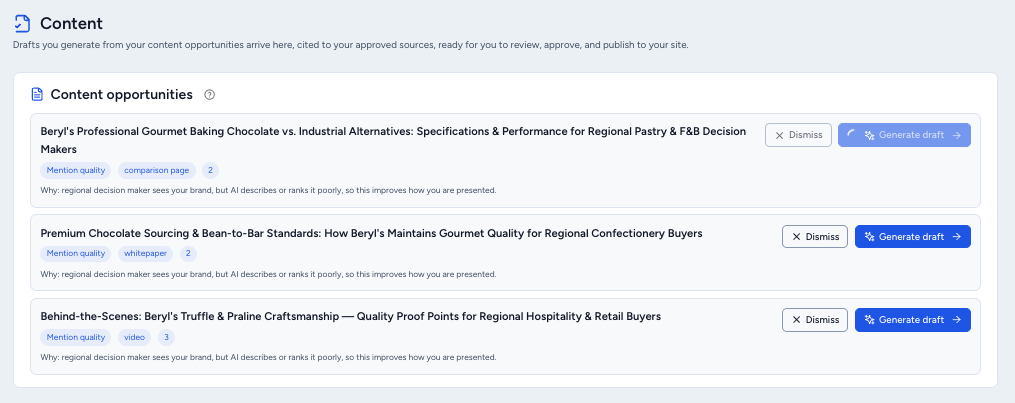
Once you've identified the questions and topics where your brand is underrepresented, the next step is to create content that addresses them clearly, accurately, and in a format AI systems can understand and use. This may involve updating existing pages, expanding thin sections, or developing new GEO-focused content based on the information your audience is actually seeking.
3. Don't stop at your own domain
Your website is only one part of the information environment AI systems can use. Depending on the platform and query, AI-powered search and retrieval systems can surface information from multiple pages and sources rather than relying on a single website. Google, for example, says its AI features may use a “query fan-out” technique to issue multiple related searches across subtopics and data sources before constructing a response. (Source: Google Search Central — guidance on AI features)
That means improving GEO isn't only about publishing more on your own domain. You also need to understand which external sources are already shaping the conversation in your category.
Start with the sources appearing in the AI answers you're tracking. Which domains are cited repeatedly? Which publications appear when competitors are recommended? Which sources show up across broader industry questions, even when they aren't talking about your brand yet?
This makes third-party analysis much more actionable. Instead of simply deciding that you need “more PR” or “more backlinks,” you can start asking which publications, platforms, or communities already influence how AI talks about your market.
Kuroma refers to the most influential sources identified across industry-level citation patterns as Kingmakers. For PR, partnership, and earned-media teams, the value is straightforward: rather than guessing which external sources might matter, you can prioritize the ones that are already appearing in the AI conversations relevant to your category.
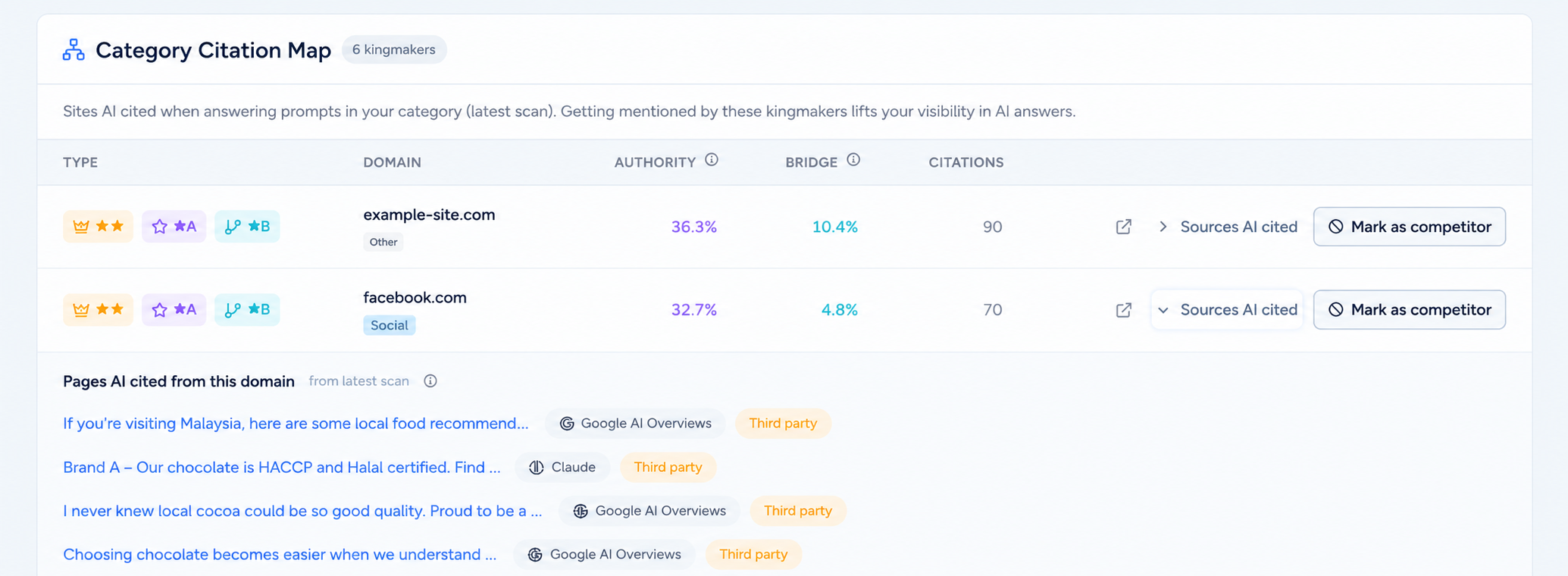
Third-party presence is also about accuracy, not just visibility. If AI repeatedly relies on an external source that contains outdated or incorrect information about your brand, publishing another article on your own website may not solve the problem. Sometimes the more useful action is to identify the source influencing the answer and correct the information there.
Benchmark against competitors
Once you've identified a gap and made a change, the work isn't finished. Measure again. Did fixing an accessibility issue change how often your brand appears? Did new content help you surface a question you previously missed? Are different sources appearing in AI answers after your PR or content efforts?
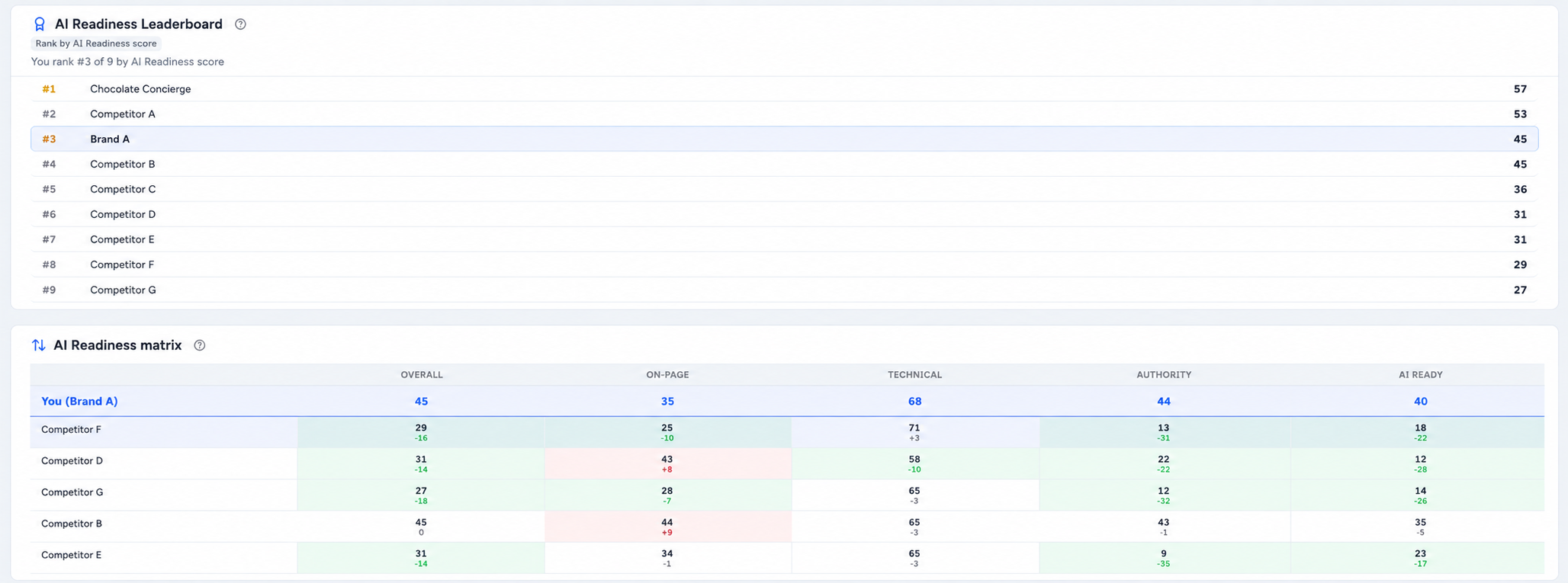
But your own score only tells part of the story. You also need to know whether you're gaining ground against competitors.
Say your brand appears in 20% of the AI answers you're tracking. If your closest competitors appear in only 5–10%, you're already ahead. If the category leader appears in 60%, the same 20% tells a very different story. And if your visibility improves from 20% to 30% while a competitor moves from 40% to 60%, your own performance has improved, but the competitive gap has widened.
This is why competitor benchmarking should be part of the ongoing GEO cycle, rather than a one-time comparison. It gives your results context and can help surface where to investigate next.
GEO improvement therefore works better as a continuous learning process:
Measure → Diagnose → Improve → Benchmark → Measure again.
Over time, you're not just tracking whether your visibility score went up. You're building a clearer picture of where you stand, whether you're gaining ground, and what deserves attention next.
The takeaway
Improving GEO starts with identifying what’s holding your visibility back. The issue may be technical accessibility, missing or unclear content, or a lack of presence in the external sources AI relies on.
The key is to know which problem to solve, where to act, and whether the change worked. That’s what turns GEO monitoring into GEO optimization.
Kuroma helps teams move from insight to action by showing how AI sees your brand, where you stand against competitors, what’s limiting your visibility, and what to improve next.
Check your AI visibility with Kuroma →
▶ This article may not be reproduced, republished, publicly broadcast, or distributed without permission. Copyright and portrait rights for all images and materials referenced in this article remain with their respective rights holders.
Frequently Asked Questions (FAQ)
Is AI visibility the same as AI readiness?
No, and mixing them up is a common source of confusion. AI readiness measures whether your own website can be accessed and understood by AI systems, a technical and content score. AI visibility measures the outcome: how often you actually get mentioned across real AI answers. A site can be technically excellent and still lose on visibility if competitors have stronger third-party coverage, and vice versa. That's exactly why comparing the two side by side, not just improving one, is the useful diagnostic step.
Do I need to fix my website before working on content or PR?
Not strictly, but sequencing helps. If your site has serious crawlability problems, pages blocked from AI bots, or content that only renders after JavaScript runs, no amount of great content or PR will get pulled in, because the engine can't reach it in the first place. Once basic access is solved, content and third-party work can run in parallel; they reinforce each other rather than needing to happen in a strict order.
How often should I re-check my GEO improvements?
Treat it as an ongoing loop rather than a one-time project. AI platforms update frequently, and even a fix that worked can lose ground as competitors update their own content. A quarterly review of your highest-value pages is a reasonable baseline, tightened to monthly for anything time-sensitive like pricing or legal content.