 Kuroma

For decades, Search Engine Optimization (SEO) has been a cornerstone of digital marketing. Businesses have invested in content, technical optimization, and search rankings to improve online visibility and attract potential customers.
But the way people search is changing.
With ChatGPT, Google AI Overviews, Gemini, Perplexity, and other LLM becoming part of how people find information, compare products, and explore recommendations, a new question is emerging:
- Is SEO still enough, or is Generative Engine Optimization (GEO) taking its place?
- Does this mean brands need to rethink everything they've built through SEO?
SEO and GEO share important foundations, but they don't always produce the same visibility outcomes. And while businesses may already be doing many things that support GEO through their existing SEO efforts, there are gaps that traditional search metrics alone cannot reveal.
The real question is no longer whether businesses should choose SEO or GEO, but how they can make both work together, and know whether their efforts are actually paying off.
Further Reading: GEO Is Here. Now What?
SEO vs. GEO: What's the Difference?
Search Engine Optimization (SEO) focuses on improving a website's visibility in organic search results, helping businesses attract relevant traffic through search engines.
Generative Engine Optimization (GEO) focuses on improving how brands and their content appear in AI-generated answers, including mentions, citations, and recommendations.
The term GEO was introduced in research later presented at the 2024 ACM KDD conference by researchers affiliated with Princeton University and IIT Delhi (Aggarwal et al.).
From Search Rankings to AI-Generated Answers
A traditional results page is a ranked list of links. The person compares the links and decides where to click, so position is the main measure of visibility.
A generative engine works differently. It retrieves relevant sources, then writes one response grounded in them, usually with inline citations. Google says AI Overviews and AI Mode may run several related searches across subtopics to build a single response (Google Search Central). In that format a brand does not only hold a rank. It also holds a share of the answer, and the person may learn which brands to consider without visiting any website.
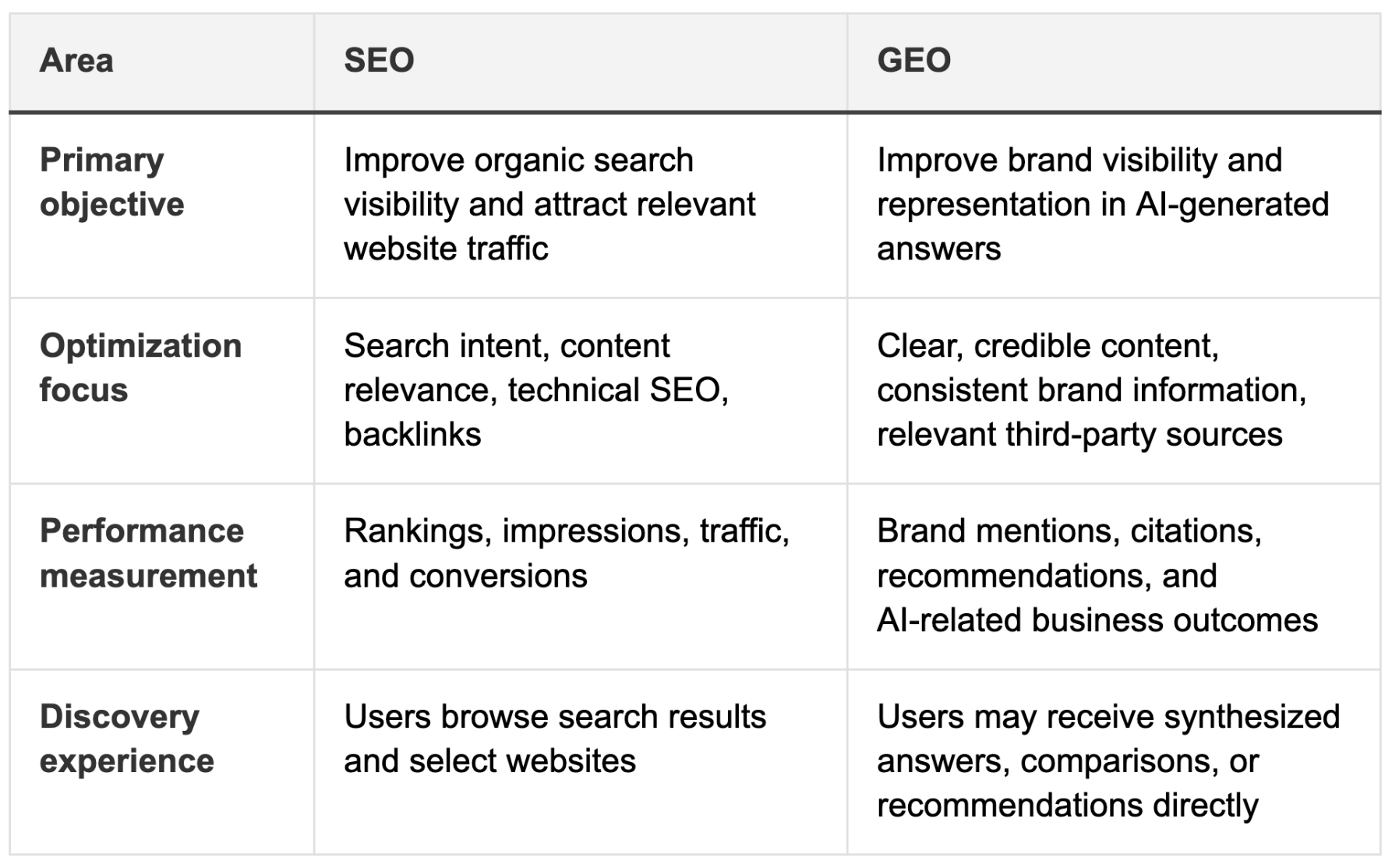
Being eligible to appear in AI search is not the same as being selected, cited, or recommended in an AI-generated answer. Strong SEO foundations can support discoverability, but they do not guarantee how a brand will be represented in AI responses.
This distinction becomes clearer in three areas:
Different systems. Google's guidance applies specifically to its own AI search features. Other platforms, including ChatGPT, Gemini, and Perplexity, use different systems and information sources, meaning brand visibility can vary across platforms.
Different optimization considerations. While SEO and GEO share many best practices, GEO places additional emphasis on how AI systems interpret, synthesize, and reference information. Research presented at KDD 2024 found that techniques involving statistics, quotations, and credible citations improved visibility in generated answers by up to 40% under experimental conditions, although results varied by technique and context.
Different measurements. Traditional SEO metrics cannot fully reveal whether a brand is mentioned, cited, or recommended in AI-generated answers. Understanding these outcomes requires additional visibility measurements.
These differences do not make SEO less relevant. Instead, they highlight why businesses need to build on existing SEO practices while accounting for how AI-powered discovery works.
Further Reading: Content Decay in the AI Era: How Google AI Overviews Are Killing Organic Traffic
How SEO and GEO Work Together
For businesses already investing in SEO, adopting GEO does not mean starting over.
Despite their differences, SEO and GEO share much of the same foundation.
Both benefit from relevant content that answers customer questions, technically accessible websites, and credible information that helps people evaluate products and services.
The opportunity is to extend existing SEO practices to account for how AI systems discover, interpret, and reference brand information.
Many familiar marketing activities can support both objectives:
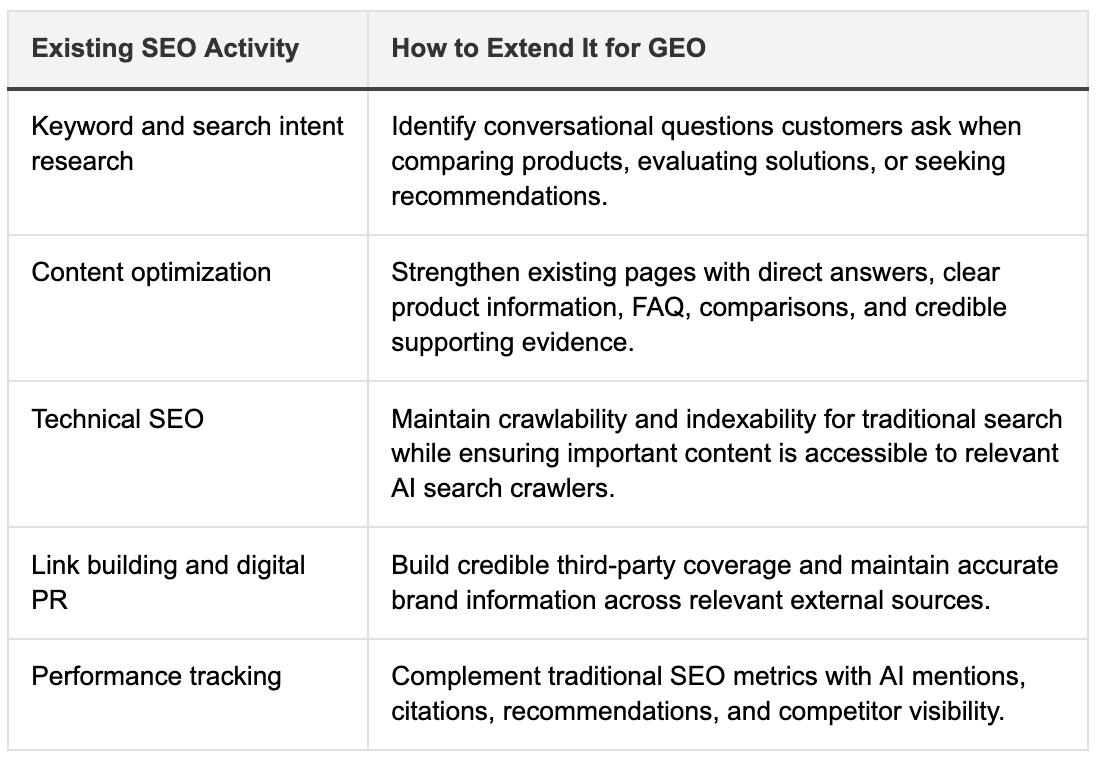
The key is not to create an entirely separate set of marketing activities, but to understand where existing efforts can serve both search experiences and where additional optimization may be useful.
One Content Strategy, Two Visibility Outcomes
Businesses can adapt existing content to support both traditional search visibility and AI discovery. For example, consider a brand optimizing a product comparison page:
- For SEO: Target relevant search intent, maintain technical accessibility, and provide useful content that can rank in traditional search results.
- For GEO: Clearly explain product differences, use cases, and supporting evidence so AI systems can interpret and potentially reference the information when answering comparison questions.
The same content can support both objectives, although visibility across traditional search and AI-generated answers may differ.
Further Reading: How to Structure Content That AI Tools Love to Recommend, The Complete Guide to AI Content Optimization
Different KPIs, Connected Performance Measurement
Although SEO and GEO can share optimization efforts, their performance should not be evaluated using exactly the same metrics.
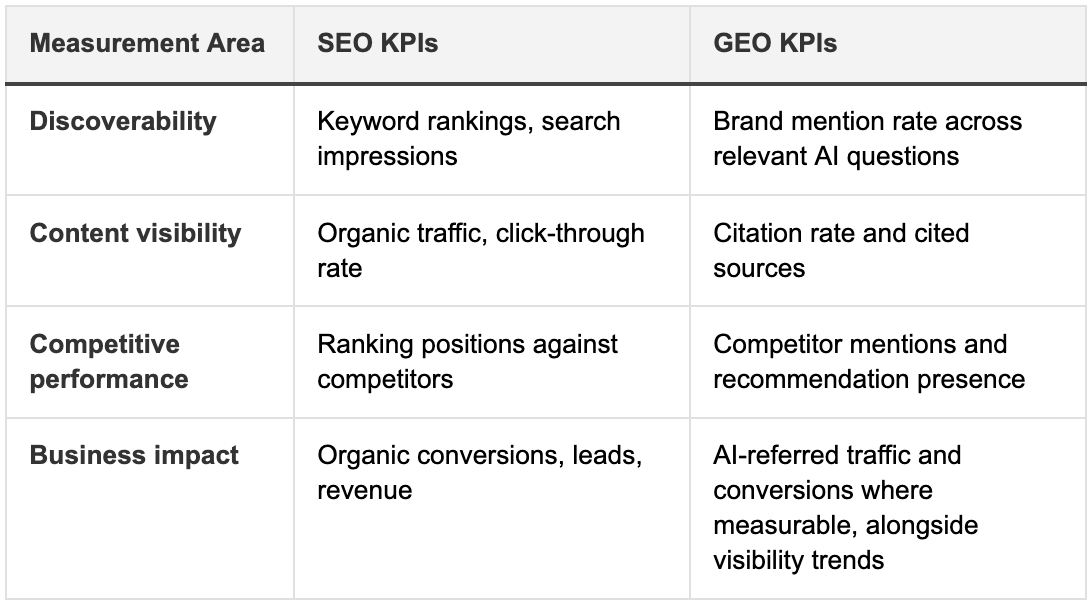
These metrics should be evaluated together rather than treated as competing measures of success.
The purpose of combining SEO and GEO measurement is to understand where a brand is visible, where it is missing, and which improvements deserve priority.
Further Reading: AI Search Performance Metrics: What Actually Measures Success
Turning SEO and GEO Insights Into Action
Comparing the two sets of results can help marketers make more informed decisions:
- Strong SEO, weak GEO visibility: Investigate whether brand information is clear, whether relevant content is being cited, and which competing sources AI systems reference.
- Weak SEO, strong GEO visibility: Identify the content and external sources associated with AI visibility while continuing to address traditional search performance gaps.
- Weak visibility in both: Prioritize foundational improvements to content relevance, accessibility, and credibility.
- Strong visibility in both: Maintain content accuracy and monitor changes across search experiences.
Because AI-generated answers can vary across questions, platforms, and time, consistent tracking is important. Checking a few prompts manually may provide an initial understanding, but it becomes difficult to compare performance and identify recurring opportunities as monitoring expands.
This is where AI visibility tools can complement existing SEO analytics, helping businesses measure brand mentions, citations, and competitor presence alongside traditional search performance.
Together, these insights support a more complete optimization strategy, connecting what customers search for with how brands are represented throughout the discovery and consideration journey.
How We Helps Brands Adapt to AI Search
As businesses begin incorporating GEO into their search strategies, measuring AI visibility consistently across multiple platforms, questions, and competitors can become challenging.
Kuroma is iKala's AI visibility intelligence and GEO platform, helping businesses understand how their brands appear in AI-generated answers across platforms.
Marketers can monitor brand mentions, citations, and competitor visibility, compare their presence with local and international competitors, and track changes over time.
These insights help businesses identify where their brands are missing, where competitors receive greater visibility, and which questions or content opportunities deserve attention first.
Rather than replacing existing SEO analytics, Kuroma adds another layer of visibility measurement. By connecting AI visibility insights with existing search performance data, businesses can better understand how they appear across different discovery experiences and prioritize optimization opportunities.
To understand how your brand appears in AI-generated answers, talk to the Kuroma team.
Check your AI visibility with Kuroma →

▶ This article may not be reproduced, republished, publicly broadcast, or distributed without permission. Copyright and portrait rights for all images and materials referenced in this article remain with their respective rights holders.
Frequently Asked Questions (FAQ)
What is the difference between SEO and GEO?
SEO improves how a website ranks in search results. GEO improves how a brand and its content appear in AI-generated answers. They share foundations (relevant content, accessibility and credibility) and work best together.
Does GEO replace SEO?
No. GEO complements SEO rather than replacing it. Strong SEO foundations, including relevant content, technical accessibility, and credibility, can support AI search visibility. However, brands also need to monitor how they appear in AI-generated answers, since strong search rankings do not guarantee AI mentions or citations.
How should a brand measure AI visibility?
Track brand mention rate, citation rate, competitor visibility and recommendation presence across several AI platforms, alongside rankings, impressions, click-through rate and organic traffic.