 Kuroma
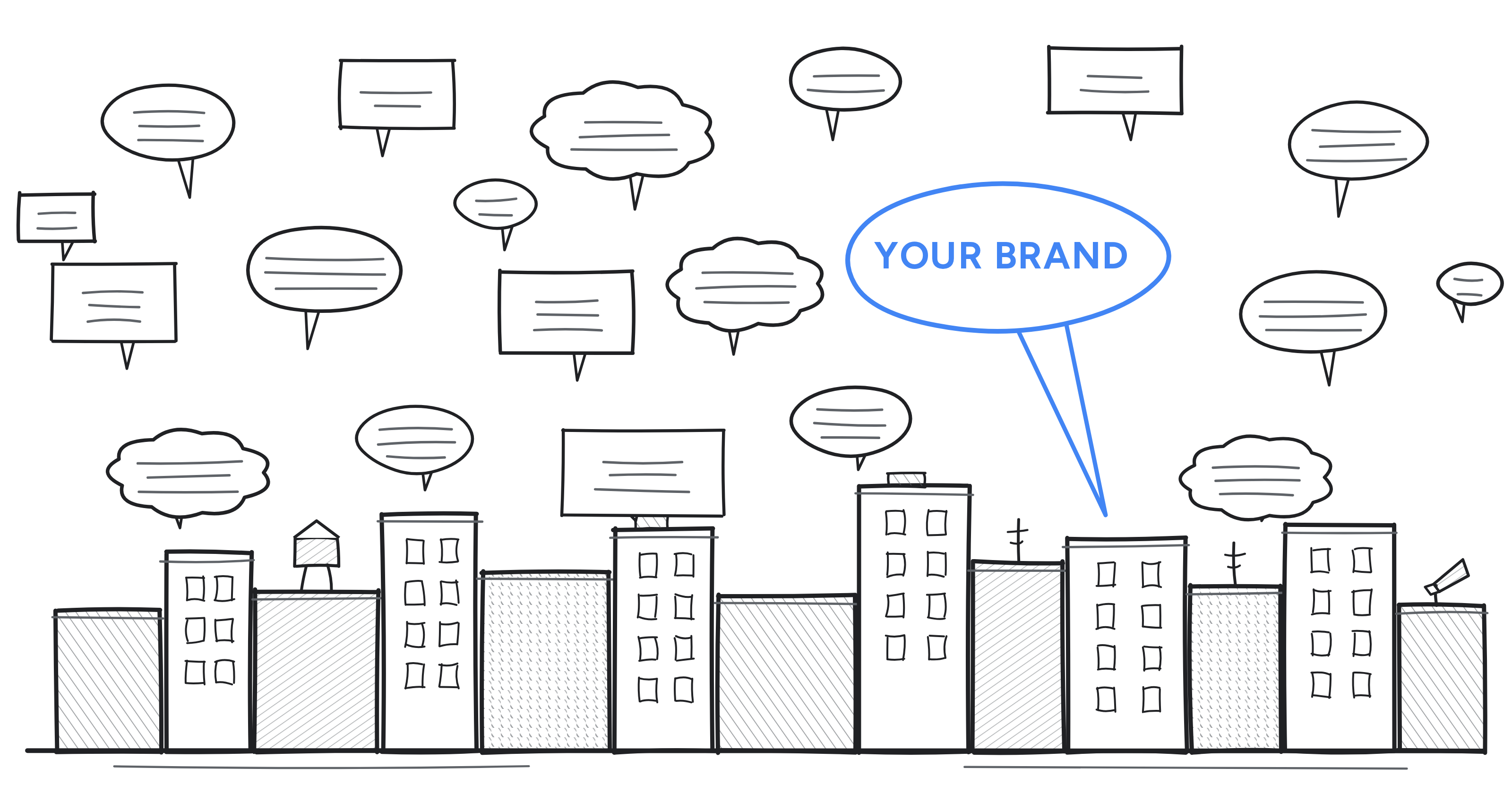
TL;DR: When ChatGPT, Google AI Mode, or Perplexity assemble a shortlist of recommended brands, they sample third-party pages: listicles, review sites, editorial coverage, YouTube, Reddit. Brand-owned domains barely register at the top of the citation stack. Your AI search visibility is decided mostly on websites you don't own, and the budget should follow that fact: earned media and third-party presence do the heavy lifting, while beloved on-site rituals like llms.txt and schema markup measure out near zero.
Most marketing teams treat AI visibility as a website project. The instinct makes sense: your site is the property you control, so that's where the optimization tickets land. Add schema. Publish llms.txt. Lengthen the pillar page. The problem is that the citation data, across every study that has measured it, says the shortlist is assembled somewhere else.
This discipline has collected too many names: GEO, AEO, AIO, AISEO. Pick whichever your team uses. Under all of them sits the same uncomfortable finding, and it changes how the money should be spent.
Where do AI answers actually get their recommendations?
When Cloro logged which domains ChatGPT cited while recommending consumer electronics, the top of the stack was YouTube at 19%, Reddit at 19%, and the reviewer RTINGS at 16%, with Google properties at 12% and editorial reviewers like PCMag and Tom's Guide at 6 to 9% each. The study's own phrasing: "brand-owned domains are conspicuously absent from the top of this list." That was shopping intent, US English, one vendor's dataset, so don't carve the percentages into stone. The shape is the finding. The pages that decide the shortlist belong to other people.
The pattern holds beyond shopping. Across 250,000 citations from ChatGPT, Perplexity, and Gemini, xfunnel found earned media (third-party editorial, review, and affiliate content) was the most frequent citation type on every engine, and 31.5% of citations came from domains with authority scores of 80 to 100. Aggregate link analyses push further: Muck Rack's 25-million-link dataset puts third-party sources around 82 to 89% of citations with owned domains near 13.7%, while Meltwater's per-engine cut lands lower, at 40 to 51% earned. These are all vendor studies with competing definitions of "earned," so hold the exact percentages loosely. What matters is that no published dataset flips the ordering.
Why doesn't your own website decide your AI visibility?
Two peer-reviewed results explain the mechanics. Kandpal et al. (ICML 2023) showed that language models fail on long-tail facts unless those facts appear repeatedly in training data; models "must be scaled by many orders of magnitude" to recall poorly supported facts, and retrieval augmentation is what closes the gap. Mallen et al. (ACL 2023) found that an entity's popularity strongly predicts whether a model knows anything about it at all.
For a brand, that leaves two doors into an AI answer. Either the model already knows you, which is a function of how often you appear in the text it trained on. Or the engine's retrieval step fetches pages that mention you, which is a function of how often you appear in the pages it trusts. Both doors open from the same side: the wider web corpus. Your own domain is one voice in that corpus, and as the citation stacks above show, it is not the voice the engines reach for first.
What correlates with actually getting picked?
The largest correlational study available is Ahrefs' analysis of 75,000 brands: branded web mentions, linked or unlinked, correlated with AI Overview visibility at Spearman 0.664. Backlinks came in at 0.218. Ahrefs is explicit that this is correlation, not causation, and brand popularity confounds everything here. Even so, a three-times gap between mentions and backlinks is not subtle. SEO spent twenty years optimizing the link; AI visibility tracks the mention, with or without one.
In Ahrefs' follow-up across ChatGPT, AI Mode, and AI Overviews, mentions on YouTube posted the highest correlation of any single factor, around 0.737. Part of that is Google surfacing its own property, but recall that ChatGPT cited YouTube more than any other domain in the shopping data too.
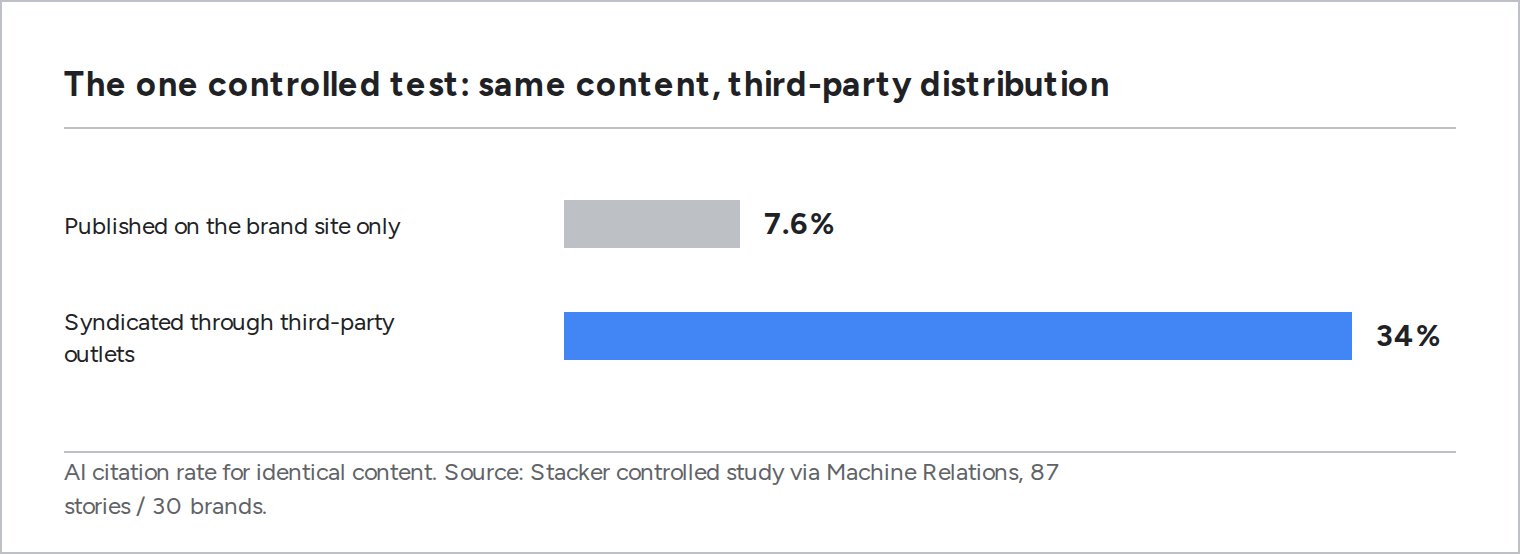
The closest thing to causal evidence comes from a controlled syndication test by Stacker: identical content had a 7.6% AI citation rate when published on the brand's site alone, and 34% once syndicated through third-party news outlets. That is a lift of about 325%, and a broader follow-up run reported a lower median near 239%. The study was run by a syndication company, so the conflict of interest is right on the label, and 87 stories across 30 brands is small. It is also nearly the only controlled distribution experiment anyone in this industry has published.
Do listicles and classic Google rank still matter?
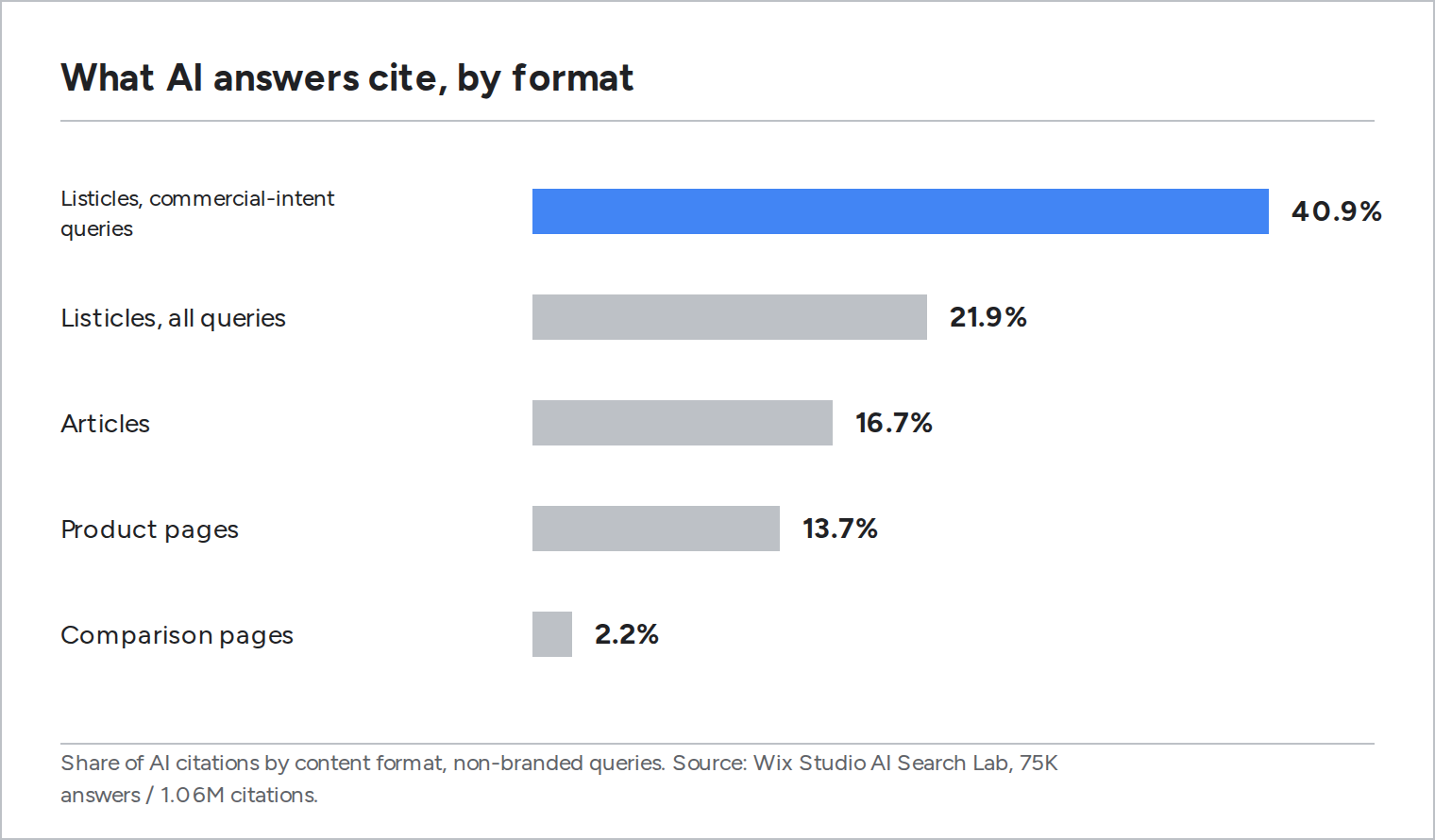
More than almost anything else. In Wix Studio's analysis of 1.06 million citations across 75,000 AI answers, listicles were the most cited format at 21.88%, ahead of articles at 16.68% and product pages at 13.66%. Comparison pages, the format brands love to build, took 2.2%. And on commercial-intent queries (by Wix's own intent classification), the listicle share jumps to 40.86%, nearly double any other format.
If your category has "best X for Y" roundups, those pages are the ballot, and publishers write them, not you. Getting named in the lists that answer engines already cite is answer engine optimization (AEO) in the most literal sense.
Classic rank feeds the same machine. In AirOps' study of 548,534 retrieved pages, pages ranking #1 in Google were cited by ChatGPT 43.2% of the time, about 3.5 times the rate of pages outside the top 20. For Google's AI Overviews, Ahrefs measured 76% of citations coming from the organic top 10 in 2025, then revised that to roughly 38% in March 2026 on a larger dataset. The direction survives the revision: rank still feeds retrieval, though the coupling is loosening.
Does schema markup or llms.txt help at all?
No, and for once the evidence is not ambiguous.
llms.txt first. Otterly's 90-day crawler log study found about 0.1% of AI crawler requests touched the file. Google's Gary Illyes confirmed Google does not support it and has no plans to; John Mueller compared it to the keywords meta tag, which is not a compliment. No major provider has confirmed using it as a signal.
Schema markup looked better on paper, then met a controlled test. Ahrefs added JSON-LD to 1,885 pages and measured the result: no effect in ChatGPT or AI Mode, and a statistically significant decline in AI Overviews. Vendor studies claiming big schema lifts are correlational citation rates, and they contradict each other. The honest reading is no reliable positive effect.
The rest of the on-page folklore does no better. Word count correlates with AI citation frequency at about 0.04, which is zero in practice. The peer-reviewed KDD 2024 GEO experiments found keyword stuffing gave little to no improvement, and an added authoritative tone gave none.
I think these rituals persist because they are legible. A developer can ship llms.txt in an afternoon and close the ticket. The mention economy is illegible: it means pitching journalists, showing up in creators' videos, being worth quoting. One of these is easy and does nothing. The other is hard and is the actual mechanism.
What still works on the pages you own?
Owned content is not worthless. It is mispriced, in both directions.
The KDD 2024 GEO paper by Aggarwal et al. remains the only peer-reviewed optimization experiment in this field. Adding source citations, quotations, and statistics to pages improved visibility in generative answers by 30 to 40% relative on the paper's position-adjusted metric. The setup was a single custom engine built on GPT-3.5 with an LLM judge, so treat the exact numbers as lab conditions. The direction is durable: evidence-dense pages get quoted, padded pages get skipped.
Placement matters too: 44.2% of citations pull from the first 30% of a page, and content buried deep in a long post is roughly 2.5 times less likely to be cited. Original numbers help when you have them: in a Growth Memo analysis of 301 pages, the 2.7% holding primary research earned 11.3 citations per page against 3.4 for everything else, though most of that effect sat in a single benchmark cluster, so publishing data is a lottery ticket rather than a guarantee.
And there is one real exception to the third-party rule: the bottom of the funnel. In xfunnel's 768,000-citation dataset, product and product-detail content took 70.46% of citations on bottom-funnel solution-evaluation queries. When a buyer is comparing specifics, engines assemble answers from spec sheets, docs, and pricing pages. Owned content earns its keep late in the journey. It goes missing upstream, where categories get framed and shortlists get formed.
How do you measure a strategy that runs on other people's websites?
Carefully, because single scans lie. SparkToro's volunteer study found the odds of getting the same brand list twice from the same prompt are under 1 in 100, and the same order closer to 1 in 1,000. Running one B2B prompt 100 times surfaced 44 distinct brands, with only about 5 appearing in 80% or more of runs. A peer-reviewed 2026 study put cross-day source overlap at 34 to 42%.
The stable signal is presence: how often you appear across many runs, not where you ranked in one. Established brands hold 60 to 90% presence for a given intent even while the ordered lists churn. Treat 10 runs per prompt per engine as a floor and score presence rate as a percentage. We covered the full measurement problem, GA4 blind spots included, in our attribution deep dive.
What does the budget inversion look like?
Line the levers up by evidence quality and by whose website they live on, and the pattern is hard to unsee.
| Lever | What the data says | Evidence grade | Where it lives |
|---|---|---|---|
| Third-party syndication | 7.6% to 34% citation rate for identical content | Controlled (vendor-run) | Other people's sites |
| Web mention breadth | Strongest correlate measured: 0.664 vs 0.218 for backlinks | Correlational | Other people's sites |
| Listicle presence | 21.9% of all citations; 40.9% on commercial queries | Correlational | Other people's sites |
| Classic Google rank | #1 pages cited by ChatGPT 43.2% of the time | Correlational | Yours and others' |
| Cite/quote/statistics edits | 30 to 40% relative visibility lift | Controlled (peer-reviewed, one engine) | Your site |
| Primary research | 11.3 vs 3.4 citations per page, heavily concentrated | Correlational | Your site |
| Word count | Spearman ~0.04 | Debunked | Your site |
| Keyword stuffing | Little to no improvement | Debunked (controlled) | Your site |
| llms.txt | ~0.1% of AI crawler requests; no engine confirms it | Debunked | Your site |
| Schema markup | No lift; slight decline in AI Overviews | Debunked (controlled) | Your site |
Everything with strong positive evidence lives wholly or partly on property you don't control. Everything debunked lives on your own.
The budget translation: PR, comms, syndication, reviewer relations, and creator outreach stop being "brand" spend evaluated on impressions. They are distribution infrastructure for the corpus AI engines sample, which makes them performance spend, evaluated on citation presence. Classic SEO keeps its seat because rank still feeds retrieval. The on-page GEO project list shrinks to the few edits with experimental support.
I sell software that scores web pages, so this conclusion costs me something to write: most of what decides AI visibility never touches the pages we score. The honest pitch for on-page work is that it sharpens the pages that third-party attention eventually points at, not that it summons the attention.
What should you do on Monday?
Five things, in order.
- Write down the ten buying questions in your category. Run each ten times on two engines. Record presence, not position.
- Collect the listicles and roundups those answers cite. Mark every one you're absent from. That's your outreach list, ranked by actual citation frequency.
- Identify the three reviewers, creators, or communities that dominate your category's citation stack, and put real budget against being covered there.
- Take this quarter's schema and llms.txt hours and move them into one syndication or digital PR test. Measure presence before and after, over many runs.
- On your two best-ranking pages, add named statistics, quotable lines, and source citations. That's the one on-page edit with experimental backing.
The shortlists in your category are being assembled right now, mostly from pages you don't own. The work that gets you into them is sitting, unfunded, in the earned media column.
Frequently asked questions
Do AI engines ever cite brand-owned websites?
Yes. Owned domains draw roughly 13.7% of citations in aggregate analyses, and far more at the bottom of the funnel, where product content takes 70.46% of solution-evaluation citations. Owned pages help close decisions. They rarely start them.
Are backlinks still worth building for AI search?
For classic rank, yes, and rank still feeds AI citations. But web mentions correlate with AI visibility about three times more strongly than backlinks (0.664 vs 0.218), and a mention counts even without a link. Being named matters more than being linked.
Is llms.txt harmful, or just useless?
Just useless, on current evidence: about 0.1% of AI crawler requests touch it and no major provider confirms reading it as a signal. It costs minutes, so keep it if you like. Expect nothing from it.
How many prompt runs before an AI visibility number means anything?
Treat 10 runs per prompt per engine as the floor, and some practitioners recommend 60 to 100. The odds of the same brand list appearing twice are under 1 in 100, so a single scan is noise, not measurement.
Are GEO, AEO, AIO, and AISEO different strategies?
They are overlapping labels for the same discipline: earning presence in AI-generated answers. Whichever term you use, the citation data points one way. The shortlist is sampled from third-party pages, so earned presence comes first and on-page hygiene second.