 Kuroma
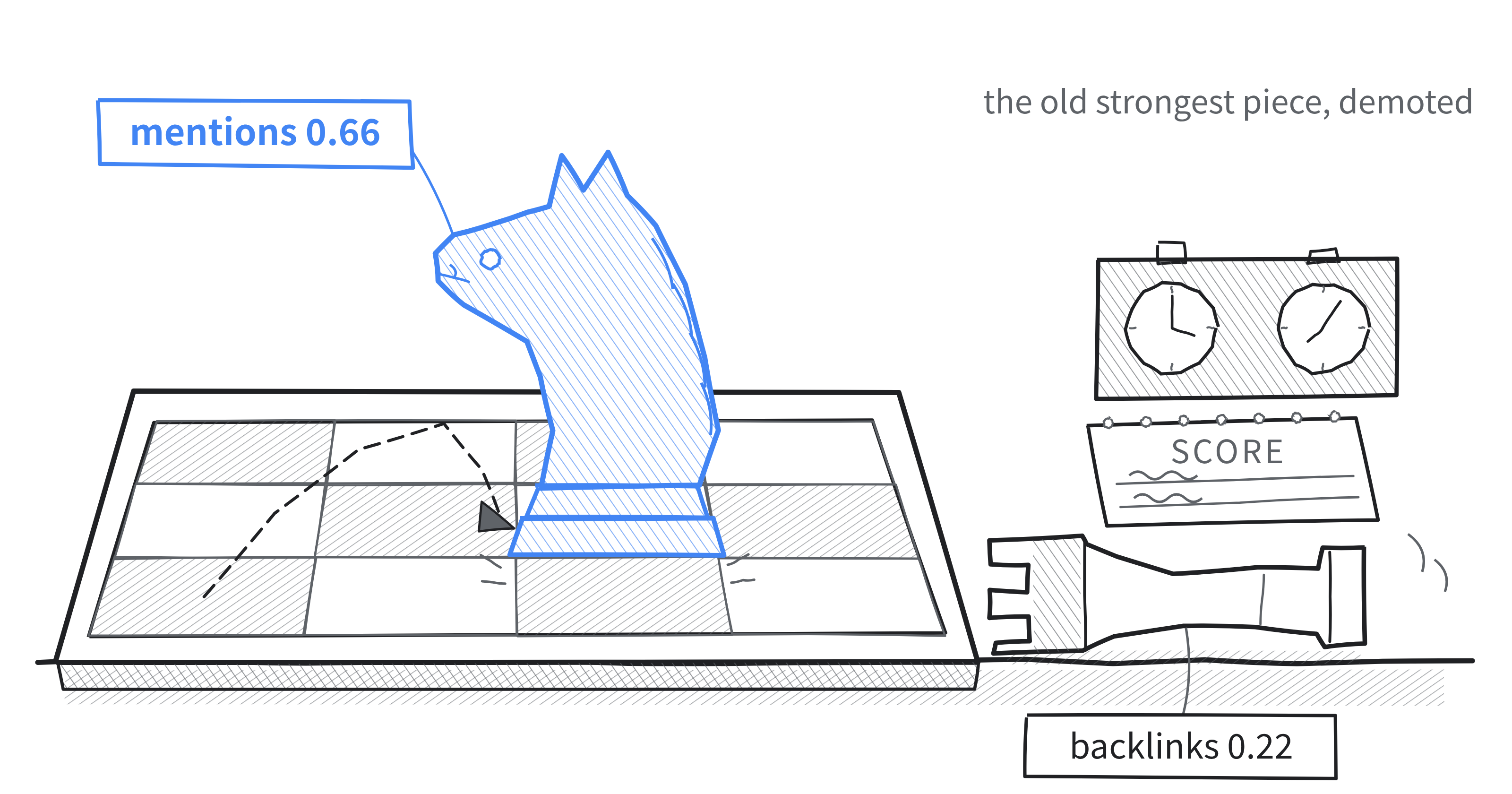
Yes, backlinks still matter. But They got demoted.
For twenty years a backlink was the closest thing SEO had to a kingmaker. One link from the right domain moved rankings, and rankings were the whole game. That referee is still on the field. It no longer decides the match. In AI search the backlink is one credibility filter among several, and on the best public data we have, brand mentions now beat it by roughly three to one.
That is not a hot take. It falls out of the largest open datasets on AI visibility, and the mechanism behind it is legible once you stop treating "AI search" as one black box. So let us go through it as operators: the proof, the why, the playbook, and the parts I would still bet against.
What ranks and what gets cited have come apart Start with the number that should end the debate about whether anything is different. Ahrefs, parsing four million AI Overview URLs across 863,000 search results, found that only 38% of AI Overview citations now come from pages ranking in Google's top 10. A year earlier that overlap sat near 76%. Moz ran 40,000 queries through Google's AI Mode and found 88% of citations came from pages outside the organic top 10 entirely.
Hold those facts next to the old model. If the chain were still links to rank to citation, one clean line, the overlap between what ranks and what gets cited would have held. It cratered instead. Something other than classic ranking is choosing who gets quoted.
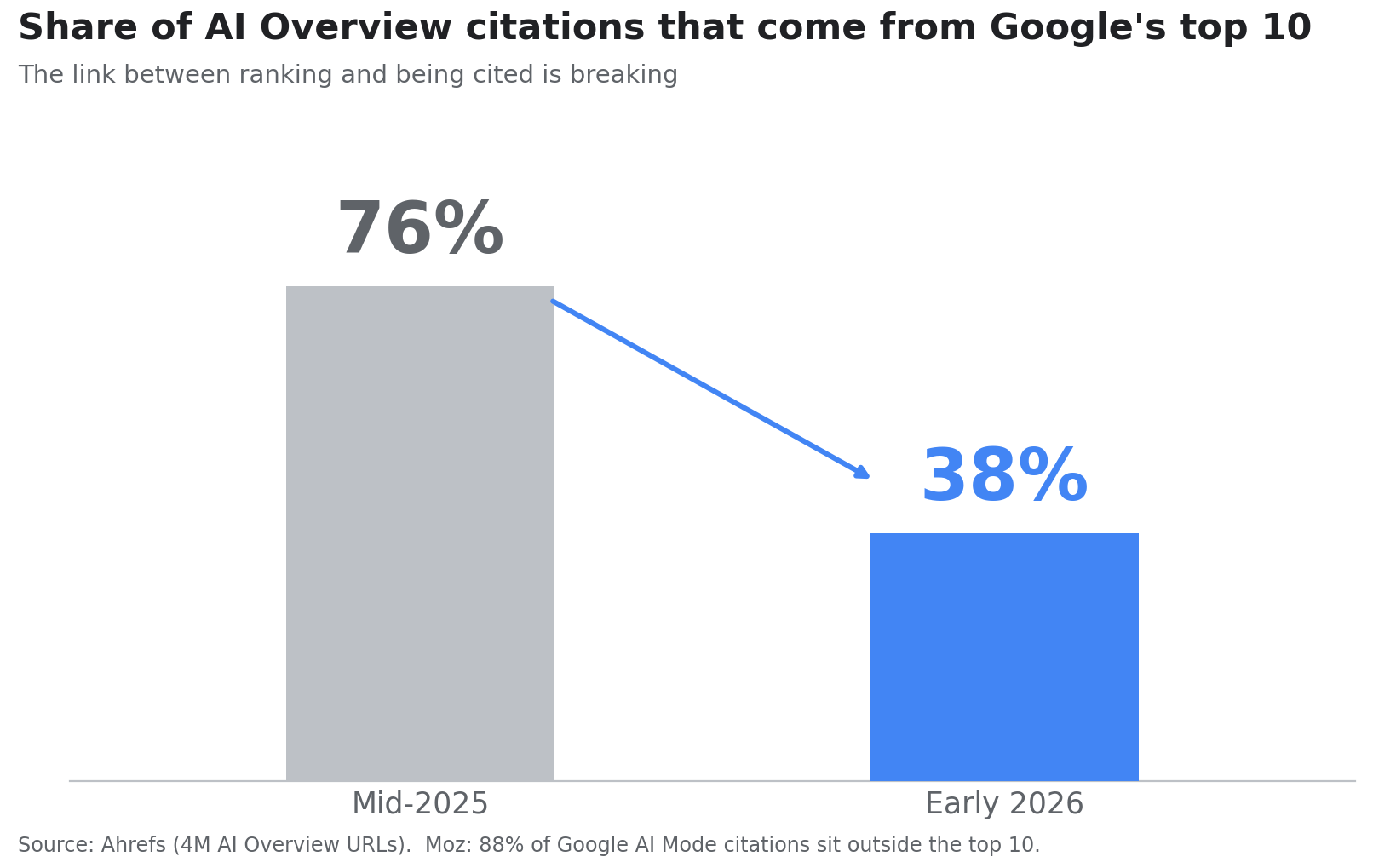
Share of AI Overview citations from Google's top 10 fell from ~76% to 38%. Sources: Ahrefs; Moz.
What the web says about you beats what the web links to
So what is choosing? Ahrefs studied 75,000 brands and ran correlations between brand properties and presence in AI Overviews, ChatGPT, and Google AI Mode. The hierarchy is blunt. Branded web mentions correlate with AI visibility at 0.664. Backlinks at 0.218. That is the three-to-one gap, in one study, on one consistent method.
It holds up the more you look. Branded anchors land at 0.527, brand search volume at 0.392, and mentions on YouTube top the whole table at 0.737. The number of pages on your own site has almost no relationship with AI visibility at all, which is its own quiet rebuke to everyone shipping programmatic content to "feed the machine." Seer Interactive, studying ChatGPT specifically, put backlinks lower still, at 0.10.
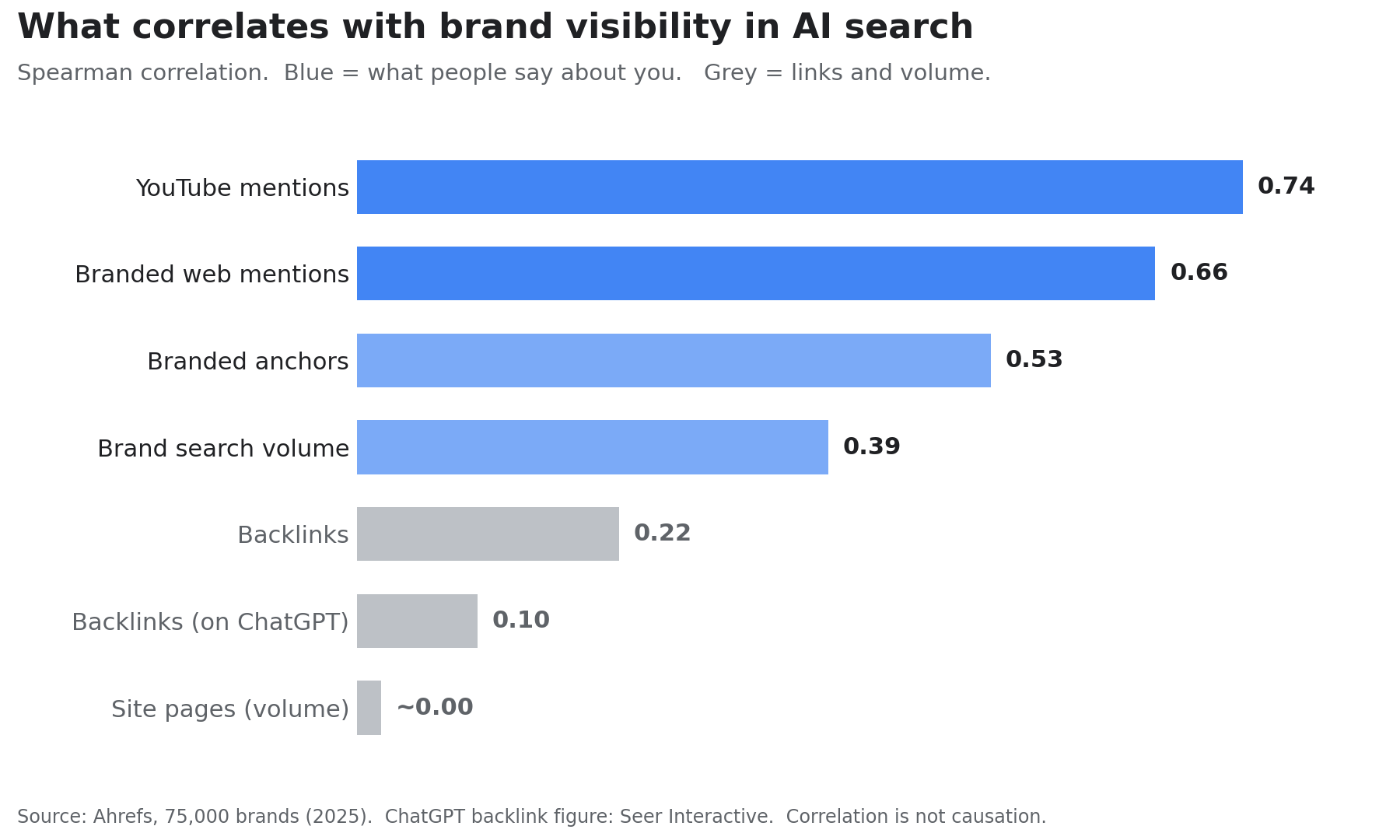
What correlates with brand visibility in AI search. Source: Ahrefs, 75,000 brands (2025); ChatGPT figure from Seer Interactive.
And the off-page picture gets sharper still. Muck Rack tracked over a million AI citations across the major platforms and found roughly 82% trace back to earned media: news, feature articles, independent editorial. Your own domain rarely shows up in that set.
Read it all together and the picture is coherent. A link is an instruction, telling a crawler where to go. A mention is a verdict, telling a model who counts. The model is shopping for verdicts.
One honest flag before you move a budget. These are correlations, and the people who published them say so. Mentions and links are collinear. The brands with strong editorial links tend to be the same ones with high mention density, so isolating the independent contribution of either is hard. The 0.218 for backlinks is "weaker," not "zero." This reorders priorities. It does not retire link building.
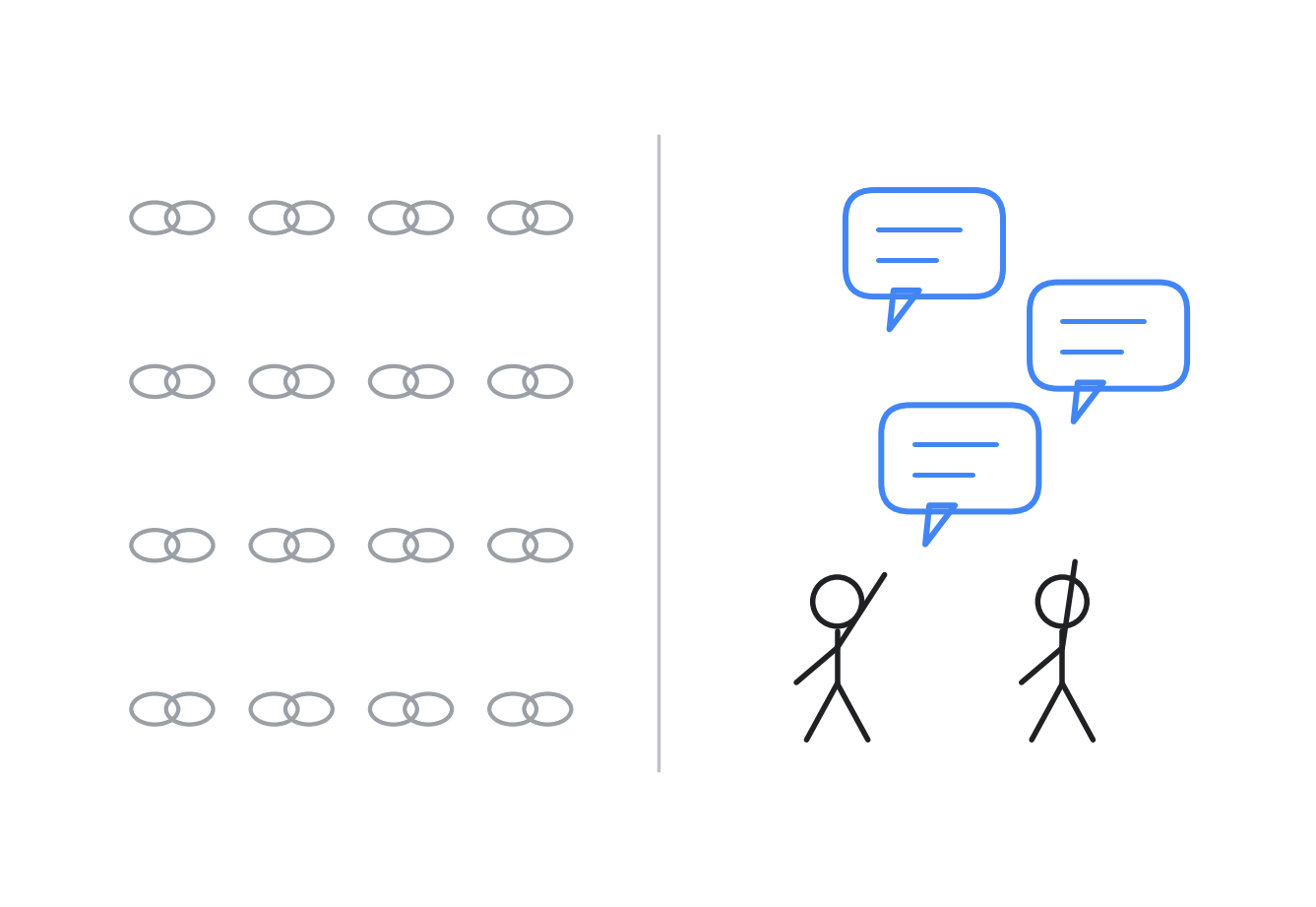
A link is something you accumulate. A mention is something people choose to give you.
Three layers, three different jobs
Backlinks fell without disappearing because the single causal chain split into three layers. Links do different work in each. This is the model that makes every number above stop being trivia and start being a map.
- Retrieval (live search). The engine does query fan-out: it shatters your question into many sub-queries and runs each through a retrieval system, often Google's or Bing's index underneath. Backlinks still influence which pages surface as candidates, through their effect on classic rank. Cyrus Shepard's Zyppy meta-analysis of 54 studies ranks the highest-evidence factors here as URL accessibility (9.5 / 10), search rank (9.4), and fan-out rank (9.3). You cannot be cited if you were never retrieved.
- Citation selection (synthesis). Once candidates are in hand, the model decides who to quote. Here links lose ground to mention density, freshness, passage extractability, and earned-media trust. This is where the 0.664-against-0.218 gap lives, and it is why a page that ranks can still go uncited while a page that barely ranks gets pulled into the answer.
- The training prior (what the model already believes). Links and mentions also shape how often you appear in the public datasets models train on, which sets what the model knows about your brand before any live search runs. This is the slow layer. You cannot optimize it for a model that already shipped, but every editorial mention you earn today is teaching next year's model that your brand is a known entity.
A note on the stats everyone repeats. Fresh content does get cited more. But the popular "4.3x" freshness figure in circulating decks is inflated and unsourced. The defensible number, from that same 54-study meta-analysis, is closer to a 25.7% edge. If you are going to brief a CFO on this, brief the number that survives scrutiny.
First question: can the AI even reach you?
Before any of this matters, the engine has to be able to read your page. Most brands skip this step, and in 2026 it became a live risk.
On 1 July 2025, Cloudflare, which sits in front of roughly 20% of the web, flipped its default from opt-out to opt-in: new domains now block AI crawlers unless the owner allows them, with a Pay Per Crawl option that charges bots via HTTP 402. Useful against scrapers. The catch is in the mix. As of mid-2025, about 80% of AI bot activity was training crawl, around 17% supported search and citation, and roughly 3% were on-demand fetches triggered when a real user asks about you by name. A blunt block aimed at the 80% also kills the 17% that feeds citations and the 3% that lets ChatGPT pull your page the moment a customer types your brand. You end up paying the cost of being scraped and keeping none of the upside of being cited. Yes, your own CDN setting can be the reason you are invisible.
So the first audit is mechanical. Check your robots rules. Check your CDN and bot-management config. Check that pages render without requiring heavy client-side JavaScript, because some citation crawlers still choke on it.
# robots.txt · allow the crawlers that actually cite you
# (training crawl and citation crawl are different bots; allow the latter)
User-agent: OAI-SearchBot      # ChatGPT search + citation
Allow: /
User-agent: PerplexityBot      # Perplexity
Allow: /
User-agent: Google-Extended    # governs Gemini / Vertex use of your content
Allow: /

# Then confirm reachability past the CDN, not just robots:
curl -A "OAI-SearchBot" -I https://yourdomain.com/key-page
# expect: HTTP/2 200   (a 403 means your edge is blocking the bot)
The playbook: five moves that match the data
The off-page budget that made sense in 2022 is mis-allocated for 2026. Here is the reorder, mutually exclusive and collectively exhaustive, each move tied to a finding above.
- Be reachable. Audit crawlability first: robots rules, CDN and bot config, server-side rendering. No reach, no citation. Full stop. This is the cheapest, highest-leverage fix on the list and the one teams forget.
- Be extractable. The Princeton GEO study (Aggarwal et al., KDD 2024) tested nine tactics across 10,000 queries and lifted AI visibility up to 40%. The winners needed no redesign, only restructuring: add specific statistics, cite credible sources inside your content, add expert quotations, lead each passage with the answer. AI cites passages, not pages, and lower-ranked pages gain the most. Make every paragraph survive being lifted out of context.
- Be mentioned. The big lever, and you cannot fake it. Earn named references where models read: industry press, analyst notes, Reddit and forum threads, YouTube titles and transcripts (the single strongest correlate), LinkedIn, review sites like G2 and Capterra, Wikipedia. A mention requires an editorial verdict, which is exactly why it carries signal a link cannot. Run link building as digital PR, not as a vending machine.
- Rank across a cluster, not for one term. Fan-out rewards topical coverage. Rank for the sub-queries the engine generates, not just the headline keyword. One number-one ranking is worth less than competent coverage of a whole question.
- Measure the right thing. Stop reporting Domain Rating and referring-domain counts as headline KPIs. Track share of citation (also called share of model): how often your brand appears in AI answers for your priority queries, measured per surface, because ChatGPT, Perplexity, AI Overviews, and AI Mode each weight signals differently.
Where I would stay skeptical
This field is about two years old. The data is correlational and largely vendor-reported, and correlation is not causation. The strongest correlates may be proxies for something a future model prices differently.
The surfaces diverge, which matters more than any single statistic. ChatGPT correlates weakly with classic authority metrics and may be the easiest entry point for a brand without a big link profile. AI Mode weighs branded anchors more heavily. AI Overviews lean on Google's index and now run on Gemini 3, so they move whenever the model moves. A tactic that wins on one surface this quarter can underperform on another next quarter. Anyone selling you a single "AI SEO score" is selling you a simplification.
So here is what I keep turning over
Today, links still earn their keep at the retrieval layer, because the big AI engines still borrow Google's and Bing's ranking to decide what to read. As models lean harder on their own crawls and their own parametric memory, and lean less on that borrowed retrieval, does the last real job of the backlink erode too?
And if mention density is what wins, is "mention density" a durable signal, or is it just the current proxy that a smarter model reprices the moment it can tell the difference between coverage that was earned and coverage that was bought?
I have a guess. I would rather have your read.