 Kuroma
On July 21, 2026, Google rolled out Gemini 3.6 Flash, its new workhorse model, to everyone in the Gemini app. Most people who use it will not notice anything. The app looks the same, the prompt box is where it always was, and answers still arrive in a second or two. What moved sits underneath: the model that writes those answers. When that model changes, your AI visibility can change with it, meaning whether Gemini names your brand at all, and where in the answer.
The short version
Google shipped Gemini 3.6 Flash on July 21, 2026 as its new workhorse Flash model, rolling out to everyone in the Gemini app. According to Google, it uses about 17% fewer output tokens than 3.5 Flash and scores higher on its coding, computer-use, and machine-learning benchmarks, at a lower price per token.
Flash is the model most people actually get, and Google keeps handing that default seat to the newest Flash version. A newer model writes different text, which can reorder or even drop the brands an answer names. In our own testing, we found that re-running the same prompts after a model swap regularly changes the wording of the answer, and sometimes who gets mentioned. So if your last visibility reading ran on 3.5 Flash, it is already describing a model your buyers have moved off. Kuroma now scans Gemini 3.6 Flash, and the only reliable way to know where you stand is to measure the model that is live right now.
What did Google actually change on July 21?
Google released three models at once: Gemini 3.6 Flash, plus two smaller ones, 3.5 Flash-Lite and a security-tuned 3.5 Flash Cyber. The one that matters for most people is 3.6 Flash, which Google calls its "workhorse model".
Google's framing: 3.6 Flash is the workhorse tier, cheaper to run than 3.5 Flash, and rolling out to everyone in the Gemini app.
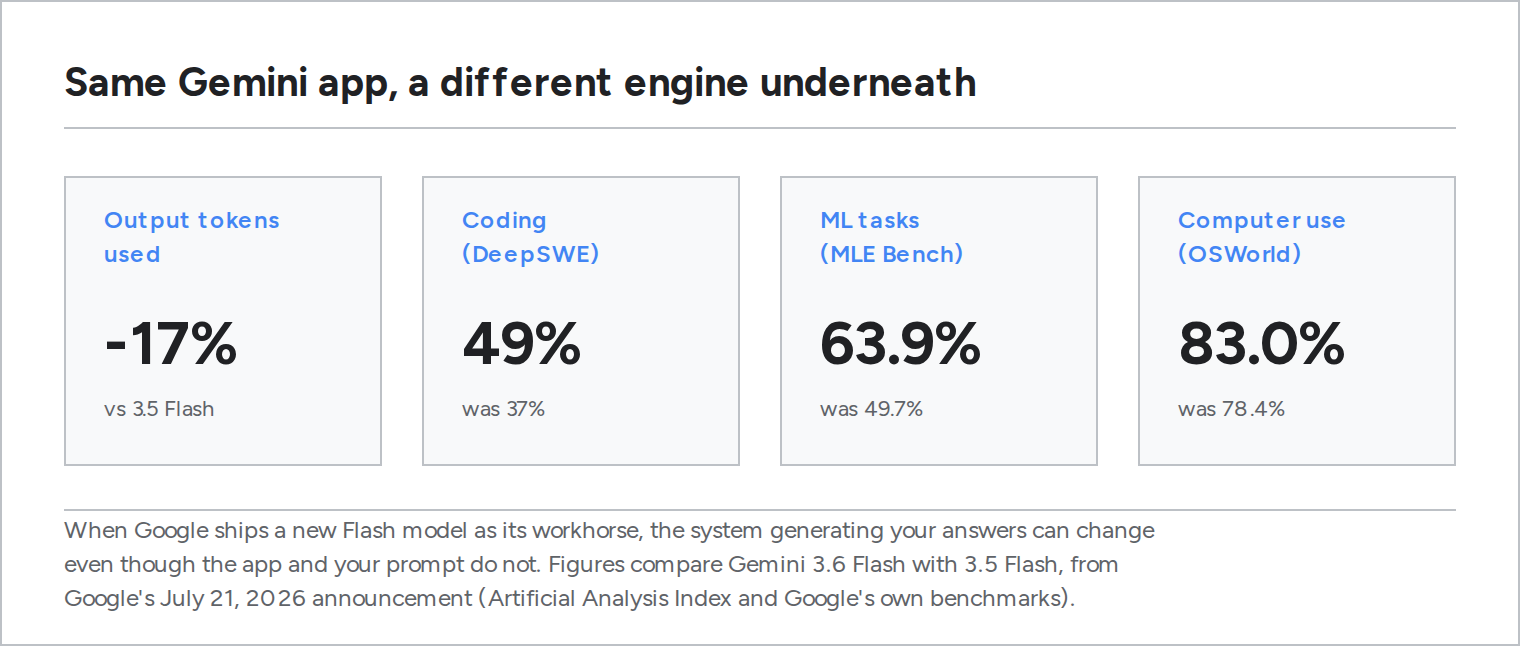
According to Google, 3.6 Flash uses about 17% fewer output tokens than 3.5 Flash on the Artificial Analysis Index, and up to 65% fewer on the DeepSWE coding benchmark. It is priced at $1.50 per million input tokens and $7.50 per million output tokens, which Google's developer changelog describes as a lower price point than 3.5 Flash. According to the same announcement, the capability numbers moved significantly too:
| Measure | Gemini 3.5 Flash | Gemini 3.6 Flash |
|---|---|---|
| Output tokens used | baseline | about 17% fewer |
| Coding (DeepSWE) | 37% | 49% |
| Machine learning (MLE Bench) | 49.7% | 63.9% |
| Computer use (OSWorld-Verified) | 78.4% | 83.0% |
| Agentic value (GDPval-AA v2) | 1349 | 1421 |
3.6 Flash is rolling out for everyone in the Gemini app, for developers through the Gemini API, Google AI Studio, and Antigravity, and for enterprises in the Gemini Enterprise Agent Platform. Notably, Google has not shipped a 3.5 Pro to everyone yet; it says that is coming soon, and it has started pre-training Gemini 4. So this is not the last swap you will see this year.
Why does a Flash model matter more than the flagship?
Most people never touch the flagship. They open the app, type a question, and take whatever the default gives them. That default is Flash, the fast and cheap tier Google tunes for everyday use. Pro models get the launch headlines, but Flash answers the bulk of real queries.
Google also keeps handing the default seat to the newest Flash. According to Google, when Gemini 3 Flash shipped it was "now the default model in the Gemini app, replacing 2.5 Flash", and it rolled out as the default for AI Mode in Search too. When 3.5 Flash arrived, it became the default for the Gemini app and AI Mode in Search globally. Now 3.6 Flash is the one rolling out to everyone. Whether or not Google flips a switch labeled "default" for it this time, the model behind the answer most people get has moved again.
Does a model swap really change which brands get named?
It can, and the mechanism is not mysterious. A new model is trained and tuned differently, and Google's own benchmarks show 3.6 Flash behaving noticeably differently from 3.5 Flash: 49% versus 37% on coding, 83.0% versus 78.4% on computer use, 63.9% versus 49.7% on machine-learning tasks. The same retraining that moves a benchmark score also moves the wording of an ordinary answer, including which sources it leans on, which products it lists first, and whether it names you at all.
That is the uncomfortable part of AI search. You are querying a system Google reserves the right to replace, and it just did. For example, a comparison answer that put you second last month can put you fourth this month for no reason you controlled, because the model underneath is new. We have watched exactly that happen in our own scans when a default model changes.
How would you know if your AI visibility moved?
You would have to ask the model people are actually getting, and ask it more than once. A screenshot from June ran on an older Flash. An answer a colleague checked by hand yesterday might have run on 3.6 Flash, with nothing on screen telling them which model replied. There is no version stamp on an AI answer.
Measuring AI visibility properly means three things: pin down the engine you are testing, run the prompts your buyers really type, and repeat the runs, because a single answer is noisy and a single model is a moving target. This is the work behind GEO and AEO, sometimes called AISEO or AIO. Done once a year, it tells you almost nothing. Done on the model that is live right now, it tells you where you actually stand.
What should you do the week a new default ships?
Our approach when a new default ships comes down to four steps:
- Re-scan on the new model. A visibility reading taken on the model it replaced is already history.
- Compare against your last baseline. Look for prompts where you fell out of the answer or slid down the list.
- Trace the movement to sources. AI answers lean heavily on third-party pages, so if a page that used to get you cited stopped getting pulled, that is your first lead.
- Fix where the mentions actually come from. A lot of GEO and AIO work lives on pages you do not own, not on your own site.
How is Kuroma handling the Gemini 3.6 Flash swap?
Kuroma now scans Gemini 3.6 Flash. When Google promotes a new default-tier model, we move our scans onto it, so the visibility score you open reflects the model your buyers get today rather than the one it replaced. The bundled auto-refresh re-runs your prompts on the current model, and our analysis holds the new reading up against your last one so you can see exactly which answers changed and by how much.
That is the whole idea of treating AI search visibility as a live measurement rather than a one-off audit. Kuroma was among the first tools built for this, and it is one of the few that keeps re-measuring as the models change. The engine keeps shifting underneath you, so the number has to be taken again each time it does. A dashboard that quietly keeps reporting a 3.5 Flash reading after 3.6 Flash went live is not measuring your visibility. It is measuring a museum.
Is this just going to keep happening?
Yes, and Google has more or less said so. It has not released 3.5 Pro to everyone yet and says that is coming soon, and it has already begun pre-training Gemini 4. The rhythm of the last year, from 2.5 Flash to 3 Flash to 3.5 Flash to 3.6 Flash, is now the normal pace.
Every one of those swaps is a chance for your AI visibility to move without anyone telling you. The brands that keep up are the ones checking continuously, on whatever model is answering today, and acting on the pages that feed those answers.
Frequently asked questions
What is Gemini 3.6 Flash?
According to Google, Gemini 3.6 Flash is its new workhorse Flash model, released on July 21, 2026 and rolling out to everyone in the Gemini app. It uses about 17% fewer output tokens than 3.5 Flash while scoring higher on coding, computer-use, and machine-learning benchmarks, at a lower price per token.
Is Gemini 3.6 Flash the default model in the Gemini app?
Google announced that 3.6 Flash is rolling out for everyone in the Gemini app as its workhorse model, but its announcement did not use the word "default" for 3.6 Flash specifically. The previous two Flash generations did become the default: Gemini 3 Flash replaced 2.5 Flash as the app default, and Gemini 3.5 Flash became the default in the app and in AI Mode in Search globally.
Does a new AI model change which brands get recommended?
It can. A new model is trained and tuned differently, which changes how it writes an answer, including which sources it pulls and which products it names first. According to Google's benchmarks, 3.6 Flash and 3.5 Flash score differently across coding, computer use, and machine-learning tasks, which is evidence the underlying behavior shifted, and answer wording shifts with it.
Why measure AI visibility on the current model instead of once a year?
Because the model behind the answers keeps changing. A reading taken on 3.5 Flash may not describe what 3.6 Flash says today. GEO and AISEO work is only meaningful when it is measured on the engine users are actually getting, and repeated as that engine changes.
Does Kuroma scan Gemini 3.6 Flash?
Yes. Kuroma now scans Gemini 3.6 Flash, so your AI visibility score reflects the model your buyers get today. When Google promotes a new default-tier model, Kuroma moves its scans onto it and lets you compare the new reading against your last baseline.