 Kuroma
Run the same product question through ChatGPT and Google AI Mode and you will often see two different brand lists, citing two different sets of pages. Marketers usually read that as noise. It isn't. The two answers were assembled by two different machines, and in many cases one of those machines never looked at the live web at all. Understanding that assembly line, retrieval-augmented generation, or RAG, is the difference between optimizing for AI search and optimizing at it.
TL;DR: AI engines build answers in two modes. In memory mode the model writes from its training data and retrieves nothing, so a brand it never absorbed cannot appear; roughly a third of ChatGPT prompts trigger a live search, and that share is falling. In retrieval mode each engine searches differently: Google AI Mode expands one prompt into about 9 sub-queries against Google's index, ChatGPT issues about 2 against a Bing-anchored stack, and Perplexity queries its own 200-billion-URL index. Citation is won or lost at retrieval time, engine by engine.
What are the two modes behind every AI answer?
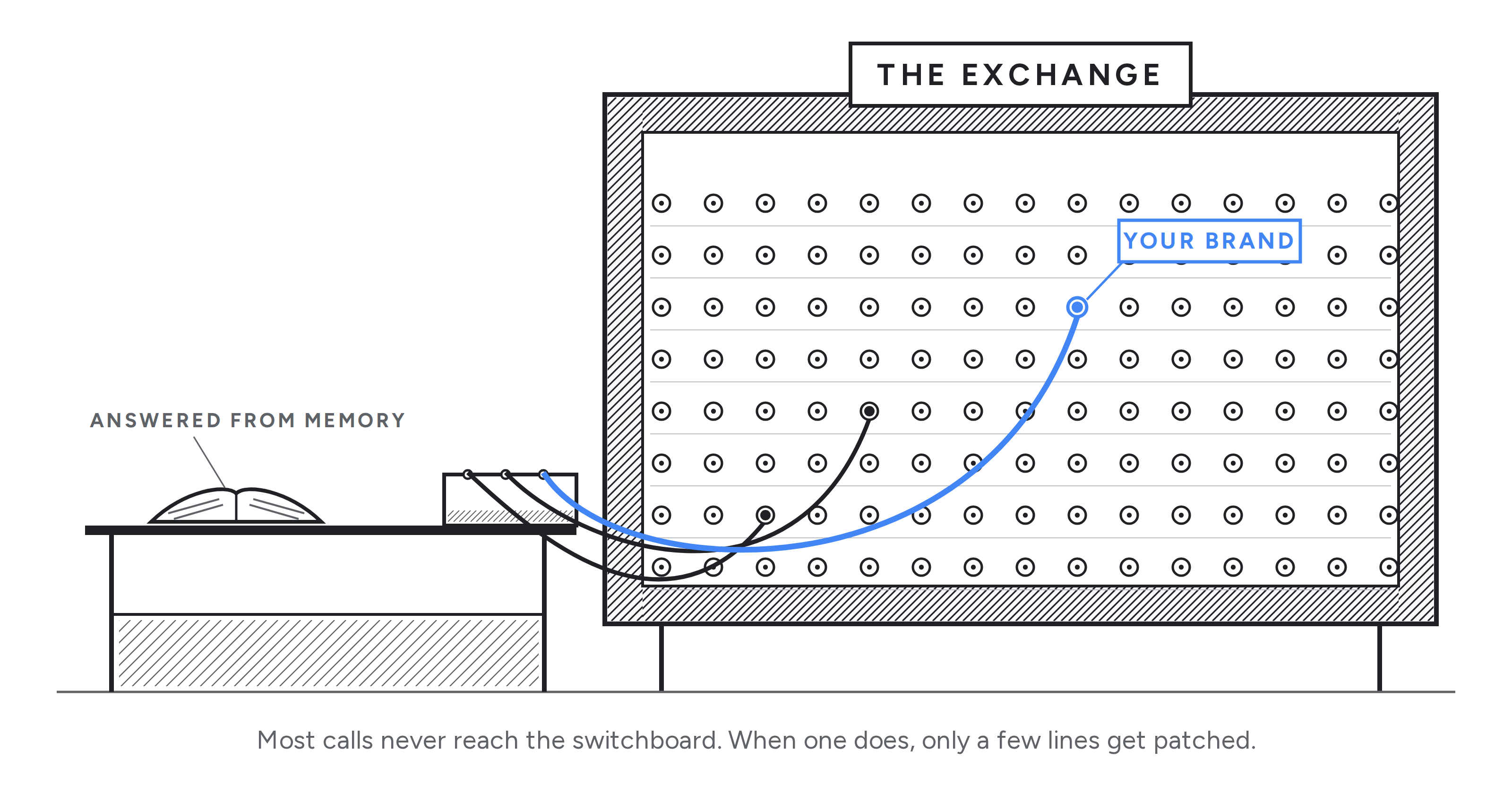
Every AI answer is produced one of two ways. Either the model writes from what it memorized during training (call it parametric or memory mode), or it runs a live search first, reads the retrieved pages, and writes from those (retrieval-augmented mode). Only the second mode can cite a source it fetched. The first mode can only repeat what the training corpus taught it.
The split between the two is more lopsided than most GEO plans assume. When Nectiv ran 8,500+ prompts through ChatGPT, only 31% triggered at least one live web search. The trigger rate ranged from 18% for credit-card prompts to 59% for local ones. Semrush's US clickstream panel, a different methodology, puts the search-enabled share of ChatGPT queries at 34.5% as of February 2026, down from about 46% in late 2024. Two studies, two methods, one direction: most ChatGPT answers involve no live retrieval, and the searching share is shrinking, not growing.
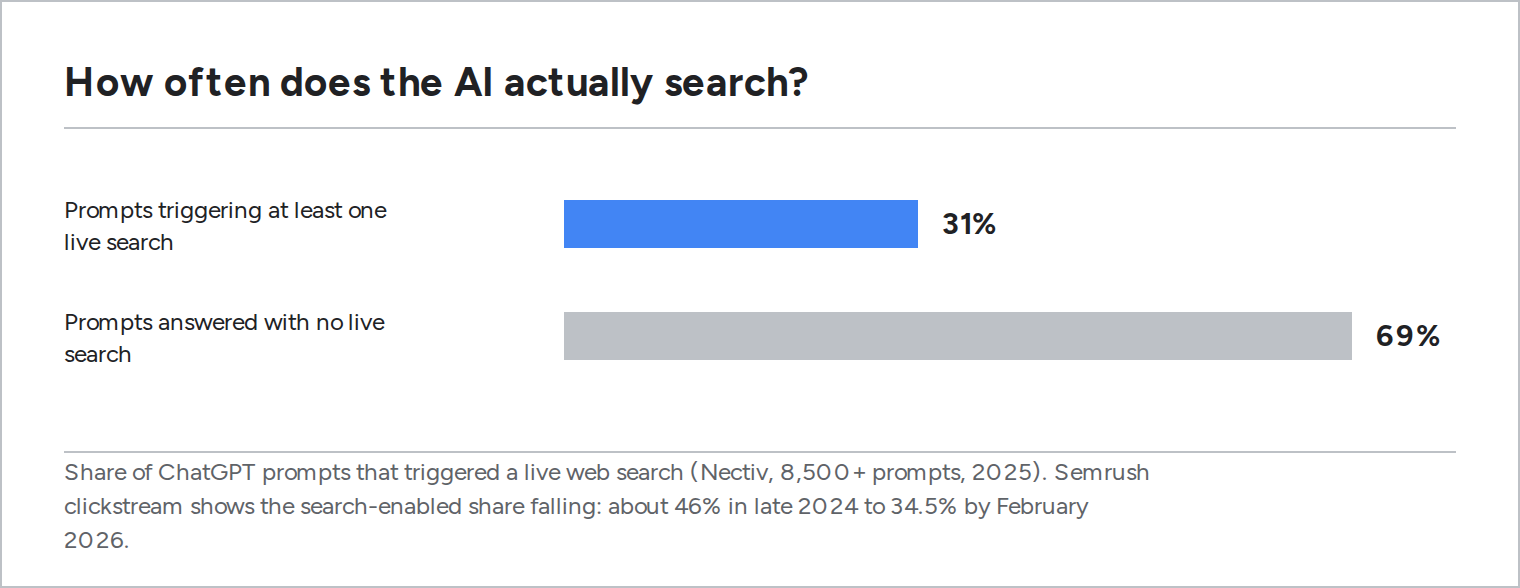
Nectiv did not analyze how the non-searching two-thirds were answered, but the mechanics leave one option: with no retrieval step, the answer contains only what the model already carries in its weights.
Why do long-tail brands vanish in memory mode?
Here is the part that should bother you. When no search fires, the candidate pool for that answer was frozen the day the model finished training. A brand that appeared rarely in the training corpus is not competing and losing in those answers. It was never entered.
This is why two brands with comparable products and comparable websites get wildly different AI visibility. The heavily covered brand exists inside the model's memory and gets recommended even when nothing is retrieved. The lightly covered one gets a chance only when retrieval fires and its pages enter the candidate pool. No amount of on-site tuning changes what a frozen model already believes; that takes third-party coverage that survives into the next training run, which moves on a scale of quarters.
Whatever your team calls this discipline, GEO, AEO, AISEO, or AIO, the plan should say which mode it is optimizing. Most GEO plans are retrieval-side plans built on the assumption that the engine always searches. On ChatGPT, the assumption fails about two times in three.
What happens when the engine does search?
When retrieval does fire, the answer passes through four stages, and a brand can drop out at each one:
- Retrieval: the engine turns your prompt into one or more search queries and runs them against an index.
- Candidate pool: the pages those queries return are fetched and read.
- Synthesis: the model writes an answer from the passages it judged relevant.
- Citation: a subset of the used sources gets linked in the visible answer.
The funnel is brutal. AirOps traced 15,000 ChatGPT prompts and watched them expand into 43,233 search queries, retrieving 548,534 pages, of which 85% were never cited. Being retrieved is necessary and nowhere near sufficient. We walked each stage in detail in our five-stage RAG funnel piece; this article is about why the same funnel produces different winners on different engines.
How differently do engines retrieve for the same question?
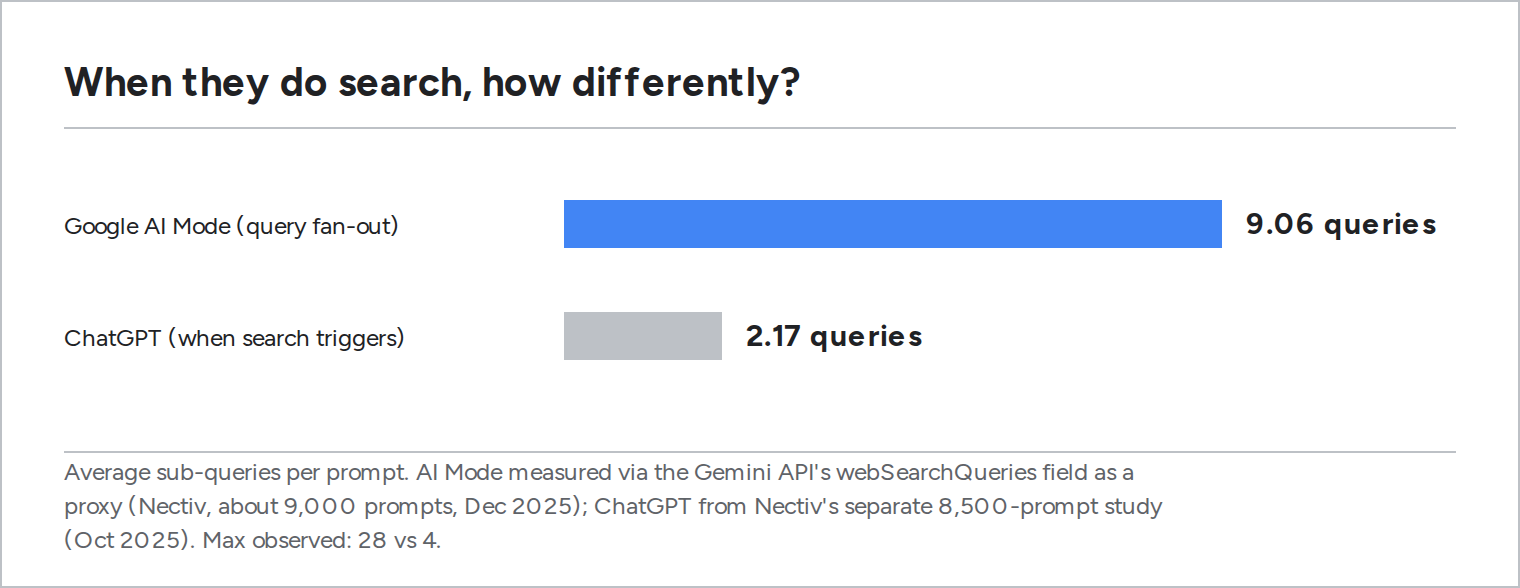
Google's official description of AI Mode is the "query fan-out technique": breaking a question into subtopics and issuing multiple queries simultaneously. Google publishes no count. The best third-party measurement, by Nectiv through the Gemini API's webSearchQueries field as a proxy for AI Mode, found an average of 9.06 fan-out queries per prompt, with 59% of prompts producing between 5 and 11 and a maximum of 28.
ChatGPT, in Nectiv's separate study, averaged 2.17 searches per searching prompt, with a maximum of 4. Roughly a 4x gap. One engine casts a wide net of sub-queries; the other makes a couple of narrow probes. If your content answers the exact prompt but not its sub-questions, AI Mode may still find you through a fan-out query. ChatGPT probably won't.
Which index does each engine search?
Fan-out counts are half the story. The other half is which index those queries hit: a brand invisible to the index cannot be retrieved, however good the content.
ChatGPT's search leg leans on Microsoft: Bing is the only web-search engine OpenAI names in its own help documentation, and Seer Interactive found that 87%+ of SearchGPT citations matched Bing's top organic results versus a 56% match with Google. OpenAI also runs its own crawler, OAI-SearchBot, and sites that block it are excluded from ChatGPT's search results. Your Bing indexing, which almost nobody audits, quietly gates your ChatGPT visibility.
Perplexity went the other way and built its own index, which it says tracks more than 200 billion unique URLs. Its docs recommend allowing PerplexityBot in robots.txt to ensure your site appears in its search results. Google's AI Overviews sit on the opposite foundation again: a Gemini model customized for Search, paired with the same crawl, index, and ranking systems as classic Google. And the Gemini app is conditional by design: according to Google's API documentation, the model decides per prompt whether a search would improve the answer and issues zero to many queries accordingly.
Each engine pairs its own index with its own trigger logic and fan-out depth, and the result is measurable: across identical prompts, the highest domain overlap between any two engines' citations was 25.19%, between Perplexity and ChatGPT. Even Google's own two AI surfaces cite the same URL for the same query only 13.7% of the time, despite 86% semantic similarity in the answers. The words agree; the bibliographies barely intersect.
Where do brands drop out of the RAG pipeline?
The whole mechanism, condensed into a drop-out map:
| Stage | What happens | Why brands drop out | What moves it |
|---|---|---|---|
| Mode decision | The engine decides whether to search at all; 31% of ChatGPT prompts trigger one | No search means memory-only answers; thinly covered brands were never memorized | Prompt category (trigger rates run 18% to 59% by vertical); long-term earned coverage |
| Retrieval | Fan-out queries hit each engine's index (9.06 vs 2.17 per prompt) | Blocked crawlers or weak Bing indexing keep pages out of the pool | Allowing OAI-SearchBot and PerplexityBot; ranking for sub-queries, not just head terms |
| Candidate pool to synthesis | Retrieved pages compete; 85% are never cited | Fetched but judged less relevant than rival passages | Rank still helps here: #1-ranked pages were cited at 3.5x the rate of pages beyond Google's top 20 |
| Citation | Each engine links its preferred source types | Your coverage lives on sources that engine discounts | Presence on that engine's kingmaker sources (Wikipedia, Reddit, forums differ per engine) |
Does ranking #1 on Google still get you cited?
Less and less, and it depends which engine you ask. In July 2025, Ahrefs measured that 76.1% of AI Overview citations came from Google's top-10 results. Its latest follow-up study found roughly 38% as of March 2026, with the rest split between positions 11-100 and beyond 100. Ahrefs attributes the shift to Gemini 3-driven query fan-out, while noting its citation parsing also improved between the two waves, so the drop is directional rather than precise. The chatbots were never rank-loyal to begin with: across 15,000 long-tail prompts, only about 12% of URLs cited by ChatGPT, Gemini, and Copilot ranked in Google's top 10 for the original prompt, with Perplexity the most Google-aligned at 28.6%. AI Mode matched Google's own organic top 10 at just 14% at the URL level.
Before you archive your SEO program, look inside the AirOps funnel again. Among cited pages that ranked in any top-20 Google SERP, about a third got there only through a fan-out query, never the user's original prompt, and #1-ranked pages were cited at 3.5x the rate of pages outside the top 20. Ranking still buys entry to candidate pools. What changed is which queries you need to rank for: the machine-generated sub-questions, not just the keyword your dashboard tracks.
Which sources does each engine prefer to cite?
Once pages survive retrieval and synthesis, each engine plays favorites at the citation stage. According to Muck Rack's most recent analysis (May 2026, 25M+ links), ChatGPT cites sources in 96% of responses, Gemini in 82%, Claude in 55%, and each has a different single most-cited domain: Wikipedia for ChatGPT, Reddit for Gemini, PubMed Central for Claude. Within each platform's ten most-cited sources, Profound's 680M-citation dataset shows Wikipedia alone is 47.9% of ChatGPT's top-10 share, while Reddit is 46.7% of Perplexity's. Wix's AI Search Lab adds that 17.35% of Perplexity's citations come from discussions and forums, more than double the cross-engine average.
Even the citation counts are mode-dependent, which loops back to the two-mode thesis: with search mode explicitly on, SE Ranking measured ChatGPT at 10.42 links per response, AI Overviews at 9.26, and Perplexity at 5.01, while default-mode ChatGPT averaged 2.62 citations when it alone decided whether to cite.
Almost none of these preferred sources are your website. That is the "where" of this story, covered in the mention economy: visibility is decided on third-party pages. This article is the "why": those pages are what retrieval fetches and citation rewards. Muck Rack puts earned, non-paid third-party media at 84% of all AI citations.
What moves retrieval, and what doesn't?
Start with the popular tactic that doesn't. Ahrefs' matched-control study found the opposite of the checklist promise: across 1,885 pages that added JSON-LD schema versus 4,000 controls, AI Overview citations declined 4.6%, the only statistically significant movement, while AI Mode and ChatGPT changes were indistinguishable from zero. A live-fetch experiment by searchVIU, reported in the same study, found none of five AI systems read JSON-LD at retrieval time; they extract visible HTML. Schema may still matter at index time, but it is not the citation lever the checklists promise.
What correlates instead, per Ahrefs' 75,000-brand study: YouTube brand mentions at roughly 0.737 Spearman across ChatGPT, AI Mode, and AI Overviews, and branded web mentions at 0.66-0.71, versus Domain Rating at 0.27-0.33 and site page count at a near-null 0.194. Correlation is not causation, and the sample skews to established brands, but the ordering is consistent: being talked about beats publishing more.
Finally, hold every number in this piece loosely, because these studies update fast and the pipeline itself is probabilistic. SE Ranking reran 10,000 AI Mode keywords three times on the same day and got 9.2% average URL overlap; a fifth of keywords shared zero URLs across runs. Ahrefs notes 45% of AI Overview citations change between regenerations of the same query. One-shot checks tell you almost nothing; occurrence rates across repeated runs are the only honest metric.
So, Monday morning: take your five highest-intent prompts and run each one ten times on the two engines your buyers use. Log three things per run: did it search, was your brand named, what got cited. I did this manually for a month before we automated it in Kuroma, and the spreadsheet settled more strategy arguments than any tool demo. By Friday you will know which mode you are losing in, and that decides everything: memory-mode losses call for earned coverage and third-party mentions; retrieval-mode losses call for crawler access, Bing indexing, sub-query content, and presence on the engine's favorite source types.
Frequently asked questions
What is RAG in AI search?
Retrieval-augmented generation is the architecture where an AI engine runs live searches, reads the retrieved pages, and writes its answer from them, citing some as sources. It contrasts with parametric answers, which come purely from the model's training memory. Only retrieval-augmented answers can cite pages the model has never memorized.
How often does ChatGPT actually search the web?
In Nectiv's 8,500+ prompt study, 31% of prompts triggered at least one search. Semrush's US clickstream data measures the search-enabled share at 34.5% as of February 2026, down from about 46% in late 2024. The exact figure depends on methodology, but every measurement agrees: most prompts get no live retrieval.
Can an AI engine cite my site if I block its crawlers?
Not on its search surface. OpenAI states that sites blocking OAI-SearchBot are excluded from ChatGPT search results, and Perplexity recommends allowing PerplexityBot so your site appears in its results. Check your robots.txt and your CDN's bot rules before spending anything on content.
Does schema markup improve AI citations?
According to Ahrefs' matched-control study of 1,885 pages, there was no positive citation effect on any engine measured, and a small significant decline on AI Overviews. Live-fetch tests show AI systems reading visible HTML, not structured data. Keep schema for classic search; do not budget it as a GEO lever.
Why is my brand cited on one AI engine but not another?
Because each engine retrieves from a different index with different fan-out and different source preferences. The maximum citation-domain overlap measured between any two engines is 25.19%, and even Google's AI Overviews and AI Mode agree on cited URLs only 13.7% of the time. Per-engine visibility requires per-engine measurement.