
Publishing more content doesn't necessarily mean your website will become more visible in AI search.
As businesses explore ways to improve their presence across ChatGPT, Google AI Overviews, and Perplexity, the conversation often focuses on creating more articles, targeting new keywords, or adopting new optimization techniques. But what if the problem isn't how much content you're publishing, but whether AI search engines can actually find, understand, and use what's already on your website?
The shift is already changing how people discover information. According to a 2025 Pew Research Center study, which analyzed browsing activity from 900 U.S. adults, users clicked a traditional Google search result in just 8% of visits when an AI summary appeared, compared with 15% when no AI summary was present. Only 1% of visits to pages with AI summaries resulted in a click on a link within the summary itself.
These findings highlight a growing challenge for businesses: customers can increasingly get information without visiting the websites that provide it. While traditional search visibility remains important, understanding how website information appears in AI-generated answers is becoming another consideration for digital marketing teams.
So, how can you tell what's holding your website back?
The good news is that you don't necessarily need to overhaul your entire website or start creating content from scratch. There are several things you can check right now to identify potential gaps.
Here are five practical checks to help make your website more AI-search-friendly, and what you can do about each one.
# 1. Website Accessibility: Can AI Search Engines Access Your Content?
Just because your website is accessible to visitors doesn't mean AI search engines can easily access it, too. Before AI tools can reference information from your website, they need to be able to find and retrieve that content. And sometimes, your website settings might be getting in the way without you realizing it.
One thing worth checking is your website's robots.txt file, which tells automated crawlers which parts of your site they can access. For example, according to OpenAI's official documentation, OAI-SearchBot helps websites appear in ChatGPT search results, while GPTBot is used for model training. These are separate crawlers, so businesses can choose which ones to allow or block.
Another common issue is how your website displays information. Some websites rely heavily on JavaScript to load product descriptions, service details, or other important content. While everything may look fine to visitors, certain crawlers might not be able to read all that information.
So, what can you do? Start by checking whether your website allows relevant AI search crawlers to access its pages. Make sure your key product and service information is available in readable HTML, and ask your website or SEO team to review any technical restrictions that might be affecting accessibility.
You don't need to rebuild your website to get started. Sometimes, a few technical checks can help uncover issues that are keeping your content from being discovered.
Check Your Website’s AI Readiness for FREE! > Click Here! https://kuroma.ai/
2. Content Relevance: Are You Answering the Questions Customers Actually Ask?
Start by identifying the specific keywords, questions, and search phrases your target customers use when researching products or making purchasing decisions. Instead of focusing only on broad keywords, explore more specific, intent-driven phrases that reflect their needs, concerns, and buying considerations.
For example, a skincare brand targeting people with sensitive skin could go beyond "moisturizer" and create content around searches like "best moisturizer for sensitive skin," "fragrance-free moisturizer," or "affordable moisturizer for dry, sensitive skin." Use these topics naturally in your page titles, headings, product descriptions, and FAQs, and make sure the content provides clear, useful answers rather than simply repeating keywords.
The goal isn't to include as many keywords as possible, but to cover the different ways your potential customers search, compare, and make decisions, giving AI search systems more relevant information to draw from.
Further Reading: Content Decay in the AI Era: How Google AI Overviews Are Killing Organic Traffic
3. Content Structure: Is Your Information Easy for AI to Understand and Reference?
Even great content can be overlooked if it's poorly organized. Long paragraphs, unclear headings, and scattered information can make it harder for AI search systems to find and reference relevant answers.
For example, a product comparison page that clearly separates pricing, features, and key differences is easier to navigate than one that buries everything in lengthy descriptions. Clear structure helps both readers and AI systems find the information they need.
Break up long paragraphs, use descriptive headings (H1, H2, H3), and organize key information into bullet points, tables, or FAQs where useful. Keep each section focused on one topic and make sure important answers are easy to find.
4. Content Credibility: Does Your Website Provide Information Worth Referencing?
AI search doesn't just need information; it needs reliable information. Generic claims like "the best solution in the market" offer little value without evidence to back them up.
A 2024 GEO study published at ACM KDD found that adding relevant statistics, quotations, and citations could improve content visibility by approximately 30–40% in experimental settings. While results vary, the research highlights the potential value of evidence-backed content.
Support important claims with credible research, statistics, customer case studies, or expert insights. Include original findings where possible, and make sure your brand and author information is clear. The more specific and verifiable your content is, the more useful it can be as a reference.
5. Content Freshness: Is Your Website Information Still Accurate and Relevant?
An article published two years ago might still attract visitors, but are its facts still accurate? Outdated prices, product features, and industry information can make your content less useful for people looking for current answers.
For example, a "Best Smartphones in 2024" article may no longer be relevant to someone researching the latest models in 2026. Simply changing the publication date isn't enough if the information itself remains outdated.
Regularly review your most important pages, update outdated statistics and product information, replace broken links, and add meaningful developments when needed. Focus on keeping your content accurate and useful, rather than updating dates just to make it look fresh.
Further Reading: AI Search Performance Metrics: What Actually Measures Success
Not Sure Where to Start? Check Your Website’s AI Readiness for FREE!
Want to know how your website performs across these five areas?
Start here: Kuroma's free AI Readiness Audit.
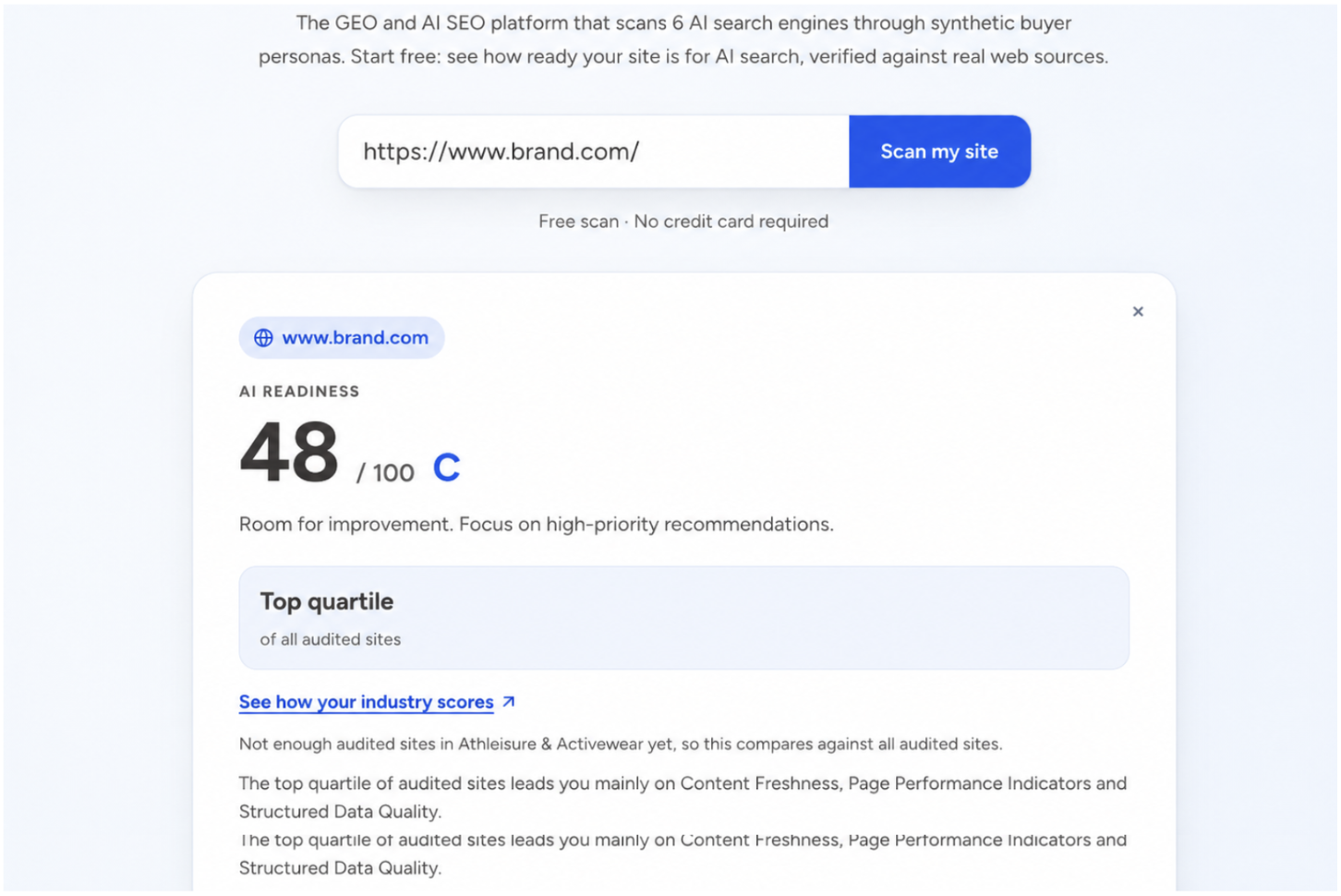
Developed by iKala, Kuroma evaluates websites, including content quality, technical accessibility, authority signals, and AI readability, helping businesses identify potential gaps and areas for improvement.
But optimizing your website is only one part of GEO. AI search doesn't rely on your website alone. It also draws information from third-party sources, including industry publications, customer reviews, and competitor websites. Even with a well-optimized website, your brand could still be missing from AI-generated answers while competitors get recommended instead.
That's why businesses need more than a website audit. Kuroma provides an end-to-end GEO solution, from monitoring brand mentions, citations, and competitor visibility to conducting detailed AI visibility scans and identifying opportunities for improvement. With actionable insights and optimization recommendations, businesses can understand not just where they're missing out, but also what to improve to strengthen their AI search presence.
Check your AI visibility with Kuroma →
▶ This article may not be reproduced, republished, publicly broadcast, or distributed without permission. Copyright and portrait rights for all images and materials referenced in this article remain with their respective rights holders.
Frequently Asked Questions (FAQ)
Why isn't my website appearing in AI search results?
Several factors may contribute, including crawler access restrictions, insufficiently relevant content, unclear information structure, or limited availability of credible information. However, AI-generated responses vary by platform and question, so even a well-optimized website is not guaranteed to appear in every answer.
Does good SEO automatically improve AI search visibility?
SEO provides an important foundation because accessible websites, relevant content, and clear information structures can benefit both traditional and AI-powered search. However, strong SEO rankings do not guarantee brand mentions or citations in AI-generated answers.
Do I need to create new content specifically for GEO?
Not necessarily. Businesses can often begin by improving existing content, addressing unanswered customer questions, updating outdated information, and making important details easier to understand. New content is most useful when it fills a genuine information gap.